
Why Customization Method Matters More for Sportswear Than Regular Apparel
Sublimation vs Screen Printing vs Embroidery in Which Customization Method Is Best for Sportswear? Sportswear customization has become a serious business decision, not just a design afterthought. Whether you’re outfitting a youth soccer league, branding a corporate wellness team, launching an athleisure clothing line, or decking out a college esports squad, the method you choose to put logos, numbers, names, and graphics onto fabric will shape everything from how the garment performs on the field to how much it costs per unit and how long it lasts in the wash.
Three techniques dominate the sportswear customization world: sublimation printing vs screen printing vs embroidery. Each has passionate advocates, each has real limitations, and none of them is universally “the best.” The right answer depends on your fabric, your budget, your order volume, your design complexity, and how the garment will actually be used.
This guide breaks down all three methods in detail — how they work, their strengths and weaknesses, their ideal use cases, their cost structures, and how they specifically perform on athletic and performance fabrics. If you’d rather skip ahead and talk through your specific project, you can always get a custom sportswear quote directly. Otherwise, by the end of this guide you’ll have a clear framework for deciding which method (or combination of methods) is right for your next custom sportswear project.
1. Why Customization Method Matters More for Sportswear Than Regular Apparel
A printed t-shirt that sits in a closet most of the week can tolerate a lot of imperfection. Sportswear can’t. Performance garments are subjected to intense, repeated stress that ordinary streetwear never sees:
- Sweat and moisture exposure on nearly every wear
- Constant stretching and flexing during athletic movement
- Frequent, sometimes daily, washing
- Friction from equipment, other players, turf, or gym equipment
- UV exposure for outdoor sports
- Tight, performance-knit fabrics (polyester, spandex blends, moisture-wicking synthetics) that behave very differently from cotton
Because of this, a decoration method that looks great on a cotton hoodie can crack, peel, fade, or feel unbearably stiff on a compression shirt or a moisture-wicking jersey. Understanding how each method interacts with movement, moisture, and synthetic fibers — something we cover in more depth in our technical fabric guide — is the difference between a jersey that looks sharp after fifty washes and one that looks embarrassing after five games.
This is also a category where the “customer” experience is unusually demanding. Athletes notice a scratchy collar tag or a stiff patch of screen print in a way that a casual t-shirt wearer might not, because they’re moving hard and sweating in the garment for extended periods. A poor decoration choice doesn’t just look bad — it can genuinely hinder performance and comfort.
2. What Is Sublimation Printing?
How It Works
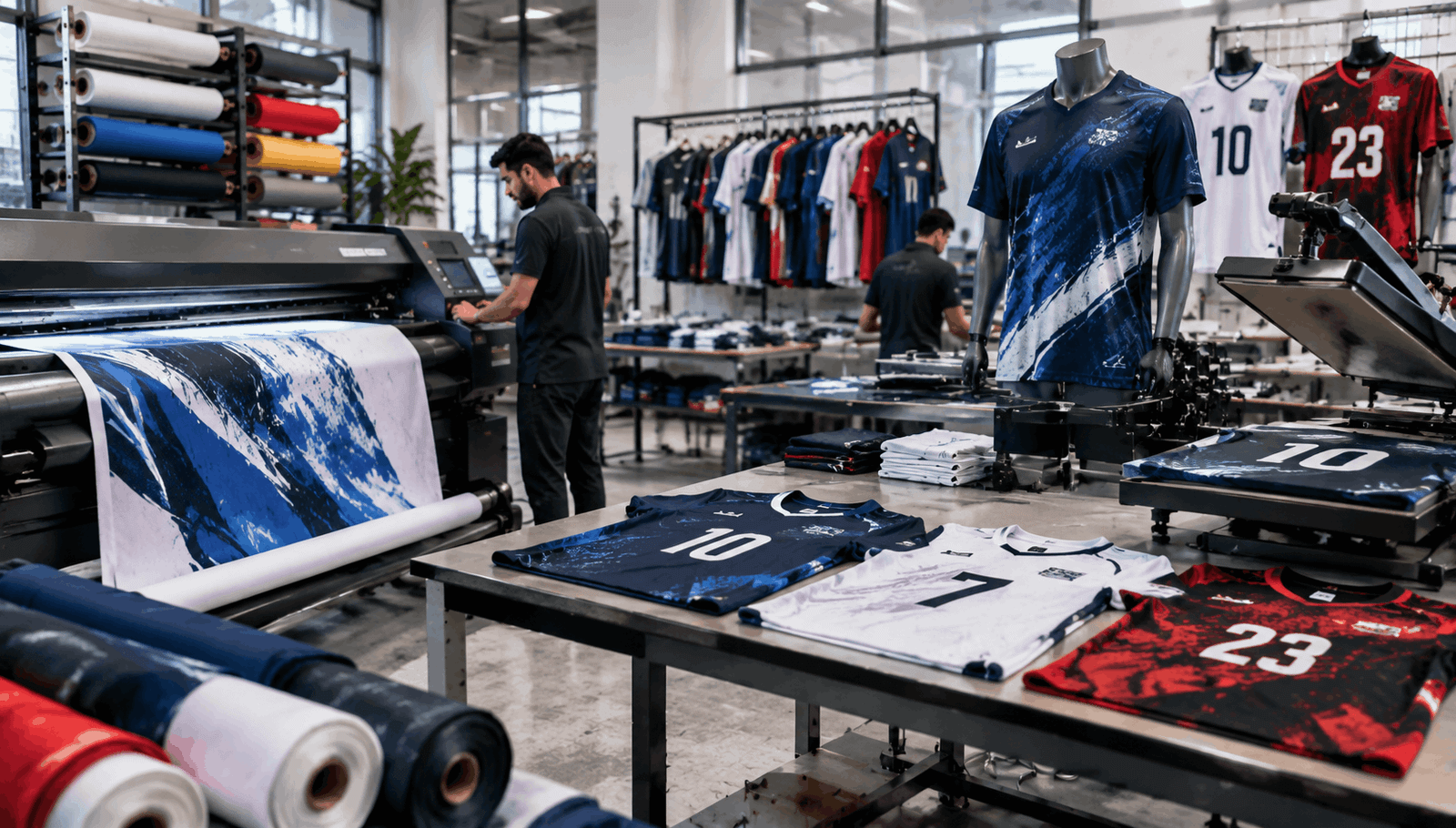
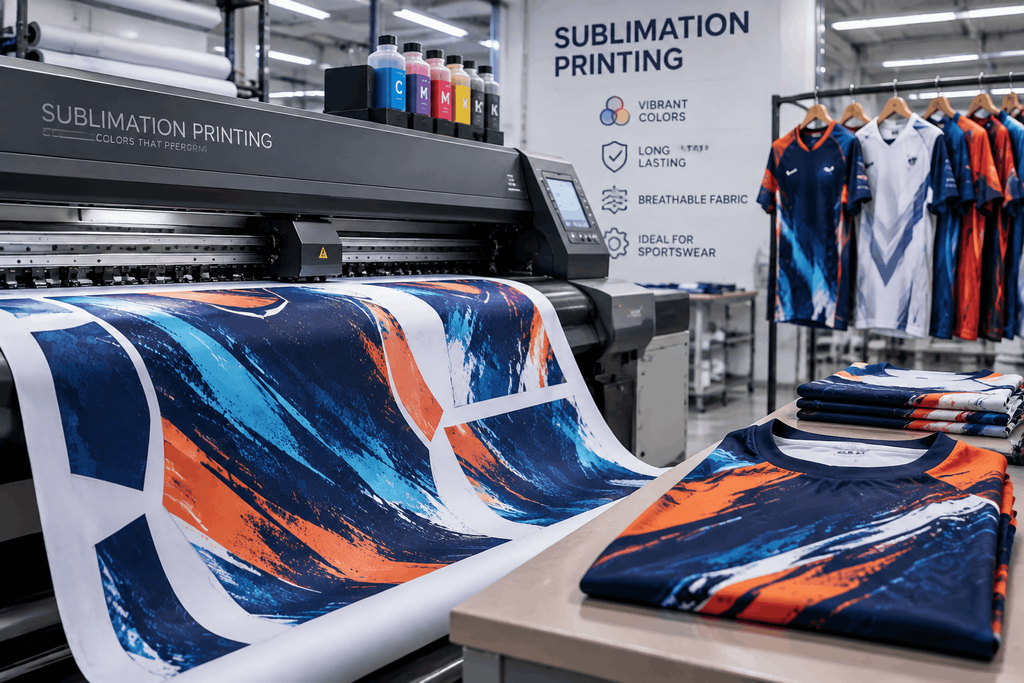
Sublimation is a heat-based, dye-transfer process. A design is printed in reverse using special sublimation ink onto a transfer paper. That paper is then placed against a synthetic fabric (almost always polyester or a poly-blend with a high polyester content) and pressed under high heat and pressure. The heat causes the solid sublimation ink to turn directly into a gas — skipping the liquid phase entirely, which is the literal chemical definition of sublimation — and that gas permanently bonds with the polyester fibers at a molecular level.
This is fundamentally different from printing “on top of” a garment. The ink doesn’t sit as a layer on the fabric surface; it becomes part of the fiber itself.
Key Characteristics
- Full-color, all-over printing: Sublimation can reproduce photographic-quality images, gradients, and unlimited colors in a single pass, with no added cost per color.
- Zero hand-feel: Because the ink becomes part of the fiber rather than sitting on top, sublimated garments feel exactly like the base fabric — there’s no texture, no stiffness, no cracking.
- Fabric restriction: Sublimation only works on polyester or high-polyester blends (ideally 100% polyester, though blends of 65%+ polyester can take a lighter, slightly muted version of the design). It does not work on cotton, and it does not work well on dark-colored garments, since the process can only add color, not remove or cover existing color — meaning a navy shirt will still show through white or light design elements.
- Cut-and-sew or all-over printing: In its most advanced form, sublimation is done on flat fabric panels before the garment is cut and sewn together, which is how brands achieve seamless, edge-to-edge, wraparound designs (think of custom cycling jerseys with graphics running across every seam).
Where You See It
Sublimation dominates in:
- Custom team uniforms for basketball, volleyball, esports jerseys, and cycling
- Running apparel and marathon bibs
- Swimwear
- All-over print performance shirts
- Custom dye-sublimated compression gear
3. What Is Screen Printing?
How It Works
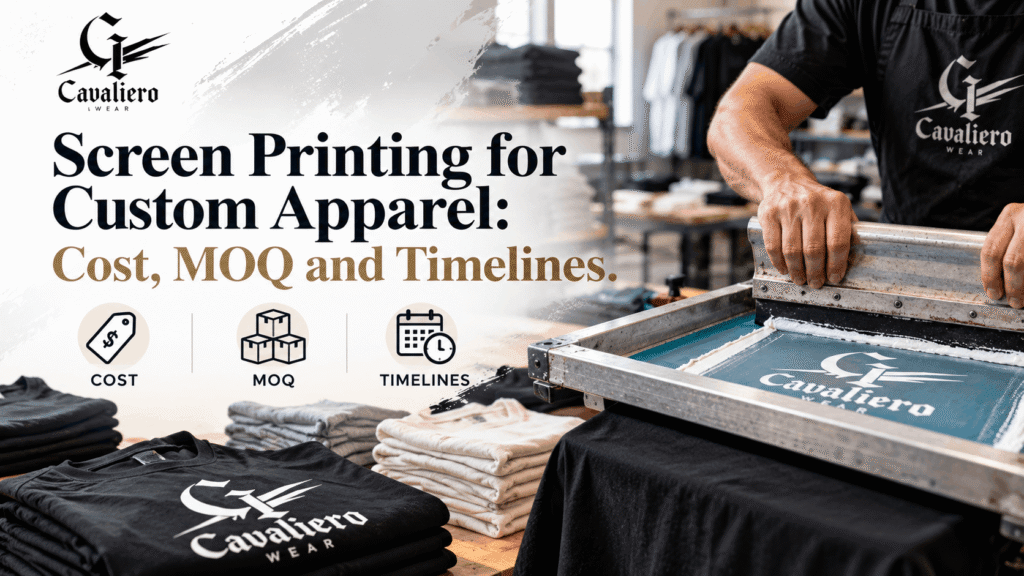
Screen printing is a stencil-based method. For each color in a design, a fine mesh screen is coated with a light-sensitive emulsion and exposed to create a stencil — areas that should print ink are left open, areas that shouldn’t are blocked. Ink is then pushed through the screen with a squeegee directly onto the garment. Multi-color designs require a separate screen (and a separate pass) for each color, all carefully aligned (“registered”) so the layers stack correctly.
After printing, the garment passes through a heat tunnel or dryer to cure the ink, which is what makes it durable and wash-resistant.
Key Characteristics
- Vibrant, opaque color, even on dark fabric: Because screen printing deposits a physical layer of ink, it can print bright white or light colors on black or navy garments without the base color showing through — something sublimation cannot do.
- Cost-efficient at scale: Once screens are made, printing additional units is extremely fast and inexpensive, which is why screen printing is the go-to method for large team orders, tournament giveaways, and event merchandise.
- Hand-feel varies by ink type: Traditional plastisol ink sits on top of the fabric and can feel slightly heavier or stiffer, especially with large print areas or multiple layers. Water-based and discharge inks soak into the fabric and feel much softer, closer to a “no-feel” print, but they perform best on natural fibers like cotton rather than 100% polyester athletic fabric.
- Setup cost per design: Each color requires its own screen, so highly detailed, multi-color, or photographic designs become expensive and impractical — screen printing shines with simpler graphics (logos, numbers, single or few-color designs).
- Works across more fabric types: Unlike sublimation, screen printing can be applied to cotton, cotton-poly blends, and some technical fabrics, making it more universally applicable across a full product line.
Where You See It
Screen printing dominates in:
- Team practice shirts and cotton-blend fan gear
- Tournament and event t-shirts
- Basic logo application on hoodies, sweatshirts, and warm-ups
- Bulk giveaway apparel
- Dark-colored jerseys needing bold, simple graphics
4. What Is Embroidery?
How It Works
Embroidery uses a computerized machine to stitch a design directly into the fabric using colored thread. A digital file (a “digitized” design, essentially a stitch-by-stitch instruction file) tells the machine exactly where to place each stitch, in what direction, and with which thread color. A backing stabilizer is typically hooped along with the garment to keep the fabric taut and prevent puckering during stitching.
Key Characteristics
- Textured, three-dimensional, premium look: Embroidery has a raised, tactile quality that reads as more upscale and “official” than any printed method — think of the polo logo on a golf shirt or the crest on a soccer jersey.
- Extremely durable: Thread is far more resistant to abrasion, washing, and general wear than any ink. Embroidered logos routinely outlast the garment itself.
- Not ideal for large or highly detailed designs: Because it’s built from discrete stitches, embroidery struggles with fine gradients, photographic detail, or very large fill areas — it can look bulky, take a long time to stitch, and use excessive thread. It’s best suited to logos, text, numbers, and simpler graphic marks, typically under about 4-5 inches for placements like a chest logo.
- Adds weight and stiffness to the immediate area: The stitching, combined with the backing material, makes the embroidered patch stiffer and heavier than the surrounding fabric. On thin, stretchy performance fabric, this can be noticeable against the skin, particularly in high-friction spots like under the arm or across the chest during a full sprint.
- Higher cost per unit at low volume, but increasingly cost-competitive with modern machines: Digitizing a design is a one-time setup cost, and then per-unit costs are driven mainly by stitch count.
Where You See It
Embroidery dominates in:
- Polo shirts and collared performance wear
- Team jackets, hats, and outerwear
- Golf apparel
- Corporate athletic wear logos on quarter-zips and fleece
- Premium team merchandise where longevity and a polished look matter more than large graphic areas
5. Head-to-Head: Durability
Durability is one of the most important factors for sportswear because these garments are used hard and washed often.
Embroidery wins on raw longevity. Because thread is woven into the fabric structure itself rather than sitting as a surface coating, embroidered designs resist cracking, peeling, and fading far better than any printed method. It’s genuinely common for an embroidered logo to outlive the garment it’s stitched onto.
Sublimation is close behind for anything on the right fabric. Because the sublimated dye becomes part of the polyester fiber, there’s nothing to crack or peel — there’s no separate layer at all. A properly sublimated jersey can be washed hundreds of times with virtually no visible degradation, assuming it’s on 100% polyester. This is why sublimation is the standard for professional and competitive team uniforms that need to survive an entire season of practices, games, and washes.
Screen printing is the most variable of the three. A high-quality screen print, properly cured, on the correct ink-to-fabric combination, can last for years. But screen printing is also the method most vulnerable to poor execution: under-cured ink cracks and flakes quickly, cheap plastisol on high-stretch synthetic fabric can crack at the first hard flex, and low-quality inks fade noticeably faster than sublimation or embroidery. The quality ceiling is high, but so is the risk of a bad result if the printer cuts corners — which is why our own quality control process tests every batch before it ships.
Durability ranking for typical sportswear conditions:
- Embroidery (best for logos/text, doesn’t apply well to large graphics)
- Sublimation (best for full designs, only works on poly-based fabric)
- Screen printing (good to excellent when done correctly, most variable)
6. Head-to-Head: Comfort and Breathability
This is where the decoration method can directly affect athletic performance, not just aesthetics.
Sublimation is the clear winner for comfort. Since there is zero added layer, zero texture, and zero change to the fabric’s breathability, a sublimated jersey performs exactly like an undecorated one. Moisture-wicking properties, stretch, and airflow are completely unaffected. This is a major reason competitive teams in sports with intense cardio demands — basketball, soccer, cycling, running — lean so heavily on sublimation.
Screen printing sits in the middle, and the comfort impact depends heavily on ink type and print size. A small, thin, water-based print has minimal impact. A large plastisol print covering a big portion of the chest and back can noticeably reduce breathability in that area and may feel stiff against sweaty skin, especially in humid conditions. Modern athletic screen printers increasingly use specialty low-bulk inks or hybrid inks designed for performance fabric specifically to combat this, but it’s a real design constraint to consider.
Embroidery is the most restrictive for comfort, ironically because of its biggest strength (durability/texture). The stitched, raised area combined with backing material is stiffer and can chafe in high-motion, high-sweat zones. This is exactly why you rarely see large embroidered graphics on the front or back of a running jersey, but you frequently see a small embroidered logo on the chest of a polo — small, low-motion placement areas minimize the downside.
Comfort ranking:
- Sublimation (no added layer at all)
- Screen printing (depends on ink type and print size)
- Embroidery (best kept small and placed away from high-friction zones)
7. Head-to-Head: Cost at Different Order Volumes
Cost structure is where these three methods diverge the most, and it’s often the deciding factor for teams and brands working within a budget.
Sublimation Cost Profile
Sublimation has relatively high setup costs (design work, especially for full custom cut-and-sew garments) but the marginal cost per additional unit stays fairly flat since there are no screens or color-based pricing — a five-color design costs the same to print as a one-color design. Because it’s most commonly paired with fully custom-cut garments (rather than decorating a blank), the base garment cost itself tends to be higher than a basic screen-printed tee. Sublimation makes the most economic sense when:
- You need full-color or photographic designs
- You want a fully custom, one-of-a-kind uniform look
- Order quantities are moderate (a team roster, a club, a league)
Screen Printing Cost Profile
Screen printing has the most favorable economics at high volume and the worst economics at low volume. Because each color requires a physical screen, a 1-piece order with a 4-color logo can be surprisingly expensive relative to the shirt itself (you’re essentially paying for screen setup that only gets used once). But once those screens exist, printing the 500th shirt costs barely more than the ink and press time. This is why screen printing is the standard choice for:
- Large tournament or league orders (100+ units)
- Fundraiser and giveaway apparel
- Simple 1-3 color logos or numbers
Embroidery Cost Profile
Embroidery cost is driven primarily by stitch count, not order volume in the same dramatic way screen printing is. A small, simple logo with a low stitch count is relatively affordable even at low volume, since there’s no per-color screen cost — just a one-time digitizing fee. However, larger or more detailed designs with high stitch counts take longer to run per unit, which keeps the marginal cost fairly steady rather than dropping sharply at volume the way screen printing does. Embroidery becomes cost-inefficient when:
- The design is large or highly detailed (long machine run time per piece)
- You need photographic or gradient-heavy designs (essentially not achievable well)
Rough Cost Comparison Table
| Order Size | Sublimation | Screen Printing | Embroidery |
|---|---|---|---|
| 1-10 units | Moderate-High (custom cut) | High (screen setup dominates cost) | Moderate (digitizing fee spread thin) |
| 50-100 units | Moderate | Low-Moderate | Moderate |
| 500+ units | Moderate (flat per-unit) | Very Low (screens fully amortized) | Moderate (stitch time doesn’t drop much) |
The takeaway: screen printing rewards scale dramatically; sublimation and embroidery costs are comparatively flat regardless of volume. For an exact breakdown on your own design and quantity, our team can put together a detailed cost estimate within a day.
8. Head-to-Head: Design Complexity and Color
If your design has photography, gradients, shading, or more than 4-5 colors, sublimation is really your only practical option among the three. It handles unlimited colors and full photographic detail with no cost penalty, because it’s essentially a digital print, not a build-up of physical layers or stitches.
Screen printing can technically reproduce complex designs using simulated process printing techniques, but this dramatically increases cost and screen count, and it still can’t match sublimation’s ability to do soft gradients and photographic realism cleanly. Screen printing is at its best and most cost-effective with clean, simple, 1-4 color designs — bold logos, team names, jersey numbers.
Embroidery is the most limited for complex designs. Fine detail, small text, and gradients simply don’t translate to stitches well. Digitizers have to simplify complex artwork significantly to make it embroider cleanly, and past a certain size and complexity, embroidery starts looking cluttered, bulky, or loses fidelity to the original design entirely. Embroidery earns its keep with clean logos, mascots, monograms, and text. If you’re not sure how your artwork will translate across methods, our custom design team can mock it up in all three before you commit.
Design complexity ranking (highest ceiling to lowest):
- Sublimation (unlimited colors, photographic detail, gradients)
- Screen printing (great for bold, simple, few-color graphics)
- Embroidery (best for simple, small logos and text)
9. Head-to-Head: Turnaround Time
Turnaround time can matter enormously for teams working against a season start date or a tournament deadline.
Screen printing is typically the fastest for large repeat orders once screens exist, since printing runs are quick. However, initial screen burning and design approval can add a few days upfront, especially for multi-color designs.
Embroidery turnaround depends heavily on stitch count and quantity — a simple, low-stitch-count logo on a modest order can be turned around quickly, but large or highly detailed designs, or big orders, take meaningfully longer because each piece runs through the machine individually and stitching physically takes time.
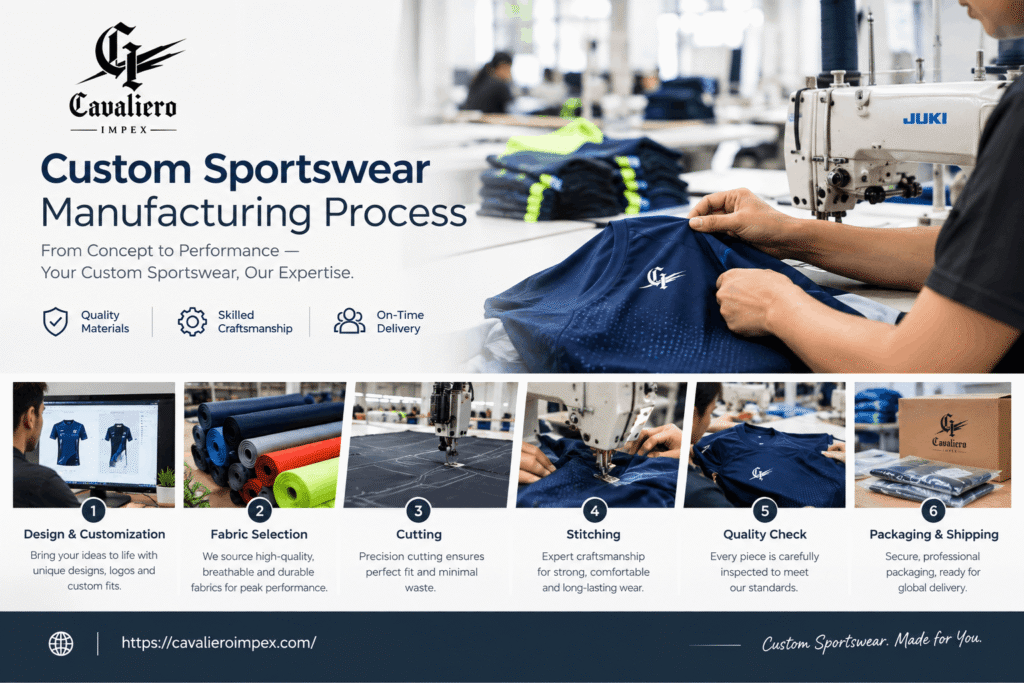
Sublimation, particularly full custom cut-and-sew sublimated uniforms, is often the slowest of the three, because it typically involves custom pattern design, printing on fabric rolls, cutting, and then full garment construction — essentially manufacturing a custom garment from scratch rather than decorating an existing blank. Simpler sublimated add-ons (like a sublimated name/number panel) can be much faster. If timing is tight, it’s worth flagging your deadline early in our production planning process so we can recommend the fastest realistic path.
General turnaround ranking for typical orders (fastest to slowest):
- Screen printing (for repeat/bulk runs)
- Embroidery (for simple designs)
- Sublimation (for full custom-cut uniforms — though simple sublimated elements can be fast)
10. Head-to-Head: Fabric Compatibility
This is a hard constraint, not just a preference, and it eliminates options quickly for certain fabrics.
- Sublimation: Requires polyester or high-polyester-content synthetic fabric (ideally 100%). Does not work on cotton at all, and performs poorly on dark-colored garments since it can’t add opaque light colors over a dark base.
- Screen printing: Works across cotton, poly-cotton blends, and technical polyester fabrics, though ink formulation should be matched to fabric type (a plastisol ink meant for cotton tees isn’t ideal for four-way stretch spandex, for example — specialty inks exist for stretch fabrics).
- Embroidery: Works across almost any fabric with enough structure to be hooped and stitched, though very thin, slippery, or highly stretchy technical fabrics require more skill (proper stabilizer/backing choice) to avoid puckering or distortion.
Fabric versatility ranking:
- Embroidery (works on the widest range of fabrics)
- Screen printing (works on most fabrics with the right ink)
- Sublimation (restricted to polyester/poly-blend, light colors only)
See our full fabric guide for a breakdown of which technical fabrics pair best with each decoration method.
11. Best Method by Sport and Use Case
Basketball
Sublimation dominates modern basketball uniforms because of bold, colorful, all-over graphic designs, breathability demands from constant sprinting, and the need for lightweight, non-restrictive fabric. Numbers and names are almost always sublimated directly into the fabric for a seamless look.
Soccer / Football
A mix is common: sublimated jerseys for the main kit (breathability and full-color crests/sponsor logos), with embroidered club crests on some premium soccer jerseys for a textured, prestige look, and screen-printed sponsor logos on lower-cost or training kits.
Running / Track and Field
Sublimation is standard for running singlets and race kits — lightweight, breathable, and capable of vibrant, motivating designs (plus bib numbers and sponsor logos in full color).
Baseball / Softball
Traditionally embroidery-heavy for caps and team logos on jerseys (that classic textured look), often combined with sublimated or screen-printed numbers on jerseys. Twill applique combined with embroidery is also extremely common for baseball specifically.
Golf
Embroidery is the category standard — golf polos, quarter-zips, and hats almost always feature embroidered club/brand logos because of the premium, polished aesthetic golf culture favors, and because designs are typically small, simple logos rather than large graphics.
Cycling
Nearly 100% sublimation. Cycling kits demand extreme breathability, tight compression fits where any added layer would be noticeable and uncomfortable, and highly detailed, colorful sponsor-heavy designs across the entire garment.
Gym / Fitness / CrossFit Apparel
A mix depending on the piece: screen printing for cotton-blend gym wear tees and hoodies, sublimation for compression gear and leggings, embroidery for small brand logos on structured pieces like joggers or jackets.
Team Fan Gear / Spirit Wear
Screen printing is the default for cost-effective, large-quantity fan gear — simple, bold designs printed cheaply at scale on cotton or cotton-blend tees and hoodies.
Corporate Athletic / Wellness Programs
Embroidery is often preferred for polos, quarter-zips, and outerwear in corporate wear programs (professional look, durability), with screen printing used for casual event t-shirts.
12. Can You Combine Methods?
Yes, and in practice, many of the best sportswear programs do exactly this rather than picking just one method for an entire team uniform program or product line.
Common combinations:
- Sublimated jersey body + embroidered crest: The main uniform uses full-color sublimation for breathability and vibrant team colors, while a small, prestige embroidered crest or captain’s mark is added at the chest for a premium touch.
- Screen-printed practice gear + sublimated game-day uniforms: Teams often use cheaper screen-printed cotton-blend shirts for daily practice (where cost and durability against wear-and-tear matters more than looking flashy) and reserve sublimated uniforms for actual competition.
- Embroidered team name on a screen-printed shirt: A screen-printed graphic covers most of the design, with a small embroidered logo added on the sleeve or chest for a mixed-texture, premium look at a lower cost than fully embroidering a large design.
- Sublimated body with embroidered numbers on collars/cuffs: Adds a tactile, distinctive detail without compromising the main garment’s breathability.
The general principle: use sublimation for the large, colorful, high-breathability areas, screen printing for bold simple graphics on budget-friendly cotton-blend pieces, and embroidery for small, durable, premium branding touches. Our custom design team can help map out exactly which method fits each part of your kit.
13. Environmental Considerations
Sustainability is an increasingly common question for teams and brands, and the three methods differ meaningfully here.
Screen printing historically has the largest environmental footprint among the three when using traditional plastisol inks (PVC-based) and involves water usage for screen reclaiming and cleaning. Water-based and discharge inks are considerably more eco-friendly alternatives, and many print shops have shifted toward them, though they aren’t always ideal for every fabric type.
Sublimation uses less water than traditional screen printing (no screen washing) and produces less ink waste since it’s a more precise, digital process, but it is entirely dependent on polyester, a petroleum-based synthetic fiber, and the heat-press process consumes energy.
Embroidery generally has a lower chemical footprint since it doesn’t involve inks or dyes at the decoration stage at all — it’s simply thread and fabric — though thread production (often polyester or rayon) and backing/stabilizer waste are factors worth considering.
If sustainability is a top priority, ask your supplier specifically about ink types (water-based vs. plastisol), thread and fabric sourcing (recycled polyester is increasingly available for both sublimation base fabric and embroidery thread), and their water reclamation practices for screen printing. You can read more about our own approach on our sustainability page.
14. Common Mistakes Teams and Brands Make
Choosing embroidery for a large, detailed graphic. This almost always results in a bulky, stiff patch that doesn’t age well and doesn’t do justice to the original design. If the design is large or detailed, it belongs in sublimation or screen printing territory, not embroidery.
Trying to sublimate onto cotton or dark fabric. Sublimation simply doesn’t work — or works very poorly — outside of polyester-based, light-colored fabric. This is a hard technical limitation, not a quality issue.
Ordering a small batch of a complex, multi-color design via screen printing. The screen setup cost dominates the price for small orders, making it one of the most expensive options per unit in this scenario, when sublimation might actually be cheaper and faster for a low-volume, colorful design.
Placing embroidery in high-friction, high-motion zones. A large embroidered logo across the chest of a running shirt will feel stiff and can chafe during long-duration cardio activity. Reserve embroidery for smaller placements or lower-motion areas of the garment.
Ignoring ink type on stretch fabric. Standard plastisol screen printing ink can crack on four-way stretch, high-spandex-content performance fabric. Specialty stretch-formulated inks exist specifically to prevent this — ask your supplier if they’re using them for athletic garments.
Assuming one method fits the entire team kit. As covered above, many successful team programs mix methods strategically rather than forcing every garment and every design element through a single decoration technique. Browsing a few more real-world examples on our blog can help you spot which combination fits your own program.
15. Decision Framework: Which Method Should You Choose?
Use this simplified framework to narrow down your choice:
Choose Sublimation if:
- Your garment is 100% polyester or a high-poly blend
- Your design has more than 4 colors, gradients, or photographic elements
- Breathability and zero added weight/texture matter (running, basketball, cycling)
- You want a fully custom, all-over graphic look
- Your order volume is moderate and doesn’t need the extreme cost efficiency of screen printing at massive scale
Choose Screen Printing if:
- You’re ordering in bulk (100+ units) with a repeatable design
- Your design is simple, bold, and uses 1-4 colors
- Your garment is cotton, cotton-blend, or you’re using stretch-appropriate specialty ink
- You need a print visible on a dark-colored garment
- Budget efficiency at scale is the top priority
Choose Embroidery if:
- Your design is a simple logo, text, or small graphic (under roughly 4-5 inches)
- Longevity and a premium, polished look matter most
- The placement is a low-motion, low-friction area (chest, sleeve, collar, hat)
- The garment is a polo, jacket, hat, or outerwear piece rather than a high-motion compression layer
- You’re fine with a higher relative per-unit cost in exchange for durability and appearance
Choose a Combination if:
- You’re outfitting a full team with different needs across garments (practice vs. game day)
- You want the breathability of sublimation with the prestige of an embroidered crest
- You’re managing a mixed budget across different pieces (premium jerseys + budget spirit wear)
Still not sure which fits your project? Reach out to our team with your fabric, design, and order size, and we’ll recommend the right method — or mix of methods — for you.
16. Frequently Asked Questions
Does sublimation fade over time?
Sublimated designs are extremely fade-resistant because the ink is embedded within the polyester fiber itself rather than sitting on top. With proper care (avoiding excessive heat drying and harsh bleach), sublimated designs typically outlast the useful life of the garment.
Can you screen print on polyester athletic fabric?
Yes, but it requires the right ink. Standard plastisol can sometimes bleed or discolor on 100% polyester (a phenomenon called dye migration, where the fabric’s own dye bleeds into the print) unless a low-bleed or specialty athletic ink formulation is used. Ask your printer specifically about dye-migration-resistant inks for polyester garments.
Is embroidery waterproof?
Thread itself doesn’t repel water, but embroidery holds up extremely well to repeated washing and moisture exposure over the life of the garment because there’s no ink layer to crack or peel — it’s simply woven fiber.
Which method is cheapest for a single custom jersey?
For a one-off, highly colorful, custom jersey, sublimation or a simple embroidered logo tends to be more cost-effective than screen printing, since screen printing’s cost structure is dominated by per-color screen setup, which doesn’t make sense for a quantity of one.
Can numbers and names be added to a sublimated jersey after it’s made?
Yes, though the cleanest, most integrated look comes from including names and numbers in the original sublimation print run. Adding them afterward typically means using heat-transfer vinyl (HTV) or twill applique, which are separate decoration methods with their own hand-feel and durability characteristics.
Does screen printing crack on stretchy fabric?
Standard plastisol ink can crack over time on very stretchy, spandex-heavy fabric if it’s not formulated for stretch, or if too thick a layer is applied. Specialty stretch inks are formulated to flex with the fabric and resist cracking, so it’s worth confirming with your printer that they’re using the correct ink for a high-stretch garment.
What is the most durable method overall?
Embroidery is generally considered the most physically durable decoration method because it’s built into the fabric’s fiber structure via thread rather than an applied surface coating, but it’s only practical for smaller, simpler designs — it doesn’t compete for large graphic areas.
Can you combine sublimation and embroidery on the same garment?
Yes, this is a common and popular approach — a fully sublimated jersey body with a small embroidered team crest or captain’s patch adds a premium touch without compromising the garment’s overall breathability.
Is heat transfer vinyl (HTV) a fourth option I should consider?
HTV is indeed a separate, popular method, particularly for adding names and numbers to jerseys after the fact or for small-batch custom orders. It involves cutting a design out of colored vinyl and heat-pressing it onto the garment. It sits somewhere between screen printing and embroidery in terms of hand-feel and durability, and is worth researching separately if your project involves frequent, small, individualized customization (like personalized player names).
Which method works best for goalkeeper jerseys or padded gear?
Sublimation is generally preferred here too, since goalkeeper jerseys often have distinct, colorful designs and need to move with padding and extra layers without adding bulk from a printed or embroidered layer.
17. Final Verdict
There is no single “best” method among sublimation, screen printing, and embroidery — there’s only the best method for your specific garment, design, budget, and use case.
If you remember nothing else from this guide, remember this simplified rule of thumb:
- Sublimation = best for colorful, breathable, all-over designs on polyester performance fabric (basketball, running, cycling, swim).
- Screen printing = best for simple, bold designs at high volume and lower cost, especially on cotton and cotton-blend fabric (fan gear, practice shirts, tournament tees).
- Embroidery = best for small, durable, premium-looking logos and text on lower-motion garment areas (polos, hats, jackets, golf apparel).
Many of the most polished sportswear programs don’t pick just one — they strategically combine sublimation, screen printing, and embroidery across different pieces of a team’s kit to get the breathability, cost-efficiency, and premium branding that each method does best. Before locking in a decorator or method, be specific with your supplier about your fabric composition, your design’s color complexity, your order volume, and how the garment will actually be worn and washed. Those four details alone will point you toward the right method almost every time.
Ready to get started? Visit Cavaliero Impex to explore our full range of custom sportswear manufacturing services, or request a quote for your next project.