
A Complete Guide, to Evaluating Quality, Pricing and Reliability Before You Place Your Order
Introduction
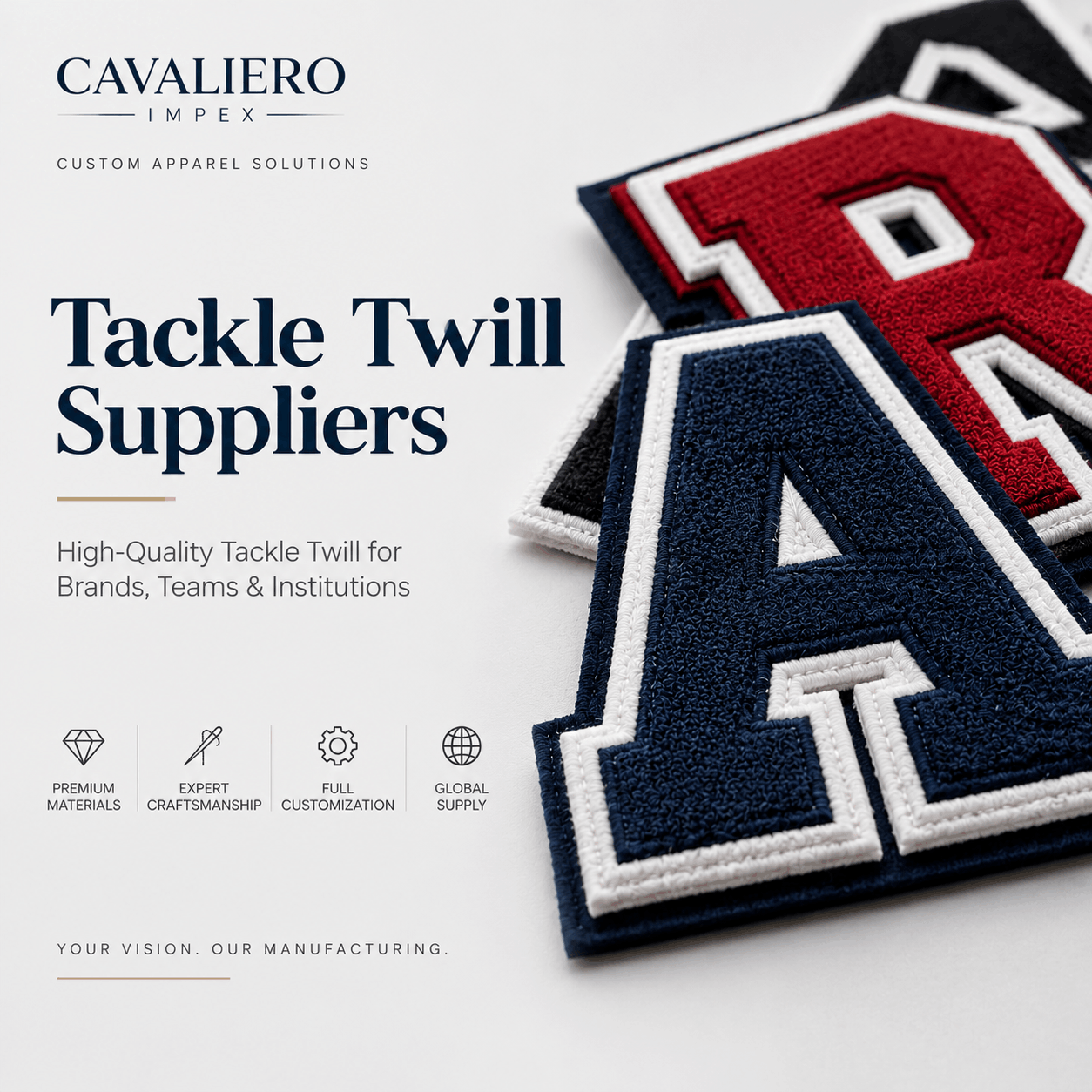
If you’ve ever admired the raised, dimensional lettering and numbers on a football jersey, a baseball uniform, or a varsity letterman jacket, you’ve seen tackle twill suppliers in action. This decorative appliqué technique has been a staple of athletic and custom apparel manufacturing for decades, prized for its durability, bold visual impact, and ability to withstand the rigors of repeated washing, stretching, and heavy use on the field or court.
Long before heat-transfer vinyl and digital printing became mainstream, tackle twill was the gold standard for team identification. Even today—amid a marketplace flooded with cheaper decoration methods—it remains the preferred choice for anyone who wants their apparel to look and feel premium.
But behind every great tackle twill design is an equally great supplier. Whether you’re a startup apparel brand, an established sportswear manufacturer, a school athletics department, a promotional products company, or an entrepreneur launching a streetwear line with a retro varsity aesthetic, the supplier you choose for your tackle twill materials and services can make or break your final product.
A poor supplier relationship can lead to inconsistent color matching, fraying edges, delayed shipments, and unhappy customers. A great one can become a long-term partner that helps you scale production, reduce costs, and elevate your brand’s reputation for quality.
This guide will walk you through everything you need to know about selecting the right tackle twill supplier for your custom apparel production needs — from understanding what tackle twill actually is, to evaluating potential vendors, to building a lasting partnership that supports your business as it grows. We’ll also cover the history and mechanics of the process, break down cost structures in detail, explore common pitfalls, and answer some of the most frequently asked questions business owners have when they’re sourcing this kind of decoration for the first time.
A Brief History and Overview of Tackle Twill
To appreciate why supplier selection matters so much, it helps to understand where tackle twill came from and why it became the industry standard for athletic identification. Tackle twill traces its roots back to mid-20th-century American sports culture, when teams needed a way to display names, numbers, and logos on uniforms that could survive being tackled, slid across dirt, drenched in sweat, and washed dozens of times over a season.
Screen printing at the time was less durable and prone to cracking, while embroidery alone was time-consuming and expensive for large block letters and numbers. Tackle twill emerged as the practical middle ground: a durable woven fabric, cut into shapes, and secured to the garment with a combination of stitching and adhesive.
Over the decades, the technique evolved. Early tackle twill was almost exclusively a sew-down application using a simple straight or zigzag stitch. As adhesive technology improved, heat-seal backing became common, either on its own for lighter-duty applications or combined with stitching for maximum durability. Today, tackle twill remains a hybrid of old-world craftsmanship and modern manufacturing efficiency — a technique that, when done well, blends artistry with industrial precision.
Understanding this history is useful because it explains why not all “tackle twill” is created equal. Some suppliers use the term loosely to describe any appliqué lettering, regardless of the fabric or application method, while others adhere strictly to traditional standards using genuine twill fabric and time-tested stitching techniques. Knowing the difference — and asking suppliers to clarify exactly what they mean when they say “tackle twill” — is one of the first steps toward avoiding disappointment.
What Is Tackle Twill, and Why Does Supplier Choice Matter So Much?
Tackle twill is a decorative appliqué technique used to create letters, numbers, logos, and designs on apparel — most commonly athletic jerseys, uniforms, letterman jackets, and team merchandise. The technique involves cutting shapes out of a twill fabric (traditionally a durable, diagonally-woven textile) and then attaching them to a garment using a combination of adhesive backing, embroidery stitching (often a zigzag or satin stitch border), or heat-sealing methods.
Because tackle twill is meant to endure heavy physical activity, frequent laundering, and years of use, the quality of the materials and application process is critical. This is precisely why the supplier you choose matters so much. Unlike a simple screen print or basic embroidery job, tackle twill production requires:
- Precision fabric cutting to avoid frayed or jagged edges
- Consistent color matching across large production runs
- Proper adhesive or stitching application that won’t peel or lift after washing
- Durable base fabrics that resist fading, cracking, and wear
- Scalable production capacity for orders ranging from a handful of jerseys to thousands of units
- Skilled labor or well-calibrated automated cutting equipment capable of handling intricate letterforms and curves without distortion
A supplier who cuts corners in any of these areas can introduce defects that aren’t always visible at the point of sale but become obvious after a few wears and washes — peeling letters, fraying numbers, mismatched thread colors, or twill that simply doesn’t hold up. For businesses whose reputation depends on quality apparel, this is a risk not worth taking. A single bad batch of jerseys delivered to a youth sports league or a corporate client can damage a relationship that took years to build, and word travels fast in tight-knit sports and apparel communities.
It’s also worth noting that tackle twill sits at an interesting intersection of art and engineering. On one hand, it’s a visual medium — the letterforms, colors, and layering choices communicate team identity and brand personality. On the other hand, it’s a manufacturing process governed by tolerances, adhesive chemistry, thread tension, and fabric behavior under stress. The best suppliers understand both sides of this equation, and that dual expertise is often what separates a supplier who merely produces “good enough” work from one who consistently delivers excellence.
Understanding Your Own Production Needs First
Before you even begin evaluating suppliers, it’s essential to have a clear picture of your own production needs. Tackle twill suppliers vary widely in terms of specialization, minimum order quantities, turnaround times, and pricing structures, so knowing exactly what you need will help you narrow the field quickly and avoid wasting time on vendors who simply aren’t a match for your business model.
Consider the following questions:
What is your typical order volume? Are you producing small batches of custom jerseys for local teams, or do you need thousands of units for a national retail launch? Some suppliers specialize in low-minimum, quick-turnaround jobs, while others are built for high-volume bulk orders and may not be interested in — or efficient at — smaller orders. Mismatched volume expectations are one of the most common sources of friction between apparel brands and suppliers, so it pays to be upfront about this from the very first conversation.
What types of garments will you be applying tackle twill to? Jerseys, letterman jackets, caps, bags, and outerwear all have different fabric compositions and construction methods, which can affect how tackle twill is applied and how well it adheres over time. A supplier experienced in fleece and wool jacket applications might not have the same expertise in moisture-wicking athletic jerseys, where synthetic performance fabrics behave very differently under heat and adhesive.
Do you need full-service production, or just the twill components? Some businesses want a supplier who can handle everything — fabric sourcing, cutting, application, and even garment assembly. Others already have their blank garments and just need a supplier to provide cut letters and numbers, or to apply twill to garments they send in. Clarifying this upfront prevents confusion about scope, pricing, and shipping logistics.
What is your budget per unit? Tackle twill applications can range from a few dollars per piece for basic single-color lettering to significantly more for multi-color, multi-layer designs with intricate detail. Understanding your budget constraints upfront will help you avoid wasting time evaluating suppliers who are priced out of your range, or conversely, dismissing a supplier too quickly because their initial quote seems high without understanding what’s included.
What is your required turnaround time? Are you working against a hard deadline, like a season opener, a championship game, or a promotional event tied to a specific date? Some suppliers offer rush production for a premium, while others have longer standard lead times that may not fit urgent projects. Building in buffer time for revisions, proofing, and shipping delays is always wise, even when a supplier promises a fast turnaround.
Do you need design support? If you don’t already have finalized artwork, fonts, or color specifications, you may need a supplier who offers in-house design services to help you develop your tackle twill graphics from scratch. This is especially relevant for smaller organizations, like youth sports leagues or new apparel brands, that may not have access to a professional graphic designer.
How important is domestic versus overseas sourcing to your brand? Some brands market themselves on domestic-production claims, which may require sourcing from suppliers within a specific country regardless of cost differences. Others are entirely cost-driven and open to overseas manufacturing partnerships as long as quality standards are met.
Will your designs change frequently, or are they relatively fixed? A school that reorders the same uniform design every year has very different needs than a promotional products company that produces dozens of unique one-off designs for different clients each month.
Having clear answers to these questions will not only help you filter out suppliers who aren’t a good fit, but will also help you communicate your needs clearly during the vetting process — which in turn helps suppliers give you more accurate quotes and timelines.
Key Factors to Evaluate When Choosing a Tackle Twill Supplier
Once you have a solid understanding of your own needs, it’s time to start evaluating potential suppliers. Here are the most important factors to consider, in roughly the order most businesses find useful to investigate.
1. Material Quality
The foundation of any good tackle twill product is the quality of the twill fabric itself. Ask potential suppliers about the composition of their twill materials — is it a cotton-poly blend, a fully synthetic twill, or a specialty performance fabric? Higher-quality twill fabrics tend to hold their shape better, resist fraying, and maintain color vibrancy through repeated washes.
Request physical samples whenever possible. A photo or digital mockup can only tell you so much — you need to feel the fabric, examine the edges of cut letters, and see how the twill has been finished. Look closely at the borders of the lettering: are the edges clean and sealed, or do they look like they could fray with a single wash cycle? Run your fingers along the edge of a sample letter. A properly finished edge should feel smooth and secure, not rough or loose.
It’s also worth asking whether the supplier sources their twill fabric domestically or internationally, and whether they maintain consistent relationships with their fabric mills. Suppliers who frequently switch fabric sources to chase the lowest price can introduce subtle but noticeable inconsistencies in texture, weight, and color from one production run to the next.
2. Application Method and Durability
There are several methods used to apply tackle twill to garments, including:
- Sew-down application, where the twill piece is stitched directly onto the garment, often with a zigzag or satin stitch border for both function and aesthetics. This is generally considered the most durable method for high-wear athletic applications.
- Heat-seal application, which uses adhesive backing activated by heat press to bond the twill to the fabric. This method is faster and often more cost-effective, but may be less durable on garments subjected to heavy physical contact or frequent industrial laundering.
- Combination methods, which use both adhesive and stitching for maximum durability.
Ask your supplier which methods they use and why. Reputable suppliers should be able to explain the trade-offs of each method and recommend the best approach based on your specific garment type and use case.
It’s also worth asking about wash testing. Has the supplier tested their tackle twill application through multiple industrial wash cycles to simulate real-world use? Suppliers who can provide wash-test data or durability guarantees demonstrate a level of quality assurance that many competitors skip.
3. Color Matching and Consistency
One of the most common complaints in custom apparel production is color inconsistency — especially when working with team colors, brand colors, or Pantone-matched specifications. A professional tackle twill supplier should have a reliable system for color matching, ideally using the Pantone Matching System (PMS) or similar standardized color libraries.
Ask potential suppliers:
- How do you ensure color consistency across different production runs?
- Can you match specific Pantone colors, and if so, what is your typical color accuracy tolerance?
- Do you maintain fabric dye lot records to ensure future reorders match previous production runs?
- Do you provide physical color swatches or digital proofs before full production begins?
This last point about dye lot records is particularly important for ongoing partnerships. If you plan to reorder the same design in the future — for example, a school that orders new team uniforms every year, or a corporate client that reorders branded jackets for new hires — you want a supplier who can replicate the exact same colors, not just something “close enough.”
4. Production Capacity and Scalability
Whether you’re placing a one-time order or planning for consistent, recurring production, it’s important to understand a supplier’s capacity limits. Ask about their maximum monthly or weekly production volume, and whether they have the equipment and staffing to scale up if your business grows.
This is also a good time to ask about minimum order quantities (MOQs). Some suppliers require large minimums that may not be practical for smaller businesses or test runs, while others are flexible enough to accommodate smaller custom orders.
5. Turnaround Time and Reliability
In the apparel industry, timing is everything — especially for seasonal sports uniforms, event merchandise, or time-sensitive promotional campaigns. Ask potential suppliers about their standard production lead times, and whether they offer rush or expedited options for an additional fee.
Beyond just asking about turnaround times, it’s worth digging into a supplier’s track record for reliability. Do they have a history of hitting deadlines, or are delays a common issue? This is a good area to investigate through customer reviews and testimonials.
6. Design and Digitizing Support
If you don’t already have print-ready or embroidery-ready artwork, look for a supplier who offers in-house design and digitizing services. This can include:
- Converting logos or artwork into cut-ready vector files
- Font matching and custom lettering design
- Creating mockups or proofs before production begins
- Digitizing complex multi-layer designs for accurate cutting and application
- Advising on which fonts or design elements translate well to twill versus which ones may lose detail when cut from fabric
Suppliers who offer these services can save you significant time and reduce the risk of miscommunication, since they’re able to translate your vision directly into production-ready files rather than relying on you to provide perfectly formatted artwork.
7. Customization Options
Not all tackle twill is created equal — some suppliers offer a wide range of customization options, including:
- Multiple twill colors and finishes (matte, glossy, metallic, tackle twill with a contrasting overlay, chenille patch combinations, etc.)
- Various border stitch styles (straight stitch, zigzag, satin stitch, merrow border)
- Layered or 3D twill designs for added visual depth
- Combination with other decoration methods like embroidery, screen printing, sublimation printing, or heat transfer printing for hybrid designs
If your brand has specific aesthetic requirements or you want to differentiate your products from competitors, working with a supplier who offers a broader range of customization options can give you more creative flexibility.
8. Pricing Structure and Transparency
Pricing for tackle twill services can vary significantly based on factors like design complexity, number of colors, garment type, and order volume. Look for suppliers who provide clear, itemized quotes that break down costs by component — material costs, labor, setup fees, rush fees, and shipping — rather than vague lump-sum pricing.
Be wary of suppliers whose pricing seems dramatically lower than industry averages — this can sometimes be a red flag for lower-quality materials, rushed production processes, or hidden fees that appear later in the process. That said, the most expensive supplier isn’t necessarily the best either.
Also, ask about setup fees, digitizing fees, and any minimum order surcharges upfront so you can accurately calculate your total cost per unit and avoid surprises on your invoice.
9. Communication and Customer Service
The quality of a supplier’s communication can tell you a lot about what it will be like to work with them long-term. During your initial inquiries, pay attention to:
- How quickly do they respond to emails or calls?
- Are they clear and thorough in answering your questions?
- Do they proactively flag potential issues, like color limitations or fabric constraints, rather than waiting for problems to arise?
- Do they assign a dedicated account representative, or will you be dealing with a different person every time you reach out?
- Do they communicate proactively about production status, or do you have to chase them for updates?
Strong communication is especially important for complex or recurring orders, where misunderstandings about specifications can lead to costly production errors. Reach out through a dedicated contact page to see how quickly a supplier responds.
10. Certifications, Compliance, and Ethical Sourcing
Depending on your industry and target market, you may need your supplier to meet certain compliance standards, such as:
- Textile safety certifications, such as OEKO-TEX Standard 100, which verifies that textiles are free from harmful substances
- Compliance with labor and ethical sourcing standards, particularly important if you’re selling to socially conscious consumers
- Country-of-origin documentation, especially if you’re importing goods or need to comply with specific retail requirements
- Fire retardant or safety compliance for certain types of protective or athletic apparel
If these factors are relevant to your business, don’t hesitate to ask suppliers directly for documentation and certifications. Reputable suppliers should be transparent and willing to provide this information without hesitation.
Where to Find Potential Tackle Twill Suppliers
Now that you know what to look for, where do you actually find qualified tackle twill suppliers? Here are some of the most effective approaches.
Industry trade shows and associations. Trade shows focused on the apparel decoration and promotional products industry are excellent places to meet suppliers face-to-face, see physical samples, and ask detailed questions. Industry associations often maintain supplier directories as well, and membership in a recognized trade association can itself be a positive signal about a supplier’s professionalism.
Online B2B marketplaces. Platforms that connect apparel brands with manufacturers and suppliers can be a good starting point for identifying candidates, especially if you’re looking for suppliers with specific certifications or production capabilities. However, always vet these suppliers thoroughly rather than relying solely on online listings.
Referrals and industry networks. Reach out to other businesses in your industry — sports teams, uniform companies, promotional products distributors, school athletic directors — and ask who they use for tackle twill production. Word-of-mouth referrals often lead to more reliable partnerships.
Direct manufacturer outreach. If you already know of specific manufacturers with a strong reputation in athletic apparel or team uniforms, reach out to them directly. Many manufacturers who specialize in team sports apparel either have in-house tackle twill capabilities or can recommend trusted partners they work with regularly.
Local and regional sourcing. Depending on your priorities — such as faster turnaround times, easier communication, or supporting domestic manufacturing — you might prioritize suppliers located closer to your business or within your own country. For businesses that value being able to physically visit a production facility, inspect equipment, and meet the team in person, local sourcing can provide a level of confidence that’s harder to achieve with an overseas partner.
Questions to Ask During the Vetting Process
Once you’ve identified a shortlist of potential suppliers, it’s time to dig deeper with direct questions. Here’s a checklist of questions to guide your conversations:
- Can you provide physical samples of your tackle twill work, including close-up images or samples of edge finishing?
- What is your minimum order quantity, and does it vary by design complexity?
- What are your standard and rush turnaround times?
- How do you handle color matching, and can you match specific Pantone colors?
- What application methods do you use — sew-down, heat-seal, or combination — and why?
- Do you offer design and digitizing services, and is there an additional fee for this?
- Can you share references or case studies from clients in a similar industry to mine?
- What certifications or compliance standards do you meet?
- How do you handle quality control, and what happens if there’s a defect in my order?
- What is your pricing structure, and are there any additional fees I should be aware of?
- Do you offer reorders with consistent color and material matching?
- What is your policy on order changes, cancellations, or rush modifications?
- What happens if my order arrives damaged or doesn’t match the approved proof?
- Can you accommodate custom packaging or individual player name-and-number sets within a single team order?
- What payment terms do you offer, and is a deposit required before production begins?
Asking these questions upfront — and paying attention to how thoroughly and transparently a supplier answers them — will give you a strong sense of whether they’re a good fit for your business.
Requesting and Evaluating Samples
No matter how impressive a supplier’s website or portfolio looks, nothing replaces a physical sample in your hands. Most reputable suppliers will be willing to provide sample pieces, either for free or for a nominal fee, especially if you’re considering a substantial order.
When evaluating samples, pay close attention to:
- Edge quality: Are the edges of the letters or numbers clean and sealed, or do they show signs of fraying?
- Adhesion: Does the twill lay flat against the garment, or is there any bubbling, lifting, or looseness?
- Stitching consistency: If a stitched border is used, is the stitching even and consistent throughout, with no skipped stitches or loose threads?
- Color accuracy: Does the color match your specifications, and is it consistent across multiple sample pieces?
- Feel and flexibility: Does the twill feel stiff and uncomfortable, or does it move naturally with the garment?
- Overall craftsmanship: Do small details, like corners and curves in lettering, look crisp and intentional, or slightly rounded and imprecise?
If possible, wash the sample garment according to standard care instructions and inspect it again afterward. This simple test can reveal a lot about how the tackle twill will hold up over the lifetime of the product.
Red Flags to Watch Out For
As you evaluate suppliers, be alert to these warning signs that may indicate a problematic partnership ahead:
- Vague or evasive answers to specific questions about materials, processes, or pricing
- Unwillingness to provide samples or a portfolio of previous work
- No clear quality control process, or refusal to discuss what happens when defects occur
- Extremely long lead times with no explanation, which could indicate an overloaded or understaffed operation
- Pressure to commit quickly without giving you time to review samples or compare other suppliers
- Lack of references or reviews, especially for a supplier claiming significant industry experience
- Inconsistent communication, such as slow response times or contradictory information from different representatives
- Pricing that seems too good to be true, which often correlates with lower-quality materials or hidden fees later in the process
- No written contract or order confirmation, leaving specifications, pricing, and timelines open to dispute later
Trust your instincts here. If something feels off during the vetting process, it’s worth continuing your search rather than committing to a supplier who raises red flags.
Building a Long-Term Partnership
Choosing a tackle twill supplier isn’t just about finding the right fit for a single order — for most businesses, it’s about establishing a long-term partnership that can support consistent, high-quality production over time.
Start with a trial order. Before committing to a large-scale contract, consider placing a smaller trial order to evaluate the supplier’s actual performance — not just their promises. This allows you to assess quality, communication, and turnaround time with lower financial risk.
Establish clear specifications documentation. Once you’ve found a supplier you trust, work together to create detailed specification documents for your designs, including exact Pantone colors, fabric types, stitch styles, and sizing guidelines. Having this documentation on file ensures consistency across future orders, even if you’re working with different representatives at the supplier’s company over time.
Maintain open communication. Regularly check in with your supplier, especially around seasonal demand spikes or when introducing new designs. Proactive communication about upcoming order volumes or changes in specifications can help your supplier plan their production schedule.
Provide constructive feedback. If you notice quality issues or inconsistencies, address them directly and constructively with your supplier rather than simply moving on to a competitor. Many suppliers value the opportunity to correct issues and improve their process, especially for clients who represent significant or recurring business.
Negotiate volume discounts as you scale. As your order volume grows, don’t hesitate to revisit pricing conversations with your supplier. Many suppliers are willing to offer volume discounts or improved payment terms for clients who demonstrate consistent, growing business over time.
Diversify when necessary. While building a strong relationship with a primary supplier is valuable, it’s often wise to maintain a backup supplier relationship as well — particularly for businesses with tight deadlines or high-stakes orders. This protects your business from disruptions caused by unexpected supplier issues.
Common Mistakes to Avoid
Even experienced apparel businesses can fall into certain traps when selecting tackle twill suppliers. Here are some common mistakes to watch out for.
Choosing based on price alone. While cost is always a factor, prioritizing the cheapest option without considering quality, reliability, and service can lead to costly problems down the line — reprints, customer complaints, and damaged brand reputation often cost far more than the initial savings.
Failing to request samples before committing to a large order. Always test the waters with samples or a trial run before placing a bulk order, especially with a new supplier.
Not clarifying specifications in writing. Verbal agreements or informal email exchanges can lead to misunderstandings. Always document exact specifications — colors, materials, stitch types, sizing — in writing, ideally in a formal purchase order or contract.
Overlooking scalability. If you anticipate growth, choose a supplier who can grow with you rather than one who’s only equipped to handle your current, smaller order volume.
Ignoring turnaround time realities. Rushing into a partnership with a supplier who can’t realistically meet your deadlines sets you up for stress and potential business consequences.
Neglecting to build a relationship beyond transactions. Suppliers who feel like true partners — rather than just vendors — are more likely to go the extra mile when you need flexibility, rush orders, or problem resolution.
Underestimating the importance of a written contract. Even for smaller orders, a simple written agreement covering pricing, specifications, timelines, and quality expectations can prevent costly disputes and misunderstandings later.
Failing to plan for reorders. If there’s any chance you’ll need to reorder the same design in the future, discuss this possibility with your supplier upfront and confirm they’ll retain your specifications and color references for consistency.
A Quick Glossary of Tackle Twill Terminology
If you’re new to sourcing tackle twill, some of the industry terminology can feel unfamiliar. Here’s a brief glossary to help you navigate conversations with suppliers more confidently:
- Appliqué: A decorative technique where a piece of fabric is attached to a larger garment to create a design.
- Merrow border: A specific type of overlock stitch, often used as a decorative and protective border around the edges of appliqué letters.
- Die-cutting: A method of cutting fabric into precise shapes using a pre-made cutting die, often used for high-volume, repeat orders of the same letters or logo shapes.
- Digitizing: The process of converting artwork into a digital file format that embroidery or cutting machines can read and execute.
- Heat press: A machine that applies heat and pressure to bond adhesive-backed twill to a garment.
- Pantone Matching System (PMS): A standardized color reproduction system used across many industries, including textiles, to ensure consistent color matching.
- Satin stitch: A tightly spaced zigzag stitch often used to create a smooth, glossy border around appliqué designs.
- Twill weave: A type of textile weave characterized by diagonal parallel ribs, known for its durability and drape.
Frequently Asked Questions
Check out our full FAQ page for more detail on any of the below.
How much does tackle twill typically cost per garment?
Costs vary widely based on design complexity, number of colors, garment type, and order volume, but simple single-color lettering might range from a few dollars per piece for large orders, while complex multi-layer, multi-color designs can cost significantly more. Always request an itemized quote for your specific design and volume.
How long does a typical tackle twill order take to produce?
Standard turnaround times often range from one to several weeks depending on order size and complexity, with rush options available from many suppliers for an additional fee.
Can tackle twill be applied to any type of fabric?
Tackle twill can be applied to a wide range of fabrics, but application methods may need to be adjusted based on the base garment’s material.
Is tackle twill more durable than screen printing or heat transfer vinyl?
Generally, yes — tackle twill is prized for its durability precisely because it holds up well to repeated washing and heavy physical activity, often outlasting screen printing or vinyl in high-wear applications.
Do I need a minimum order quantity to work with a tackle twill supplier?
Many suppliers do have minimum order quantities, though these vary widely. Always confirm MOQs upfront with your chosen supplier.
Final Thoughts
Selecting the right tackle twill supplier is a decision that extends far beyond a single transaction — it’s an investment in the long-term quality, consistency, and reputation of your custom apparel business.
By thoroughly understanding your own production needs, carefully evaluating potential suppliers across the factors outlined in this guide, and taking the time to build genuine partnerships rather than one-off vendor relationships, you’ll position your business for sustained success in the competitive world of custom athletic and promotional apparel.
Take your time during the vetting process, don’t be afraid to ask tough questions, and always prioritize quality and reliability over the lowest possible price. Whether you’re outfitting a single youth league team, launching a corporate apparel program, or scaling a national streetwear brand, the principles in this guide remain the same. If you’d like to talk through your specific project, get in touch with our team — we’re happy to walk you through samples, pricing, and timelines.