
Your complete guide to the best GSM for hoodies: weights, fabrics, costs and quality checks
Introduction: The One Number That Decides How Your Hoodie Feels
If you are planning a custom hoodie line, the first question to answer is the best GSM for hoodies. GSM (grams per square meter) tells you how heavy the fabric is, and fabric weight decides almost everything customers notice Best GSM for Hoodies: warmth, drape, structure, softness, print quality and price.
Pick too light and your hoodie feels cheap and loses its shape after a few washes. Pick too heavy and it feels stiff, runs hot and costs more to make and ship. The right number depends on your customer, climate and brand position.
In this guide you will learn:
- What GSM means and how it converts to ounces (oz) used in the US
- The best GSM range for each type of hoodie
- How fleece, French terry and blends change the feel at the same weight
- Which GSM works best with screen printing, puff print, embroidery and DTF
- How to check that you are really getting the GSM you ordered
- Mistakes brands make and how to avoid them
Quick answer: for most custom hoodie brands, 300 to 400 GSM is the sweet spot. Use 250 to 300 GSM for lightweight or layering hoodies, 350 to 450 GSM for a premium, structured look, and 450 GSM and above only for ultra-heavyweight streetwear.
Key takeaways
- GSM measures fabric weight in grams per square meter; US buyers often use oz/yd² (multiply by 33.9 to get GSM)
- Most custom hoodie brands choose 300 to 400 GSM
- Brushed fleece feels warmer than French terry at the same GSM
- Heavier fabric holds embroidery, puff print and boxy fits better, but costs more to make and ship
- Yarn quality, knit structure and finishing matter as much as the GSM number
- Always approve a swatch or sample before bulk production
1. What Is GSM and Why Does It Matter?

GSM stands for grams per square meter. It is a measure of fabric density: how much a one-meter-by-one-meter piece of fabric weighs.
- Higher GSM means thicker, heavier, warmer, more structured fabric
- Lower GSM means thinner, lighter, more breathable fabric
- GSM does not measure quality by itself. A 400 GSM hoodie made from poor yarn can feel worse than a 320 GSM hoodie made from good combed cotton. But GSM is the best first filter when comparing suppliers.
To understand how fabric weight, fiber and construction work together, see our page on fabric sourcing and GSM customization.
GSM vs Ounces (oz/yd²)
US buyers often talk in ounces per square yard instead of GSM. Convert like this:
GSM = oz/yd² × 33.9
| Ounces (oz/yd²) | Approx. GSM |
|---|---|
| 7 oz | 237 |
| 8 oz | 271 |
| 9 oz | 305 |
| 10 oz | 339 |
| 11 oz | 373 |
| 12 oz | 407 |
| 13 oz | 441 |
| 14 oz | 475 |
| 16 oz | 542 |
When you request quotes, state your target in both GSM and oz so there is no confusion.
2. Best GSM for Hoodies: The Quick Guide
| Hoodie type | GSM range | Approx. oz | Feel and use |
|---|---|---|---|
| Lightweight | 200 to 280 | 6 to 8 oz | Spring, summer, layering, warm climates |
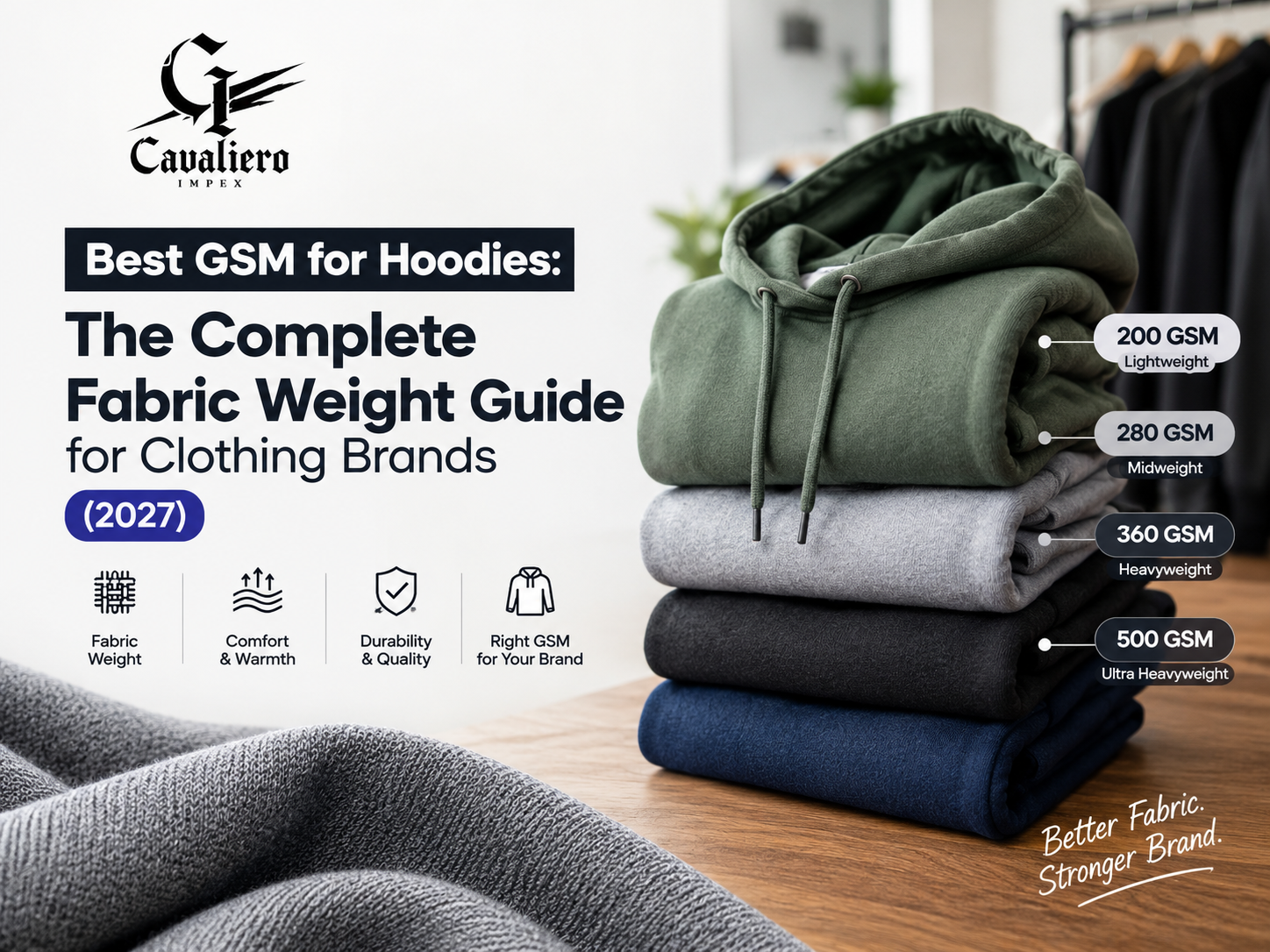
| Midweight | 280 to 350 | 8 to 10 oz | Year-round everyday hoodie |
| Heavyweight | 350 to 450 | 10 to 13 oz | Premium feel, structured fit, fall and winter |
| Ultra-heavyweight | 450 to 550 | 13 to 16 oz | Statement streetwear, boxy cuts, cold weather |
Our Simple Recommendation
| If your brand is… | Start with |
|---|---|
| A first collection with broad appeal | 300 to 350 GSM |
| Premium streetwear | 380 to 450 GSM |
| Warm-climate or layering focused | 240 to 300 GSM |
| Team, school or club merch | 280 to 350 GSM |
| Budget-friendly promotional hoodies | 250 to 300 GSM |
Why 300 to 400 GSM wins for most brands: it is heavy enough to feel substantial and hold a print or embroidery well, but not so heavy that it becomes stiff, hot or expensive to ship.
3. Hoodie Fabric Types: Why Construction Matters as Much as GSM

Two hoodies with the same GSM can feel completely different depending on how the fabric is made.
| Fabric | Inside surface | Feel | Best for |
|---|---|---|---|
| Brushed fleece | Soft, fluffy, brushed | Warm and cozy | Cold weather, classic hoodies |
| French terry | Small loops, not brushed | Lighter, breathable, smooth | Year-round, spring, layering |
| Loopback terry | Unbrushed loops | Structured, durable | Premium and vintage-style hoodies |
| Heavy fleece | Dense, brushed | Thick, warm | Winter and heavyweight styles |
Fiber Content Options
| Fiber blend | Pros | Cons |
|---|---|---|
| 100% cotton | Soft, breathable, takes garment dye well | More shrinkage and wrinkles |
| Cotton and polyester blend | Less shrinkage, durable, holds shape | Slightly less breathable |
| CVC (cotton-rich blends) | Soft with improved durability | Slightly less natural feel than pure cotton |
| Recycled blends | Sustainability story | Feel varies by supplier |
Rule of thumb: brushed fleece feels warmer than French terry at the same GSM. If you want a hoodie that works across seasons, choose French terry at 280 to 350 GSM. If you want maximum warmth, choose brushed fleece at 350 GSM and above.
4. GSM and Fit: How Weight Changes the Silhouette
Weight changes how a hoodie hangs on the body.
| Fit style | Best GSM | Why |
|---|---|---|
| Regular fit | 280 to 350 | Drapes naturally without feeling stiff |
| Relaxed fit | 300 to 380 | Holds shape with a softer fall |
| Boxy and oversized | 380 to 480 | Heavier fabric supports the square shape |
| Cropped | 300 to 400 | Needs enough weight to avoid collapsing |
| Zip-up hoodie | 300 to 400 | Needs stability along the zipper line |
The heavier the fabric, the more structure you get. That is why heavyweight, boxy hoodies look sharp: the fabric stands away from the body instead of clinging.
5. GSM and Decoration: Which Weight Works With Which Print?
The fabric you choose affects how your logo or artwork looks.
| Method | Best GSM | Notes |
|---|---|---|
| Screen printing | Any weight | Works on light to heavy; heavier fabric gives a solid base |
| Puff screen printing | 300 and above | A stable base helps the raised effect look clean |
| Embroidery | 280 and above | Heavier fabric holds dense stitching better and puckers less |
| DTF printing | Most weights | Flexible for multi-color artwork |
| DTG printing | Cotton-rich fabrics | Best on smooth cotton surfaces |
| Garment dye and wash finishes | Usually cotton-rich, midweight to heavyweight | Gives a soft, vintage look |
Note on sublimation: sublimation requires polyester fabric, so it is not suitable for typical cotton fleece hoodies. For polyester team or performance hoodies, see our sublimation printing page.
Print Tips by Weight
- Light hoodies (under 280 GSM): keep prints smaller and avoid very dense embroidery
- Midweight hoodies: most decoration methods work well
- Heavy hoodies: large chest or back prints sit nicely, and dense stitching looks premium
6. Cost, Shipping and Business Impact of GSM
Heavier fabric uses more material, so cost rises with weight. It also adds to shipping weight, which can affect freight and courier costs.
| Factor | Lighter hoodie | Heavier hoodie |
|---|---|---|
| Fabric cost | Lower | Higher |
| Shipping weight | Lower | Higher |
| Perceived value | Casual, budget | Premium |
| Return risk (feels thin) | Higher | Lower |
| Sewing and finishing | Easier | Needs stronger machines and care |
| Retail positioning | Everyday or promotional | Premium and streetwear |
Finding Your Balance
- Decide your retail price range first.
- Choose the GSM that supports the quality customers expect at that price.
- Check how the weight affects shipping to your market.
- Ask your manufacturer for a quote at two GSM options and compare.
7. Best GSM by Customer and Use Case
7.1 Streetwear and Fashion Brands
- Best GSM: 380 to 480
- Fabric: heavy brushed fleece or loopback terry
- Fit: boxy or oversized
- Finish: garment dye, acid wash or vintage wash
7.2 Sports Teams, Clubs and Schools
- Best GSM: 280 to 350
- Fabric: cotton and polyester blend for durability and easy care
- Decoration: screen printing, embroidery or tackle twill
7.3 Promotional and Corporate Merch
- Best GSM: 250 to 320
- Fabric: blend, easy to print and affordable
7.4 Warm Climates and Layering
- Best GSM: 220 to 300
- Fabric: French terry or lightweight fleece
7.5 Cold-Weather Hoodies
- Best GSM: 350 to 500
- Fabric: heavy brushed fleece
8. How to Check That You Are Getting the GSM You Ordered
A supplier can say 400 GSM on a quote. Here is how to verify it.
8.1 Verify With a Sample
- Ask for fabric swatches at your target GSM before bulk production.
- Request a finished sample and compare feel, drape and weight to your reference.
- Wash-test the sample for shrinkage and shape.
8.2 Test It Yourself (Simple GSM Check)
A GSM cutter takes a round sample of exactly 100 square centimeters. Weigh the cutout on a precise scale in grams and multiply by 100 to get GSM. If you do not have a cutter, many labs and local tailors can do this test cheaply.
8.3 Ask About Tolerance
Small variations in fabric weight are normal. Ask your manufacturer what tolerance they work to, and put your target GSM in writing in your tech pack.
8.4 Fabric Quality Checklist
- Stated GSM and fabric composition
- Pre-shrunk or washed fabric
- Even loop or brush surface with no thin patches
- Rib cuffs and hem that recover their shape
- Double-layer hood that lies flat
- Strong, even stitching at the pocket and hood
Learn how quality checks work in our manufacturing process and quality guarantee.
9. Eight Mistakes Brands Make When Choosing Hoodie GSM
| Mistake | Better approach |
|---|---|
| Choosing by GSM alone | Check fiber, yarn quality and construction too |
| Going too light to cut cost | Thin hoodies hurt reviews and returns |
| Going too heavy for all customers | Test your audience and climate first |
| Not stating oz and GSM together | Give both numbers to avoid confusion |
| Ignoring shrinkage | Choose pre-shrunk or washed fabric and wash-test |
| Skipping fabric swatches | Always approve a swatch or sample |
| Using the same GSM for every style | Match weight to fit and season |
| Forgetting shipping weight | Include freight in your cost model |
10. Putting It Together: Sample Specifications
Here are three example specs you can adapt in your tech pack.
| Spec | Everyday hoodie | Premium streetwear hoodie | Lightweight layering hoodie |
|---|---|---|---|
| GSM | 320 | 420 | 260 |
| Fabric | Brushed fleece | Heavy brushed fleece or loopback | French terry |
| Fiber | Cotton and polyester blend | Cotton-rich | Cotton or CVC |
| Fit | Regular | Boxy | Relaxed |
| Finish | Pre-shrunk | Garment dye or vintage wash | Enzyme wash |
| Decoration | Screen print or embroidery | Puff print, embroidery | Small embroidery or print |
These are starting points. Your final specification should be confirmed during sampling.
11. Hoodie GSM Chart by Season and Climate
A hoodie is usually a mid-layer or outer layer, so the right weight depends on where and when it will be worn. Use this chart as a starting point.
| Season or climate | Suggested GSM | Best fabric | Notes |
|---|---|---|---|
| Summer, hot and humid | 200 to 260 | Lightweight French terry | Breathable, good for evenings and air-conditioned spaces |
| Spring and early fall | 260 to 320 | French terry or light fleece | The most versatile weight range |
| Mild winter | 300 to 380 | Brushed fleece | Comfortable with a light jacket |
| Cold winter | 380 to 500 | Heavy brushed fleece | Warm enough as an outer layer |
| Year-round collections | 280 to 350 | French terry or mid fleece | Safest choice for broad customer bases |
How Layering Changes the Right Weight
- As a base layer under a jacket: choose 250 to 320 GSM so it does not bulk up
- As the main outer layer: choose 350 GSM and above
- Indoor and gym use: choose 240 to 320 GSM for breathability
- Fashion and streetwear styling: choose 380 GSM and above for structure, even if warmth is not the goal
If your customers live across several US climate zones, a 300 to 350 GSM hoodie is often the most flexible option. Offer a heavyweight style as a premium add-on rather than your only option.
12. Hoodie Quality Beyond GSM: Yarn, Knit and Finishing
Two hoodies at 350 GSM can feel very different. These factors explain why.
12.1 Yarn Type and Spinning
| Term | What it means | Effect on the hoodie |
|---|---|---|
| Carded cotton | Standard cotton yarn with shorter fibers included | More affordable, slightly rougher feel |
| Combed cotton | Short fibers removed before spinning | Smoother, stronger, softer feel |
| Ring-spun yarn | Yarn twisted and thinned in a more refined process | Softer, more durable fabric |
| Open-end yarn | Faster, lower-cost spinning method | Bulkier, less smooth feel |
| Yarn count | Thickness of the yarn | Finer yarns create smoother fabric at the same GSM |
12.2 Knit Structure
Most fleece hoodies use a three-layer knit structure: a face yarn on the outside, a binding yarn in the middle and a thicker yarn on the inside that is brushed to create softness. French terry uses loops on the inside instead of brushing. The way these layers are built affects warmth, weight, softness and how well the fabric holds its shape.
12.3 Finishing Processes
| Finish | Purpose |
|---|---|
| Brushing | Raises fibers inside for a soft, warm feel |
| Pre-shrinking or compacting | Reduces shrinkage after washing |
| Enzyme or bio-wash | Softens the surface and reduces loose fibers |
| Garment dye and vintage wash | Creates a soft, worn-in look |
| Anti-pilling treatment | Reduces surface fuzz balls over time |
To explore finish options, see our garment dye, acid wash and vintage wash page.
12.4 Same GSM, Different Result
| Hoodie A | Hoodie B |
|---|---|
| 350 GSM, carded open-end cotton, no pre-shrink | 350 GSM, combed ring-spun cotton, pre-shrunk |
| Feels rougher, may shrink more, pills sooner | Feels smoother, holds size better, lasts longer |
| Lower fabric cost | Higher fabric cost |
Lesson: when comparing quotes, ask for GSM, fiber, yarn type and finishing together. A cheaper quote at the same GSM often uses a lower-grade yarn.
13. Hoodie GSM for Men, Women, Kids and Unisex
| Customer | Suggested GSM | Notes |
|---|---|---|
| Men’s hoodies | 300 to 450 | Heavier weights are popular for boxy and streetwear fits |
| Women’s hoodies | 260 to 380 | Many styles use French terry or lighter fleece for drape; cropped styles still need enough weight to hold shape |
| Unisex hoodies | 300 to 400 | A balanced weight works across sizes |
| Kids’ hoodies | 220 to 320 | Lighter weights are more comfortable and easier for children to move in |
| Plus size ranges | 300 to 380 | Enough weight for structure without extra heat |
Children’s hoodies: if you plan to sell children’s hoodies in the United States, drawstring rules for hoods and necklines apply. Confirm current requirements with the US Consumer Product Safety Commission before finalizing your design.
Building a full range under your own label? Read about private label clothing manufacturing.
14. Hoodie vs Sweatshirt vs Zip-Up vs Crewneck: GSM Differences
| Style | Typical GSM | Notes |
|---|---|---|
| Pullover hoodie | 280 to 450 | The standard style, with kangaroo pocket and hood |
| Zip-up hoodie | 300 to 400 | Needs stability along the zipper for a clean line |
| Quarter-zip pullover | 280 to 350 | Often a lighter performance or casual style |
| Crewneck sweatshirt | 280 to 420 | Same fabrics as hoodies, without the hood |
| Cropped hoodie | 300 to 400 | Needs weight to avoid collapsing at the hem |
| Tracksuit hoodie | 260 to 340 | Lighter, often paired with matching trousers |
| Hooded jacket or varsity-style layer | 320 to 450 | Structured, sometimes with lining or contrast panels |
If you want a custom pattern, hood shape or panel layout, explore cut and sew customization.
15. Hoodie GSM Glossary: Key Terms Explained
| Term | Meaning |
|---|---|
| GSM | Grams per square meter, a measure of fabric weight |
| oz/yd² | Ounces per square yard, the US unit for fabric weight |
| Fleece | Fabric with a brushed, soft inner side |
| French terry | Knit fabric with loops on the inside |
| Loopback terry | Terry with unbrushed loops on the back, often used in premium hoodies |
| Brushed | Inner fibers raised to create softness |
| Combed cotton | Cotton with short fibers removed for a smoother yarn |
| Ring-spun | A spinning method that creates softer, stronger yarn |
| CVC | A cotton-rich blend with some polyester |
| TC | A polyester-rich blend with some cotton |
| Hand feel | How the fabric feels to the touch |
| Drape | How the fabric hangs on the body |
| Pilling | Small fuzz balls that form on fabric surface |
| Pre-shrunk | Fabric treated to reduce shrinkage after washing |
| Swatch | A small fabric sample for approval |
| Lab dip | A small dyed sample used to approve color |
| MOQ | Minimum order quantity |
| Tech pack | A document listing all production specifications |
How to Write GSM in a Tech Pack
Use clear wording so there is no confusion. For example:
Fabric: 100% cotton brushed fleece, combed ring-spun yarn, 350 GSM (approx. 10.3 oz/yd²), pre-shrunk, tolerance to be agreed.
16. Why Brands Work With Cavaliero Impex
Cavaliero Impex is a factory-direct custom apparel and sportswear manufacturer based in Sialkot, Pakistan, supporting fashion brands, private label companies, teams, retailers and wholesalers.
What brands can expect:
- Fabric sourcing and GSM customization matched to your product goals
- Cut and sew development with pattern making and grading, see cut and sew customization
- Printing and embroidery in one place
- Labels, tags and packaging with custom labels and tags and custom packaging
- Design review and pre-production checks before bulk manufacturing
- Design confidentiality for your artwork and specifications
- Worldwide shipping support
If you are building your own brand, read about private label clothing manufacturing. You can also learn about us.
17. Frequently Asked Questions (FAQs)
Q1. What is the best GSM for hoodies?
For most brands, 300 to 400 GSM is the best range. It feels substantial, holds prints and embroidery well and is not too stiff or hot.
Q2. Is 400 GSM too heavy for a hoodie?
Not necessarily. 400 GSM is a heavyweight hoodie that suits premium and streetwear brands, especially in cooler climates. It may feel warm for hot weather.
Q3. What is the best GSM for heavyweight hoodies?
Heavyweight hoodies usually range from 350 to 450 GSM. Ultra-heavyweight styles go from 450 to 550 GSM.
Q4. What GSM is best for streetwear hoodies?
Most streetwear brands choose 380 to 480 GSM with a boxy or oversized fit, often finished with garment dye or vintage wash.
Q5. What is the difference between French terry and fleece at the same GSM?
French terry has loops on the inside and feels lighter and more breathable. Brushed fleece has a fluffy inside and feels warmer. At the same GSM, fleece usually feels cozier.
Q6. How do I convert oz to GSM?
Multiply ounces per square yard by 33.9. For example, 12 oz is about 407 GSM.
Q7. Does higher GSM mean better quality?
Not always. GSM measures weight, not quality. Yarn quality, knit density, finishing and construction also matter.
Q8. Which GSM is best for embroidery on hoodies?
Midweight to heavyweight fabrics (around 280 GSM and above) hold dense stitching better and pucker less.
Q9. Can I request a specific GSM for my custom hoodies?
Yes. GSM customization is part of our fabric development services. Share your target GSM and fiber preference through our custom inquiry form.
Q10. What is the minimum order quantity for custom hoodies?
MOQ depends on fabric, design and decoration method. Use our custom inquiry form to select your estimated quantity. For more answers, visit our FAQs page.
Q11. How many GSM is a normal hoodie?
Most standard hoodies fall between 280 and 350 GSM. This is considered midweight and works across most seasons.
Q12. Is 350 GSM good for a hoodie?
Yes. 350 GSM is a popular choice for custom hoodies because it feels substantial, holds prints and embroidery well and works in many climates.
Q13. What GSM do boxy heavyweight hoodies use?
Boxy and oversized streetwear hoodies usually use 380 to 480 GSM so the fabric supports the square shape.
Q14. What is the difference between 280 GSM and 350 GSM hoodies?
A 280 GSM hoodie is lighter, softer in drape and better for mild weather. A 350 GSM hoodie is thicker, warmer and holds its structure better.
Q15. Does GSM affect shrinkage?
Not directly. Shrinkage depends mainly on fiber type, knit structure and whether the fabric is pre-shrunk. Always wash-test a sample.
Q16. Should kids’ hoodies be lighter?
Usually yes. Lighter fabric around 220 to 320 GSM is easier to wear and move in. For US sales, also check current drawstring safety rules for children’s hoodies.
Q17. Which hoodie fabric is better for printing?
Both fleece and French terry can be printed on the outer face. Heavier, stable fabrics give a more consistent base for puff print and embroidery.
Q18. How much does GSM affect hoodie price?
Heavier fabric uses more material, so fabric cost and shipping weight usually rise with GSM. Ask for quotes at two weights to compare.
Q19. What GSM is best for zip-up hoodies?
Zip-up hoodies usually work best at 300 to 400 GSM, which gives enough stability along the zipper.
Q20. How should I write the GSM in my tech pack?
Include fabric type, fiber, yarn if known, GSM and oz, finishing and tolerance, for example: 100% cotton brushed fleece, 350 GSM, pre-shrunk.
18. Ready to Choose the Right GSM for Your Hoodies?
The best GSM for hoodies depends on your customer, climate, fit and price point. Start at 300 to 400 GSM for a safe, premium-feeling result, and move lighter or heavier based on your brand. Always approve a swatch or sample before bulk production.
What to Send for an Accurate Quote
- Your design or reference hoodie
- Target GSM (and oz, if you use it) and fabric type
- Fiber preference (cotton, blend, CVC)
- Fit and size chart
- Decoration method and placement
- Label, tag and packaging needs
- Target quantity, delivery country and timeline
Start your hoodie project today:
Not sure which GSM suits your brand? Tell Cavaliero Impex about your customer and climate, and we will help you choose the right fabric weight.