
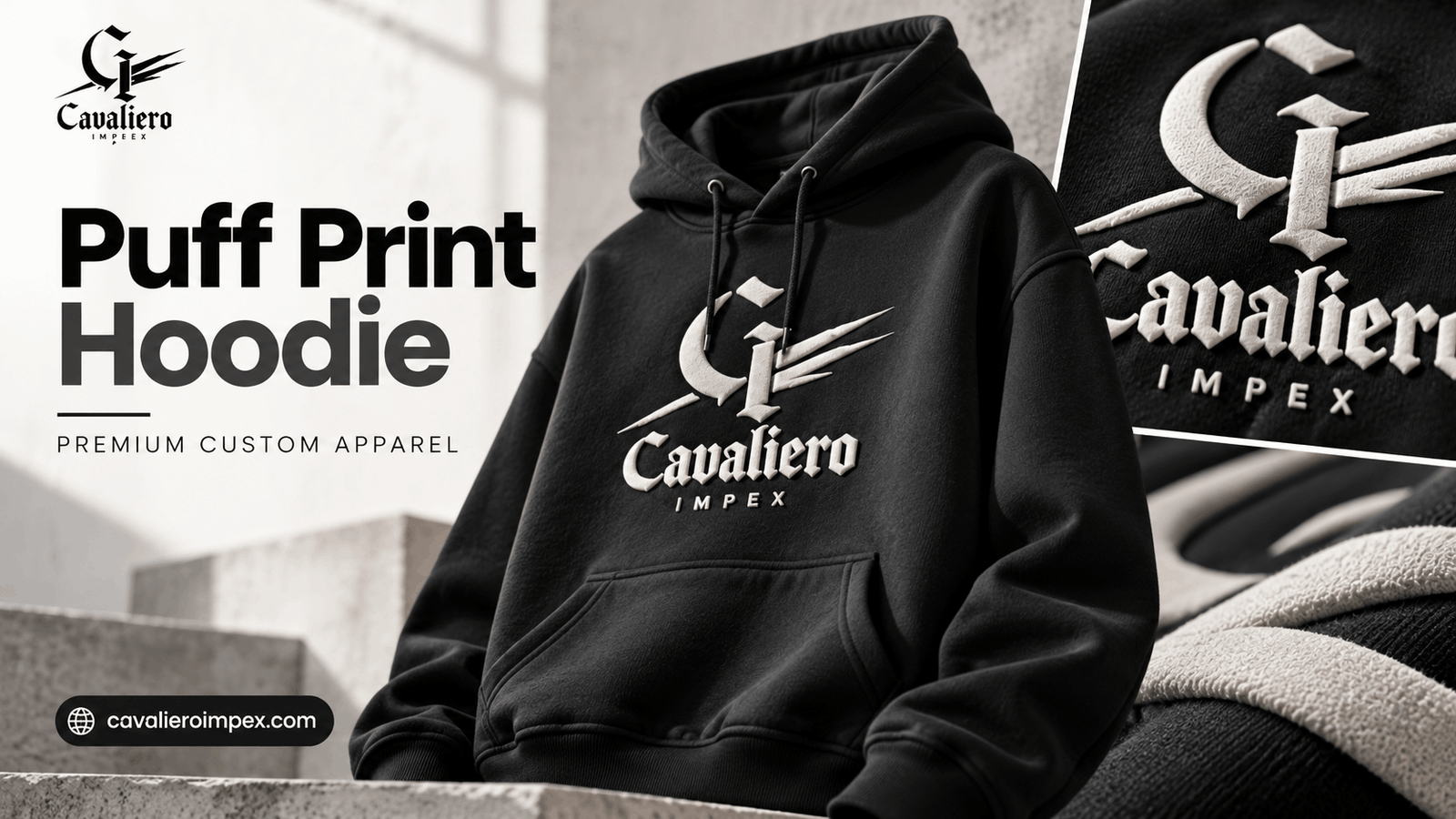
How to Design, Produce and Order a Puff Print Hoodie That Looks Premium and Lasts Wash After Wash
If you walk through any fashion district, university campus or sports club car park you will see a pattern: logos and lettering that appear to lift off the cloth. I have seen this pattern times. That raised soft‑to‑the‑touch, sculpted effect is puff printing and the garment that displays it best is the puff print hoodie. Once a niche detail on varsity jackets and skate tees in the 1980s and 1990s puff print has come back as one of the requested ways to decorate streetwear labels, school and club gear, corporate gifts and fashion start‑ups.
The reason is simple. A flat print is something you see. A puff print is something you see and feel. When a customer runs a thumb across a chest logo and feels the height the puff print hoodie feels more premium, more thoughtful and more memorable. In a market where hoodiesre everywhere that touch difference can decide if a design stands out on a rail or blends in.
This guide is written for brand owners, team managers, merchandise buyers and designers who want to understand the puff print hoodie from all angles. I will explain what puff printing is, the chemistry behind the raised effect how it compares with embroidery, screen printing and other methods, which hoodie fabrics and weights work best how to prepare artwork, what the production process looks like how quality is checked how to care for the puff print hoodie and what to look for in a manufacturing partner. If you are planning an order you can also see the custom apparel options at Cavaliero Impex as you read.
By the end you will know how to brief a manufacturer avoid the most common design and production mistakes and get a puff print hoodie that looks sharp on day one and still looks good after many washes.
What Is a Puff Print Hoodie?
A puff print hoodie is a sweatshirt decorated with a special ink that expands when heated creating a raised three‑dimensional design on the cloth. The effect is often called 3D print puff ink print, foam print or raised print but all of these names describe the core idea: the design physically rises above the puff print hoodie instead of lying flat inside the fibres.
The decoration is usually applied by screen printing. A foaming additive is mixed into a water‑based or plastisol‑style ink. The mixture is printed through a mesh screen onto the puff print hoodie. The garment is then passed through a heat source such as a conveyor dryer or heat press. As the ink warms microscopic gas‑filled capsules inside it expand. The printed area swells into a soft cushioned shape. Once cooled the raised form is permanent.
Typical areas for puff print on a hoodie include:
- Left chest or centre chest logos on the puff print hoodie
- back graphics and brand names on the puff print hoodie
- Sleeve text and arm hits on the puff print hoodie
- Hood or pocket lettering on the puff print hoodie
- Full‑front typography and slogans on the puff print hoodie
- Number sets for team and club hoodies on the puff print hoodie
Because a hoodie offers a large smooth heavyweight canvas it is one of the best garments for puff print. The thick fleece or French terry gives the raised ink a base and the generous panels allow bold shapes that take full advantage of the puff print effect.
The Science Behind the Puff: How 3D Puff Ink Actually Works
Understanding the chemistry helps you make design and ordering decisions because almost every rule of puff print comes back to how the ink expands.
The expanding additive
Puff ink contains a blowing agent, tiny microspheres or a chemical foaming component. When the print reaches a temperature the blowing agent releases gas or the microspheres soften and balloon outward. The surrounding ink film stretches around the expansion. Then sets as it cools locking the raised shape into place. If you want to read more about the plastisol inks often used as a base, in textile decoration the overview of plastisol is a starting point.
Timing
Every puff formulation has an expansion window. Little heat and puff ink stays flat and tacky. Much heat and puff bubbles collapse, crack or burn leaving a rough uneven surface. Experienced printers test each puff ink on the fabric being used because a thick fleece hoodie conducts and holds heat differently from a thin cotton tee. This is why puff printing is considered a technique rather than a simple add‑on.
Ink film thickness
The height of the puff depends largely on how much puff ink’s deposited. Thicker deposits, achieved with a mesh or a thicker stencil emulsion expand more. Finer mesh produces a subtler lift and holds finer detail. Balancing height against sharpness is one of the design decisions in a puff print hoodie.
Why puff does not behave like ink
Standard screen printing ink sits at roughly the same thickness before and after curing. Puff ink can expand to times its printed thickness. That means edges can soften small gaps can fill in. Narrow lines can merge. Good puff design is design that anticipates this growth.
A History of Puff Print in Fashion
Puff print first became popular in the late 1970s and flourished through the 1980s and early 1990s. It decorated childrens sweatshirts, school merchandise, band tees, skate brands and sportswear. As printing and fine‑detail screen printing advanced puff print faded from mainstream attention and was often dismissed as nostalgic.
The comeback began as streetwear culture embraced aesthetics and designers looked for tactile details that could not be replicated by an online photo filter or a cheap mass‑market print. Luxury labels, independent streetwear brands and college merchandise programmes began to show raised graphics on hoodies, caps and jackets. Social media amplified the trend because dimensional prints photograph under angled light and invite close‑up videos.
Today puff print is no longer only retro. Modern formulations are softer, more flexible, more colourful and more wash‑resistant than their counterparts, which is why professional manufacturers are comfortable offering puff print as a premium finish on everything from relaxed oversized hoodies to tailored team apparel. Brands that want to see this finish on real garments can start with the custom clothing manufacturer behind this guide.
Puff Print vs Other Hoodie Decoration Methods

Choosing the decoration depends on budget, design complexity order size and the feeling you want the garment to deliver. Here is how puff print compares with the common alternatives.
Puff print vs screen print
Standard screen printing lays a thin flat layer of ink on the fabric. It is excellent for graphics, multi‑colour artwork and large volumes at low unit cost. Puff print uses the stencil‑and‑squeegee process but adds the expanding ink and a dedicated heat step, which raises cost slightly while delivering a premium three‑dimensional result. If you want an overview of the base process see this explanation of screen printing.
Puff print vs embroidery
Embroidery is also dimensional. Is prized for durability and a high‑end look. However it is stitched thread which makes it heavier, slower and more expensive for designs and it struggles with fine detail, gradients and big solid shapes. Puff print gives a raised impression across much larger areas with a softer rubbery feel and a lighter garment. Many brands combine both: embroidered logos and puff‑printed large graphics.
Puff print vs DTG (direct to garment) printing
DTG sprays water‑based ink into the fibres, which makes it ideal for detail and short runs. It has no raised effect all. Puff print is better when the goal is texture and boldness than photographic realism.
Puff print vs heat transfer vinyl (HTV)
Heat transfer vinyl is cut from sheets. Pressed onto the garment. It is flexible and suited to names and numbers. It sits on top of the fabric like a sticker and can feel stiff. Puff print bonds naturally with the surface and gives a pillowy cushioned finish instead of a flat plastic one.
Puff print vs sublimation
Sublimation dyes polyester fibres and leaves no feel all which is great for all‑over sportswear and poor for tactile statements. Puff print is the opposite: it is about feel.
Quick comparison
- Look and feel: puff print is raised and soft; screen print is flat; embroidery is stitched and firm; DTG and sublimation are flat.
- Best for: puff print suits bold. Typography; embroidery suits small refined marks; DTG suits photos; sublimation suits, all‑over polyester designs.
- Cost: puff print sits between screen print and large embroidery.
- Durability: cured puff print is durable yet it is more sensitive to heat and abrasion than flat print.
Why Brands and Teams Choose a Puff Print Hoodie

A premium feel at a price
The raised surface signals craftsmanship. Compared with large-area embroidery puff print delivers a perceived value for a fraction of the stitching time, which lets brands position a hoodie as a premium item without pushing the retail price out of reach.
Strong visual identity
Light catches the edges of a raised design creating shadows and highlights. A simple one-colour logo gains depth and a bold word mark becomes a statement piece. For labels trying to build recognition that visual punch matters.
Excellent for typography
letters, rounded fonts, block numerals and graffiti-inspired lettering all look fantastic in puff. Team names, club slogans, university crests and event titles read clearly from a distance.
Works across styles
Puff print suits oversized streetwear hoodies, cropped hoodies, zip hoodies, varsity-style pullovers and uniform hoodies. Puff print also pairs well with techniques such as embroidery patches, woven labels and tonal prints.
Media friendly
Customers love to film and photograph raised graphics. A hoodie that looks interesting in a close-up shot generates exposure, which is valuable for new brands with limited advertising budgets.
Merchandise and gifts
Corporate teams, event organisers, schools and clubs use puff print hoodies as keepsakes. A raised crest or event name feels special. Tends to be worn long after the event itself.
Choosing the Right Hoodie Blank for Puff Printing
The garment is half of the result. A beautiful puff print on the fabric can crack, shrink unevenly or feel uncomfortable so selecting the blank deserves as much attention as the artwork.
Fabric composition
- 100% cotton fleece: the choice. It takes ink well feels soft and handles curing temperatures. Brushed fleece interiors add warmth. Must be pre-shrunk to avoid distortion.
- Cotton and polyester blends: popular for durability and shape retention. Heavily polyester-rich blends can suffer from dye migration, where the garment dye bleeds into light- ink during curing so blends need testing and sometimes blocker ink.
- French terry: a looped interior that is ideal for three-season hoodies and gives a smooth printing surface.
- Organic cotton: excellent for brands with sustainability goals and it prints well when properly prepared. Certified fabrics, such as those meeting the OEKO-TEX Standard 100 requirements are a choice for buyers who need proof of low harmful-substance levels.
Fabric weight (GSM)
Weight is measured in grams per metre. For puff print hoodies 280 to 450 GSM is the range. Lighter fabrics may not support a raised print and can pucker around it. Heavier fabrics give a premium base and make bold graphics look intentional rather than fragile.
Surface texture
A smooth tightly knit face gives the cleanest result. Fabrics with a nap slub or loose fuzz can interfere with print sharpness unless the printer adjusts the process. Always request a sample print on the production fabric rather than a similar-looking alternative.
Colour of the hoodie
Dark hoodies in black, navy, charcoal and forest green make puff inks such as white, cream and neon pop dramatically. Light hoodies work beautifully with puff prints, where the ink is a shade deeper or lighter than the fabric for a subtle luxury effect. Always confirm colour combinations in a sample because puff ink can look slightly different once expanded.
Fit and construction
Consider where the print will sit. A chest print needs a uninterrupted panel so avoid placing designs over seams, zip lines, pocket edges or thick drawcord channels. For prints make sure the panel is wide enough for the artwork. Garment cut also matters: oversized and boxy hoodies suit graphics while slim fits suit smaller chest hits.
Puff Print Hoodie Design Guidelines
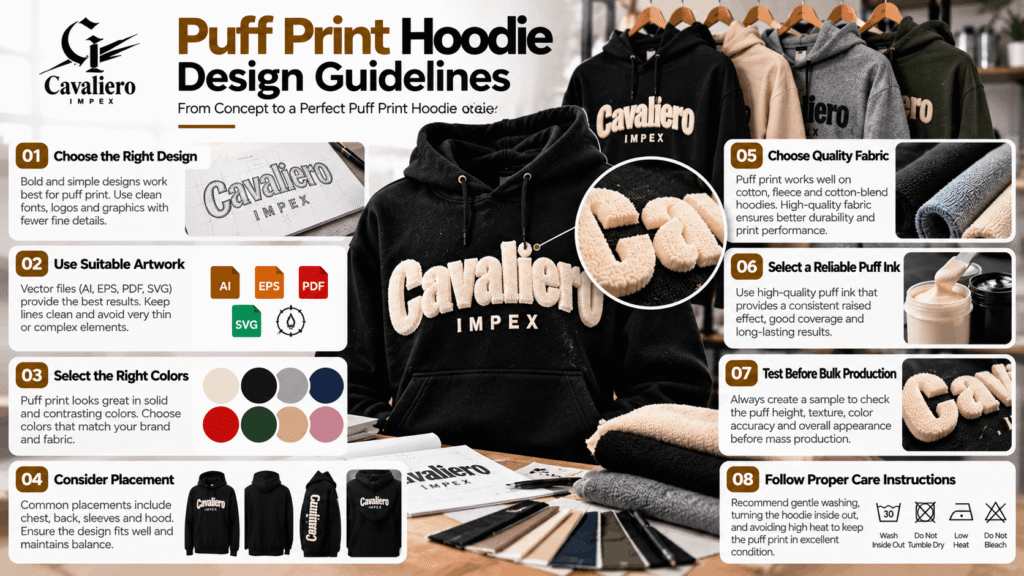
Great puff print starts with artwork that respects how the ink behaves. Use the guidelines when briefing your designer or supplying files.
Keep shapes simple
Puff ink excels at solid confident forms. Thick lettering, rounded icons and clean silhouettes expand beautifully.
Intricate details such, as hairline strokes, tiny text and dense textures will. Close up as the ink grows.
Respect minimum line thickness
As a rule, lines and gaps in puff artwork should be noticeably thicker than those in a flat print. Many printers advise that strokes be at about 2 to 3 millimetres wide and that the spaces between letters be generous enough so that expansion does not fuse them together. Your manufacturer can give tolerances for their inks.
Choose appropriate font styles
Heavy sans‑serif fonts, rounded display faces, block letters and bubble lettering perform best. Thin script fonts and kerned serifs often fail with puff. If your brand font is delicate ask the studio to produce a thickened version for puff applications.
Limit the number of colours
Puff print is typically done in one to three colours. Each colour requires its screen and its own expansion step and overlapping puff layers can create uneven heights. If you need colours consider combining a puff element with flat print, embroidery or a woven patch.
Plan layering carefully
You can print a flat base colour. Then add a puff layer on top for a two‑level effect. For example a flat outline with a raised fill gives a contrast. However layering demands registration so discuss it with your manufacturer before finalising the design.
Think about size and placement
small puff prints look like blobs while very large solid areas can feel heavy and may crack when the garment flexes. Medium to graphics with some negative space usually produce the best balance of dimension and comfort. Keep puffed areas away from high‑movement zones such as underarms and elbow creases.
Prepare artwork files properly
- Supply vector artwork (AI, EPS, SVG or high‑quality PDF) with text converted to outlines.
- Use Pantone references for colour accuracy.
- Provide the print dimensions at size.
- Indicate placement with a mock‑up or technical pack.
- Flag any areas where you want flat versus raised effects.
Test before you commit
A strike‑off or pre‑production sample is the insurance you can buy. It lets you check ink height, colour, softness, sharpness and placement on the hoodie before a full run is produced.
Step‑by‑Step: How a Puff Print Hoodie Is Made
Knowing the production flow helps you understand lead times and quality checkpoints. Here is a typical process for a bulk order.
1. Briefing and artwork review
The manufacturer reviews your artwork advises on any puff‑specific adjustments. Confirms print positions, sizes and colours. This is the stage to ask questions about order quantities, fabric options, packaging and branding add‑ons such as woven labels and hang tags.
2. Sampling and approval
A sample hoodie is produced, with the actual fabric and ink. You assess the height of the puff, edge sharpness, colour, hand feel and fit. Adjustments to screen mesh, ink thickness or artwork are made until the sample is approved.
3. Fabric sourcing and cutting
approved fabric is sourced or prepared. Panels are cut to pattern. In some workflows the panels are printed before sewing, which makes it easier to produce accurate placements, especially for large front and back graphics.
4. Screen preparation
Each colour in the design needs its screen. The mesh is coated with emulsion exposed to the artwork and washed out to leave the stencil. A thicker emulsion layer or a coarser mesh is often selected for puff prints because more ink needs to pass through.
5. Printing
The panel or finished garment is positioned on the printing platen. The puff ink is pushed through the screen with a squeegee. Printers control pressure, angle and speed because they affect how much ink is deposited and therefore how high the print will rise.
6. Expansion and curing
The printed items pass through a conveyor dryer. Are heated with a heat gun or press at a controlled temperature. The ink. Then cures into a stable flexible raised film. This step is the sensitive in the whole process and careful temperature profiling is essential for a consistent result across an entire batch.
7. Cooling and inspection
Garments cool, before handling so the raised shapes harden fully. Inspectors check height, evenness, placement, cleanliness and finishing.
8. Finishing
If panels were printed before assembly puff print hoodies are sewn into hoodies with hoods, pockets, cuffs, hems and drawcords added. Labels are attached, threads. Garments pressed or steamed gently avoiding direct pressure on the puffed areas.
9. Final quality control and packing
Each puff print hoodie is checked against the approved sample and the specification sheet. Finished puff print hoodies are folded, polybagged and packed in cartons with size ratios, barcodes and shipping marks applied according to your instructions.
Quality Control: Common Puff Print Defects and How to Prevent Them
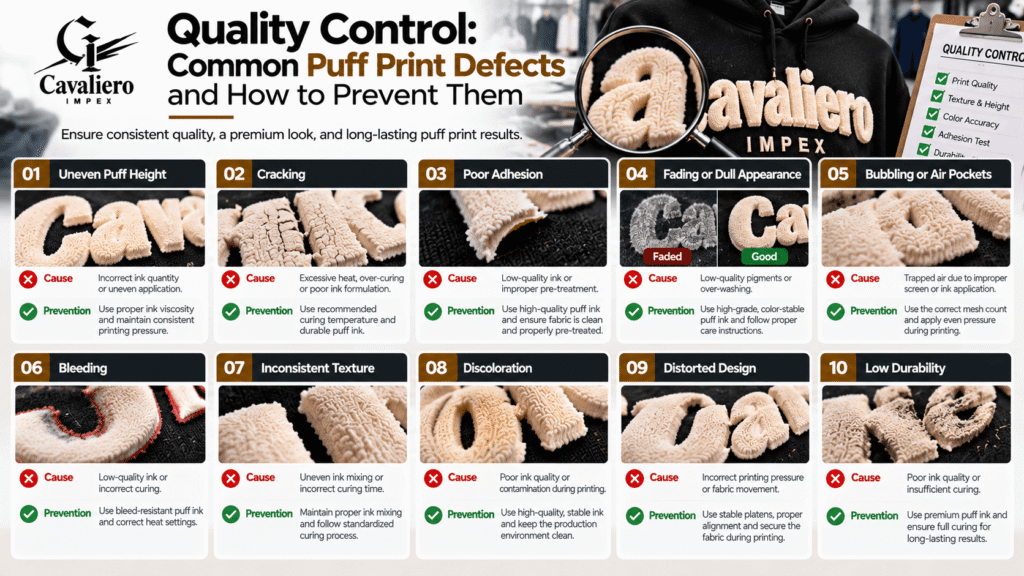
Professional manufacturers monitor a list of defects specific to puff print. Knowing them helps you evaluate puff print samples and approve production confidently.
- Uneven puff height: caused by ink deposit or uneven heating. Prevented by squeegee settings and controlled dryer temperatures.
- Cracking: caused by overheating thick prints or incompatible fabrics. Prevented by testing and by using ink formulations.
- Blurry edges: caused by expansion into detail or poor screen registration. Prevented by artwork and accurate stencil preparation.
- Under-expansion: the print stays flat. Only partially rises because heat was too low. Prevented by profiling each batch and checking temperature at the garment surface.
- Blistering: caused by trapped moisture or uneven heat. Prevented by -drying garments and controlling dwell time.
- Dye migration: garment dye bleeds into ink. Prevented by using blocker inks or low-bleed fabrics.
- Misregistration: layered colours are out of alignment. Prevented by screen setup and test prints.
- Tackiness: a finish due to under-curing. Prevented by curing time and temperature.
- Poor washfastness: the print peels or breaks down after laundering. Prevented by curing, suitable ink and a wash test during sampling.
Ask your manufacturer how they test for these issues, including whether they perform wash tests and stretch tests on sample pieces before production begins.
Who Orders Puff Print Hoodies?
Streetwear and fashion labels
Independent brands use puff print to create signature drops, limited collections and collaboration pieces. The tactile quality helps justify retail pricing and supports a strong brand story.
Schools, colleges and universities
Campus apparel has always embraced lettering. Puff print hoodies suit class years, society names, mascots and graduation merchandise. Puff print hoodies also make fundraising items.
Sports clubs and teams
Team names, player numbers and club crests look striking in puff. If you manufacture or buy sportswear you may also want to explore custom team sportswear manufacturing for matching tracksuits, jerseys and training kits alongside puff print hoodies.
Corporate and promotional buyers
Companies commissioning staff uniforms conference swag and client gifts want items that people actually wear. A subtle puffed logo on a high-quality hoodie delivers brand visibility without feeling like an advertisement.
Event organisers and festivals
Concerts, marathons and community events use raised graphics to create merchandise. Short planned runs can sell out quickly when the design feels special.
Label and wholesale buyers
Retailers building their own labels need consistent quality, scalable production and reliable lead times. For these buyers partnering with a private label clothing manufacturer can simplify everything from sampling to packaging.
MOQ, Pricing and Lead Time: What to Expect
Every factory has its policies but the following factors consistently influence puff print hoodie orders.
Minimum order quantity
Puff print requires screen setup and heat testing so manufacturers often set a minimum order quantity per design. Larger quantities lower the cost per piece because setup costs are spread across garments. If you are a start-up ask whether the factory offers a trial run or a flexible MOQ for first orders.
Factors that affect price
- Hoodie fabric type, weight and construction
- Number of puff colours and print positions
- Print size and ink coverage
- Additional decoration such, as embroidery, appliqué or flat print
- Custom labels hang tags and packaging
- Order quantity and size breakdown
- Shipping method and destination
Lead time
A typical timeline includes artwork confirmation, sampling, approval, bulk fabric preparation, production, quality control and shipping. Sampling alone can take days to a couple of weeks depending on complexity. Bulk production times vary with quantity and season. The best way to avoid delays is to finalise artwork early approve samples and share your delivery deadline at the very start.
Ways to manage cost
- Limit the design to one or two puff colours
- Choose simple shapes
- Choose one style and colour for the first run
- Order sizes in realistic ratios that match your audience
- Combine puff print with cheaper flat elements when full height is not needed
How to Care for a Puff Print Hoodie
Proper care keeps the raised finish and extends the life of the puff print hoodie. Share these instructions with your customers either on a care label or an insert card.
- Turn the puff print hoodie inside out before washing.
- Wash the puff print hoodie in lukewarm water on a gentle cycle.
- Use detergent and avoid bleach and fabric softener on the puff print hoodie.
- Do not iron directly on the puffed print; if ironing is necessary turn the puff print hoodie inside out. Use a low setting.
- Air dry the puff print hoodie where possible; if tumble drying, use a heat setting.
- Avoid cleaning solvents unless the manufacturer says they are safe for the puff print hoodie.
- Store the puff print hoodie folded or on a hanger and avoid placing heavy items on top of the print.
With care a quality puff print hoodie retains its shape, colour and texture for a long time.
Sustainability and Compliance in Puff Print Production
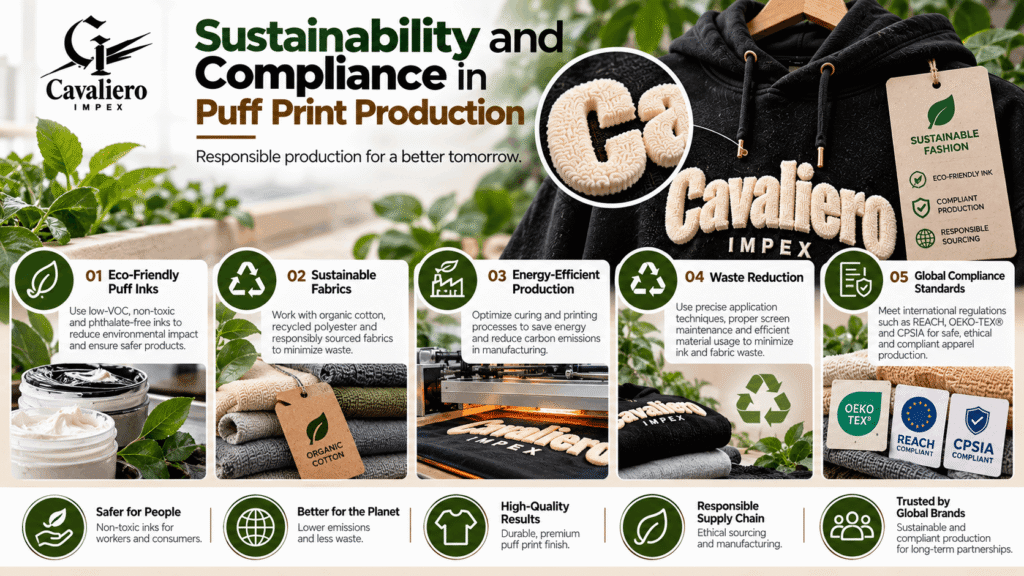
Modern buyers increasingly ask about safety standards. When sourcing a puff print hoodie consider the following.
Ink chemistry
Water-based puff inks are popular because they offer a hand and lower solvent emissions. Plastisol puff inks deliver expansion and opacity. Either type should comply with the restricted‑substance rules of the markets where you sell. Ask your manufacturer which ink systems they use and whether they can provide compliance documentation.
Restricted substances
Apparel sold in Europe, the United Kingdom and the United States must meet chemical and labelling requirements. In the US for example children’s products must follow rules from the Consumer Product Safety Commission. If your hoodies are aimed at children or teenagers discuss safety testing before production begins.
Responsible fabrics
Organic cotton, recycled polyester blends and sourced fleece can reduce the footprint of your range. Choosing fabrics and strong print quality also supports sustainability because a puff print hoodie that lasts for years is better than one discarded after a few washes.
Waste reduction
Efficient pattern cutting, careful ink management and accurate sampling reduce waste. Producing to demand than overordering helps too. A good manufacturer will advise on quantities that suit your sales forecast.
How to Choose a Puff Print Hoodie Manufacturer
Not every factory is equally skilled at puff print. Use this checklist when comparing suppliers.
- Experience: ask for examples of puff print hoodies and request photographs of close‑up details.
- Sampling process: confirm how many sample rounds are included and what they cost.
- Fabric range: check that they can supply the weights, blends and finishes you need.
- Quality systems: ask about inspection stages wash testing and defect tolerances.
- Customisation breadth: a supplier that also handles embroidery, labels, packaging and tech packs can streamline your project.
- Communication: clear answers early on usually predict a smoother production run.
- Capacity and lead times: be sure they can meet your deadline, including peak seasons.
- Pricing transparency: request itemised quotations so you can see where costs come from.
- Compliance: verify that materials and inks meet the requirements of your target markets.
- Flexibility: ask about MOQs, repeat orders and size‑run adjustments.
Why Work With Cavaliero Impex for Custom Hoodies
If you are planning custom hoodies, team apparel or a full private‑label collection Cavaliero Impex is built around helping brands, clubs and businesses turn design ideas into garments. From artwork discussions to sampling, production and delivery the focus is on clear communication, consistent quality and flexible customisation.
Brands that approach the team with a puff print hoodie concept can expect support on questions: which fabric weight best suits the artwork, how thick the lettering should be how many colours are sensible for the budget and how to combine puff print with other decoration methods. Visit the Cavaliero Impex website to explore the services and to start a conversation about your next collection.
Puff Print Hoodie. Merchandising Ideas
A good garment still needs to be presented. Here are some ideas for getting the most from your puff print hoodies once they are made.
Build a capsule collection.
Pair the puff print hoodie with matching joggers, caps and tote bags that repeat the raised graphic. A cohesive set encourages customers to buy than one item.
Offer colourways.
Release the design, in different hoodie colours and puff ink combinations. Limited seasonal colourways create urgency. Give loyal customers a reason to return.
Photograph the texture.
Use side lighting. Close‑up photos to show the raised surface clearly. Short videos of a hand brushing across the print explain the feel better than any words.
Tell the craft story
Explain how the puff print is created. Customers like to know that the effect comes from production and not from a cheap shortcut. The story also helps justify a premium price.
Use hang tags and inserts
Include care instructions and a brief note about the puff print technique. This reduces returns from washing and strengthens perceived value.
Mix techniques for depth
Try a printed background and a raised puff focal point.. Pair a puffed front chest logo with an embroidered sleeve detail. Combining methods creates a layered designed look.
Puff Print Colour Guide: Pairing Ink and Hoodie Shades
Colour choice changes how the raised effect looks because expanded ink catches light differently from ink. Use these pairings as a starting point. Always confirm them on a physical sample.
High‑contrast combinations
White or cream puff on black, navy or charcoal hoodies is the streetwear look. The raised edges create shadows that make lettering look almost carved. Neon yellow, electric blue and pink puff on dark hoodies deliver a loud youthful energy that suits festival and limited‑drop merchandise.
Tonal combinations
A puff on a sand hoodie or a deep green puff on a forest green hoodie gives a quiet premium impression. Tonal designs rely entirely on texture and light. They suit brands that want to communicate confidence instead of volume.
Team and school colours
Clubs and schools usually need brand colours. Provide Pantone references. Request a colour match on the sample. Gold on maroon white on royal blue and red on grey are combinations that read well from a distance.
Colours to approach with care
light inks on very light fabrics can disappear. Dark inks on dark fabrics can lose definition. Bright whites on dark polyester‑rich blends need attention because of dye migration. When in doubt ask for a swatch test before committing.
Mistakes Buyers Make When Ordering Puff Print Hoodies
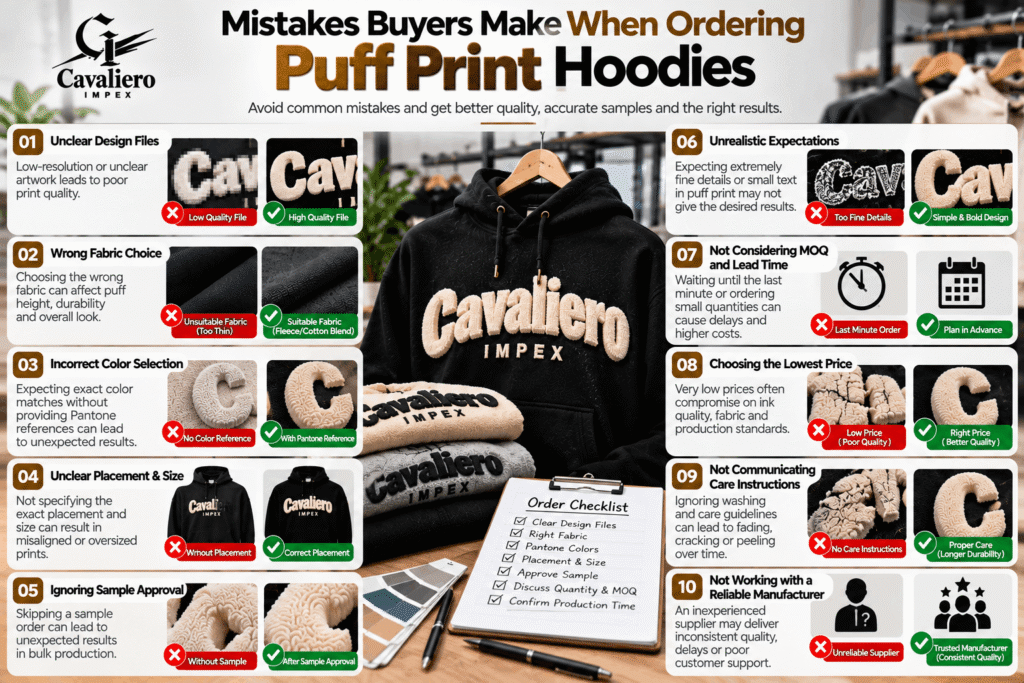
Even experienced brand owners can stumble on a first puff print order. Avoid these pitfalls.
- Supplying artwork with fine detail: thin lines and tiny text will not survive expansion. Simplify the design first.
- Skipping the sample: approving production from a mock‑up alone is risky because the raised effect cannot be judged on a screen.
- Choosing a blank: thin fabric can pucker or feel flimsy under a large raised print.
- Placing prints over seams: raised ink across a seam or zip gives a result and may crack over time.
- Overloading the design with colours: every extra colour adds cost and increases the chance of misregistration.
- Ignoring care instructions: without a care label customers may. Hot‑wash the garment and blame the print.
- Leaving deadlines late: sampling, revisions and shipping all take time especially in busy seasons.
- Not planning size ratios: ordering quantities of every size often leaves you short in the popular sizes and overstocked in others.
A short briefing document that covers fabric, print size, placement, colours, quantities and deadline prevents most of these issues before they start.
Puff Print Hoodie Trends to Watch
Trends move quickly. Several directions in raised‑print design are shaping how brands approach hoodies right now.
Typography
Large chunky wording across the chest or back remains the dominant look. Brands are experimenting with stacked words, letters that bleed off the panel and slogans that wrap around sleeves.
Mixed‑technique designs
Designers increasingly combine puff print with embroidery, flat print, rhinestones, chenille patches and woven labels. A single hoodie might feature a raised logo, a stitched sleeve detail and a flat back graphic creating a look that rewards close inspection.
Soft muted palettes
Alongside neon and bold colours muted earth tones washed pastels and off‑whites are popular for puff prints on garment‑dyed or vintage‑washed hoodies.
Nostalgic and playful graphics
Smiley faces, retro sports crests, cartoon‑style icons and varsity lettering are returning in puff form. Their rounded shapes are perfectly suited to the technique.
Personalisation
Short runs with player names, member numbers or custom initials let teams and communities create hoodies that feel personal. Puff print on names and numbers adds a premium touch, to small orders.
Conscious production
Buyers want to know where garments come from and how they are made. Brands that combine a puff print hoodie with sourced fabric and clear production information build trust with customers.
Preparing a Strong Brief for Your Manufacturer
I find that a clear brief speeds up sampling and cuts down revisions. Gather the following before you contact a manufacturer.
- Product details: I should record style (pullover, zip, cropped, oversized) fabric preference and approximate weight.
- Artwork: I need vector files, Pantone colours and actual print dimensions.
- Placement: I should create a mock‑up showing where each graphic will sit on the front, back, sleeves and hood.
- Quantities: I should list pieces and the expected size split.
- Branding extras: I should include neck labels, hang tags, polybags, cartons and any special packaging.
- Timeline: I should note the date I need the goods delivered and any launch or event dates.
- Budget: I should set a target price range so the manufacturer can suggest options.
- Destination: I should specify the country and delivery method so shipping can be planned accurately.
With this information on hand a good manufacturer can respond quickly with recommendations a quotation and a sampling schedule.
Frequently Asked Questions About Puff Print Hoodies
What is a puff print hoodie?
A puff print hoodie is a sweatshirt decorated with expanding ink that rises when heated creating a raised 3D design on the fabric surface.
Is puff print durable?
Yes a puff print hoodie is durable when it is properly cured and cared for. Follow washing guidelines avoid heat and request a wash test during sampling for confidence in the finished product.
Does puff print crack?
A puff print hoodie can crack if the ink is overheated applied thickly or used on an unsuitable fabric. Professional printers prevent cracking through testing, temperature control and flexible ink formulations.
Can any design be puff printed?
Bold simple designs work well on a puff print hoodie. Fine lines tiny text and intricate gradients are not suited to puff print. A good manufacturer will advise on modifications.
How colours can a puff print hoodie have?
One to three colours can be used on a puff print hoodie although layered or combined techniques can add visual variety. Each colour adds setup and production steps.
Can I mix puff print with embroidery?
Absolutely. Many puff print hoodies use puff print for graphics and embroidery for small logos or details.
Which hoodie fabric is best for puff print?
Mid to cotton fleece or cotton‑rich blends with a smooth surface usually give the best results on a puff print hoodie. Always sample on the fabric you plan to use.
How high does puff print rise?
A puff print hoodie typically rises a millimetres depending on the ink the mesh and the amount of ink deposited. You can discuss the desired height with your manufacturer.
Can puff print be used on light‑coloured hoodies?
Yes. Tonal or contrast puff inks both work on light‑coloured hoodies though light fabrics may show any heat marks more easily so careful processing is important.
Is puff print for team and school hoodies?
Yes. A puff print hoodie is an option for names, crests, numbers and slogans because it looks bold and holds up well to regular wear when produced correctly.
How long does it take to produce custom puff print hoodies?
It depends on sampling order size and factory schedules. Share your deadline early so the production plan can be built around it.
How do I order custom puff print hoodies in bulk?
Prepare your artwork decide on quantities, sizes and fabrics and contact a manufacturer. You can start by reaching out through cavalieroimpex.com with your design brief.
Make Your Next Hoodie Impossible to Ignore
The puff print hoodie has earned its place as one of the popular decoration trends in modern apparel. It brings together comfort, bold graphics and a tactile quality that flat printing simply cannot match. Whether you are launching a streetwear label outfitting a team creating school merchandise or sourcing apparel for your business a well‑made puff print hoodie gives people something they want to wear and touch.
The key to success lies in the details: choosing a quality hoodie blank designing artwork that suits the way puff ink expands controlling temperature and curing during production approving a sample, before bulk manufacturing and caring for the finished garment correctly. Work with a manufacturer who understands these steps and communicates clearly. You will avoid most of the problems that frustrate first‑time buyers.
Are you ready to bring your idea to life? Tell the Cavaliero Impex team about your concept, how many you need and when you want them done. Then you can start planning a custom puff print hoodie collection away.