

Introduction:Why the Label Matters More Than You Think
Pick up any garment in a store and, within seconds, your eyes will move to the label. It might be the woven brand tag at the neck, the printed size mark inside the side seam, or the care label stitched near the hem. These small pieces of fabric and ink do a surprising amount of work. They tell the customer who made the product, what it is made of, how to wash it, and what size to expect. For a brand, they are also a quiet promise of quality.
This is exactly why relabeling services have become one of the most requested solutions in the apparel and sportswear industry. Whether you are launching a new clothing line, rebranding an existing one, shifting production to a new factory, or selling in a new country with different legal requirements, you will almost certainly need to remove, replace or add labels to your garments. Done well, relabeling makes products look consistent, professional and legally compliant. Done badly, it leads to damaged fabric, rejected shipments, unhappy customers and wasted money.
In this guide, we walk through everything a brand owner, sourcing manager, team coach or startup founder should know about relabeling services: what they are, why they matter, the types of labels available, the step-by-step process, legal requirements, quality control, costs, common mistakes, and how to choose the right partner for relabeling services. If you are exploring custom clothing or team sportswear production, you can also see what we offer at Cavaliero Impex.
What Are Relabeling Services?
Relabeling services are professional production services that remove existing labels from garments and replace them with new ones, or add new labels where none existed. The new labels carry your brand name, logo, size information, fiber content, country of origin, care instructions and any other details your market requires.
In practical terms, a relabeling services job can include several tasks:
- Removing old labels from garments without damaging the fabric, stitching or print.
- Sewing or attaching new labels such as woven neck labels, printed labels, heat transfer labels, hang tags and care labels.
- Re-sizing and re-tagging products so that size information is accurate and consistent.
- Adding compliance information such as fiber content, RN numbers where relevant, country of origin and care symbols.
- Re-packing the finished garments in polybags, cartons or retail-ready packaging with updated barcodes and stickers.
Relabeling services is sometimes confused with full manufacturing, but it is different. In a full manufacturing job, the factory cuts, sews and finishes garments from scratch. In a relabeling job, the garments already exist, and the focus is on changing their identity: the brand, the labelling or the packaging. Many manufacturers offer both, which is useful because a single partner can handle everything from fabric to finished, branded product.
Relabeling is also closely connected to private label and white label clothing. Both models rely on garments that are branded with the buyer’s name rather than the maker’s name. We explain the differences in a later section.
Why Brands Use Relabeling Services
There is no single reason brands choose relabeling. The motivations vary widely, and understanding them helps you decide whether the service fits your situation.
1. Launching a New Brand Quickly
Starting a clothing brand from zero is expensive and slow. Designing patterns, sourcing fabric, sampling and production can take months. With relabeling, a new brand can take high-quality blank or ready-made garments and apply its own labels, getting to market in weeks. This is especially attractive for startups testing an idea before committing to larger custom production.
2. Rebranding an Existing Business
Companies change names, logos and positioning. A merger, a new owner or a visual refresh can make existing stock outdated overnight. Instead of discarding inventory, relabeling lets you update the labels on that stock so it matches the new identity.
3. Meeting Legal and Market Requirements
Every market has its own rules about what must appear on a textile label. A garment made for one country may need new labels before it can be sold in another. Relabeling services help bring products into line with those rules without remaking the garments.
4. Correcting Errors
Mistakes happen: a wrong size label, a misspelled fiber content, an incorrect care symbol. Rather than scrapping a whole batch, a careful relabeling job can fix the problem and rescue the inventory.
5. Creating Consistency Across Suppliers
Brands that source from several factories often end up with different label styles, fonts and quality levels in the same collection. Relabeling services lets you standardize labels so every product feels like part of the same family.
6. Team and Club Branding
Sports clubs, schools and corporate teams often buy quality garments and then need them branded with club names, crests, player numbers or sponsor marks. Relabeling and branding services let teams get a professional finish without ordering a full custom run.
7. Cost Control
Because relabeling works with existing garments, it can be significantly cheaper than full custom production, especially at low or medium quantities. For many businesses it is the most cost-efficient route to a branded product.
The Main Types of Labels Used in Relabeling Services
Choosing the right label is both a branding decision and a practical one. A label sits against skin, goes through hundreds of wash cycles and must stay legible. Here are the most common label types used in relabeling services.
Woven Labels
Woven labels are created on a loom, with threads forming the design. They are durable, have a premium feel, and are widely used for brand names and logos at the neck or hem. Damask woven labels offer fine detail and a smooth finish, while taffeta labels are more economical and softer. Satin woven labels have a glossy surface that suits fashion brands.
Printed Labels
Printed labels use ink on fabric tape such as satin, cotton or polyester. They are ideal for care and content information because they can hold small text and multiple lines at a lower cost. Quality matters here: poor ink fades or cracks after washing.
Heat Transfer Labels
Heat transfer labels, sometimes called tagless labels, are applied with heat and pressure directly onto the inside of the garment. They are popular in activewear, sportswear and underwear because they remove the itchy edge of a traditional tag. They are also the best choice when a garment has no room for a sewn label.
Leather and Faux Leather Patches
These patches are sewn onto denim, jackets, caps and bags. They give a rugged, premium look and can be embossed, debossed or laser engraved.
Rubber and Silicone Labels
Rubber or silicone labels are common on sportswear, outerwear and streetwear. They are waterproof, flexible and durable, and can be molded in 3D shapes for a distinctive look.
Care and Content Labels
These are the labels relabeling services that carry washing instructions, fiber composition and country of origin. In many countries they are legally required, so care and content labels deserve as much attention as the brand label itself. The laundry symbol system is a helpful reference for understanding the pictograms used on care labels.
Hang Tags
Hang tags are attached to garments with string, plastic fasteners or tag pins. They carry price, barcode, brand story and sometimes sustainability messages. Because they can be removed, they do not replace sewn labels, but they are important for retail presentation.
Size Labels
Size labels can be standalone or combined with the main label. Clear, consistent sizing is one of the biggest factors in reducing returns.
Barcode and SKU Stickers
These are used for inventory control and retail scanning. In relabeling projects, getting barcodes right is essential, because a wrong barcode can cause stock mix-ups in warehouses and stores.
The Relabeling servicesProcess, Step by Step
A professional relabeling project follows a clear workflow. Understanding it helps you plan timelines, avoid surprises and communicate clearly with your manufacturer.
Step 1: Brief and Requirements
Everything starts with a conversation. You explain what garments you have, how many, what labels you want, where they should be placed, and the deadline. You should share your logo files, brand colors, fonts and any legal text that must appear.
Step 2: Garment Inspection
Before any work begins, the garments are inspected. The team checks fabric type, existing label attachment method, stitching quality and any damage. This step matters because some fabrics, such as fine knits, delicate synthetics or printed jerseys, require special handling when labels are removed.
Step 3: Label Design and Artwork
Your label artwork is prepared or adapted to the correct dimensions, color codes and production method. A good manufacturer will advise on font size, color contrast and material, because a design that looks beautiful on screen can be unreadable on a one-centimeter woven tape.
Step 4: Sampling and Approval
Samples of the new labels are produced and, ideally, attached to a few garments so you can see exactly how they will look. You approve the sample, or request adjustments, before bulk production begins. Skipping this step is one of the most common causes of regret.
Step 5: Label Removal
Old labels are carefully removed. Depending on how they were attached, this may involve precision unpicking of stitches, gentle heat removal of transfer labels, or careful cutting. The goal is to leave no holes, scars or residue.
Step 6: Label Attachment
New labels are sewn, heat-pressed or otherwise attached in the agreed position. Consistency is critical: a label that sits one centimeter off in half your units looks sloppy.
Step 7: Quality Control
Each batch goes through quality control for placement accuracy, stitching strength, legibility, color matching and damage. Random sampling or full inspection is used depending on the order size.
Step 8: Packing and Dispatch
Finished garments are folded, polybagged, barcoded and packed according to your instructions, then shipped to your warehouse, retailer or customers.
Legal Compliance: Getting Labels Right for Your Market

One of the strongest reasons to use professional relabeling services is compliance. Textile labeling laws exist to protect consumers, and fines or shipment rejections can be costly. Although exact requirements differ by country, most markets ask for some combination of the following.
Fiber Content
Most regions require a label showing what the garment is made of, listed by percentage and in descending order. For example, “80% cotton, 20% polyester.” Names must follow accepted generic fiber terms rather than invented marketing names.
Country of Origin
Many countries require a “Made in” statement. The rules for what qualifies as the country of origin can be complex, particularly when garments are cut in one place and sewn in another. In the United States, U.S. Customs and Border Protection publishes guidance on origin marking.
Care Instructions
Care labels tell the customer how to wash, dry, iron and, where relevant, dry-clean the garment. In some markets these instructions are mandatory and must use standardized symbols or wording.
Manufacturer or Importer Identification
Some jurisdictions require the name or registered identifier of the manufacturer, importer or brand owner to be on the label.
Size Information
Sizing may need to follow national conventions or show multiple size systems.
Where to Learn More
If you sell in the United States, the Federal Trade Commission publishes guidance on the Textile and Wool Acts labeling requirements and on its Care Labeling Rule. The full legal text of the rule is available in 16 CFR Part 423. In the European Union, textile fiber names and labeling are governed by Regulation (EU) No 1007/2011. For symbols and standardization topics, the International Organization for Standardization maintains standards relevant to textile care labeling. Requirements in the United Kingdom, Canada, Australia and the Middle East differ, so always confirm the rules for each country where you plan to sell.
A responsible relabeling partner will not give you legal advice, but it should ask the right questions, apply the information you provide accurately, and flag anything that looks inconsistent. Always have your legal or compliance advisor confirm label text before bulk production.
Materials and Methods: Choosing How Labels Are Attached
The way a label is attached affects comfort, durability, appearance and cost. Here are the main methods.
Sewn-In Labels
Labels are stitched into a seam, such as the back neck or side seam. This is the traditional approach, strong and durable, but it requires access to the seam and can leave stitch marks if poorly done.
Sewn-On Labels (Top-Stitched)
Labels are stitched onto the surface of the garment, usually on all four sides or two sides. This is common for patches, brand flags and external labels , relabeling services.
Heat Transfer Application
A label design printed on transfer paper is applied to the fabric using heat and pressure. It is comfortable and suits stretch or performance fabrics, but it needs correct temperature, time and pressure settings to last through repeated washing.
Adhesive and Fusible Application
Some labels use heat-activated adhesive for light-duty or temporary placement. These are less durable than stitching and are generally used when sewing is not possible.
Choosing the Right Method
Consider the garment type, fabric, expected wear and wash cycles. A cotton t-shirt may take a woven neck label beautifully, while a lightweight compression top may be far better suited to a heat transfer label. Sportswear that will be washed heavily needs especially durable methods.
Relabeling services vs. Private Label vs. White Label vs. Custom Manufacturing
These terms are often used interchangeably, but they are not the same. Knowing the difference helps you pick the right service.
Relabeling
Existing garments, whether your own stock or ready-made blanks, receive new labels. The garment design and construction are not changed.
White Label
A manufacturer produces a generic product that multiple brands can buy and brand as their own. The product design belongs to the manufacturer, and you simply add your label. It is fast and low-risk, but your product may look similar to others sold by other brands.
Private Label
A product is made exclusively for one brand, often based on that brand’s specifications or selected from the manufacturer’s range with modifications. It offers more differentiation than white label.
Custom Manufacturing
The garment is designed and produced from scratch to your exact specifications: pattern, fabric, trims, labels and packaging. This gives you the most control and uniqueness but typically requires higher quantities and longer timelines.
Which Should You Choose?
- Choose relabeling if you already have garments or want the fastest, most affordable route to a branded product.
- Choose white label if you want to test a market quickly with proven designs.
- Choose private label if you want a more distinctive product without developing everything from scratch.
- Choose custom manufacturing if you have a clear design vision and the volume to support it.
Many brands start with relabeling or white label, then move into private label and custom manufacturing as they grow. A manufacturer that offers all of these, like the one described on our homepage, lets you scale without changing suppliers.
Who Benefits Most from Relabeling Services?
Startup Clothing Brands
New brands with limited budgets can create a professional-looking product range without investing in full production. Quality labels instantly elevate a basic garment.
Established Brands Changing Identity
If you are refreshing your logo or merging with another company, relabeling stops your existing inventory from becoming obsolete.
Retailers and Wholesalers
Retailers who want to sell products under their own house brand can source garments and apply their own labels.
Sports Clubs and Teams
Clubs, academies and leagues can brand training wear, jerseys, hoodies and tracksuits with their crest, team name and player information. This is particularly useful for teams that need small runs or frequent updates.
Schools and Universities
Uniforms, sports kits and merchandise often need consistent branding across different suppliers.
Corporate and Promotional Buyers
Companies ordering staff uniforms or promotional apparel often need labels that carry the company brand and, sometimes, a separate internal identification.
E-commerce and Dropshipping Sellers
Sellers who want to move beyond reselling generic products can build a recognizable brand by adding custom labels, hang tags and packaging.
Exporters and Importers
Businesses moving products between countries often need labels updated to match the destination market’s rules.
Quality Control: What Separates Good Relabeling services from Bad

Relabeling looks simple, but the details decide whether the result looks premium or amateur. Here is what quality control should cover.
Placement Accuracy
Labels should be positioned consistently, usually measured from a fixed point such as the center back or the shoulder seam. A professional team uses templates or jigs so every garment is identical.
Stitch Quality
Stitches should be even, tight and the right color. Poor stitching can pucker the fabric, show through to the outside, or come loose after washing.
Fabric Integrity
Removing old labels must not leave holes, snags, shiny marks or stretched areas. This is especially important on delicate and performance fabrics.
Legibility
Text on care labels must remain readable after many washes. Test samples should be washed and checked before bulk production, especially for printed labels.
Color Consistency
Brand colors should match your approved sample. Different dye lots or printing batches can drift slightly, so approval and batch checking matter.
Comfort
Labels at the neck or waistband should not scratch or irritate. If a label feels rough, customers will cut it out, which defeats its purpose and can remove legally required information.
Packaging and Barcode Accuracy
A wrong barcode or mismatched size sticker can create costly warehouse errors. Checks should confirm that every carton and polybag matches the order.
Inspection Standards
Reputable factories use recognized sampling methods, such as AQL (acceptable quality limit) inspection, to decide how many units to check and how many defects are acceptable. Ask your supplier which standards they apply.
Minimum Order Quantities, Pricing and Lead Times
Every brand wants to know how much relabeling will cost and how long it will take. The honest answer is that it depends, but understanding the factors helps you budget.
What Affects Cost
- Label type: Woven damask labels cost more than printed satin labels, and silicone patches cost more than both.
- Label size and complexity: More colors, more detail and larger sizes increase cost.
- Quantity: Larger orders reduce the per-unit price because setup costs are spread across more pieces.
- Garment type: Delicate or complex garments take longer to relabel than simple t-shirts.
- Removal difficulty: Removing heavily stitched or glued labels takes more time.
- Additional services: Re-packing, barcoding, folding and custom hang tags add to the total.
- Shipping and duties: For international orders, these can be a significant part of the final cost.
Minimum Order Quantities
Label production usually has minimums, because looms and printing setups must be configured for each design. Some suppliers have lower minimums for printed labels and higher minimums for woven or custom-molded ones. If you are testing a new brand, ask about low-MOQ options and whether stock label designs are available.
Typical Lead Times
While every project differs, a rough timeline might look like this:
- Artwork and approval: a few days to a week, depending on how quickly you respond.
- Label sampling: one to two weeks.
- Bulk label production: one to three weeks.
- Relabeling and quality control: depends on quantity and complexity.
- Packing and shipping: variable by destination.
Plan extra time for approvals, public holidays and shipping. Rushing usually increases the cost and the risk of errors.
How to Get an Accurate Quote
Send your supplier clear information: garment type and quantity, current label type and location, desired new labels, artwork files, packaging needs and destination country. The more detail you give, the more accurate the quote. You can request a quote with these details ready to speed things up.
Common Mistakes to Avoid
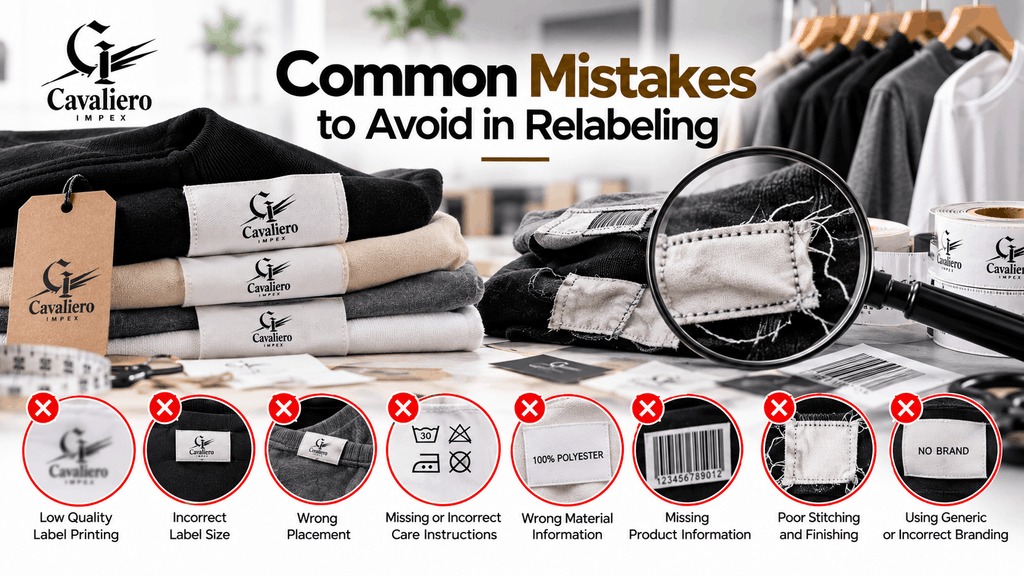
Even experienced buyers make avoidable errors in relabeling projects. Watch out for these.
Skipping the Sample
Approving labels from a screen image alone is risky. Always ask for a physical sample, and wash-test it if the garment will be washed often.
Ignoring Legal Requirements
Assuming one label design works in every market is a common and expensive error. Check the rules for each destination country.
Choosing the Wrong Label Type
A stiff woven label on a baby garment or a thin printed label on a heavy-duty work jacket will cause problems. Match the label to the product and its use.
Poor Artwork Files
Low-resolution logos produce blurry labels. Provide vector files, such as AI, EPS or PDF, whenever possible.
Forgetting About Placement
Where the label sits affects comfort and appearance. Define the exact position in your brief, ideally with a diagram or photo.
Overcomplicating the Design
Tiny text, too many colors and thin lines do not reproduce well on small labels. Simple designs are often more elegant and more durable.
Not Checking Stock Condition First
If your existing garments have flaws, relabeling will not fix them. Inspect inventory before you invest in new labels.
Choosing Only on Price
The cheapest quote can hide poor materials, rushed work and weak quality control. Consider total value, including reliability and communication.
Neglecting Hang Tags and Packaging
Labels are only part of the brand experience. A beautifully labeled garment in a crushed, unbranded bag undermines the effort.
How to Choose the Right Relabeling Partner
The partner you choose affects quality, timelines and your brand’s reputation. Here are the questions worth asking.
Do They Have Experience With Your Product Type?
Relabeling a team jersey is different from relabeling a tailored jacket. Look for a partner with experience in sportswear or whichever category you sell, whether that is streetwear, casual wear or uniforms.
Can They Show Samples and Past Work?
Ask for photos, sample labels or references. Seeing real examples reveals a lot about craftsmanship.
What Are Their Quality Control Processes?
A good supplier can describe their inspection steps, tolerances and how they handle defects. Vague answers are a warning sign.
Do They Offer a Full Range of Label Options?
A partner who offers woven, printed, heat transfer, leather, rubber and hang tags can recommend the best option rather than the only one they can make.
How Is Their Communication?
Clear, prompt and honest communication is vital, especially when working across time zones. Pay attention to how quickly and thoroughly they answer your first inquiry.
Are Their MOQs and Pricing Transparent?
You should know the minimums, the price breaks and any extra charges before you commit.
Can They Scale With You?
If your brand grows, can they also handle private label, custom design and large-scale production? Staying with one manufacturing partner saves time and keeps your quality consistent.
Do They Understand Export Requirements?
If you sell internationally, your partner should be familiar with packaging, documentation and labeling needs for different markets.
Sustainability and Trends in Garment Labeling

Labeling is evolving, and relabeling services are evolving with it. Several trends are worth watching.
Eco-Friendly Materials
Recycled polyester, organic cotton and biodegradable materials are increasingly used for woven and printed labels. Brands that care about sustainability often extend that commitment to their trims and labels.
Tagless and Comfort-First Designs
Heat transfer and printed-on labels are growing in activewear, kidswear and loungewear, driven by customer demand for comfort.
Digital and QR Labels
QR codes and digital product IDs on labels allow customers to access product stories, care videos, authenticity checks and recycling information. Regulators in some regions are also moving toward digital product passports, so this area is changing fast.
Minimalist Branding
Many brands are choosing smaller, cleaner labels with subtle logos, which can feel more premium than large, loud branding.
Reuse and Resale
As resale and repair culture grows, durable labels that stay readable matter more. A label that survives years of wear supports the long life of the garment.
Transparency
Customers increasingly expect clear information on where and how products are made. Accurate, honest labeling builds trust.
Practical Tips for a Smooth Relabeling Project
Here is a quick checklist to help your project run smoothly:
- Define your goal. Are you rebranding, complying with new rules, or building a new line?
- Gather your assets. Vector logo files, color references, fonts, legal text and size charts.
- Choose label types early. They affect design, cost and timelines.
- Specify placement. Provide a diagram or photo.
- Confirm legal requirements with your advisor for each market.
- Approve a physical sample before bulk production.
- Agree on quality standards and inspection methods.
- Plan your timeline with buffer for approvals and shipping.
- Keep records. Save approved samples, specifications and correspondence for future reorders.
- Review the first shipment carefully and give feedback so future batches improve.
Why Work With Cavaliero Impex
When you are looking for relabeling services, you want more than someone who can stitch a tag. You want a partner who understands apparel, respects deadlines and treats your brand as if it were their own.
At Cavaliero Impex, we focus on custom clothing and team sportswear manufacturing, which means we understand how garments are built, how they are worn and how they need to perform. That background shapes how we approach labeling: we pay attention to fabric behavior, comfort, durability and brand presentation, not just attachment.
Here is what brands and teams can expect from working with a manufacturer that combines production experience with customization capability:
- Guidance on label choices based on your garment, fabric and market.
- Flexible options for brands starting small and brands scaling up.
- Consistent quality supported by inspection at key stages.
- A single point of contact for design, production and finishing, rather than juggling multiple suppliers.
- Room to grow, from relabeling and branding to private label and fully custom collections.
If you already have garments that need new labels, or you are planning a new collection and want labeling built in from the start, you can explore our services and get in touch through cavalieroimpex.com. Share your requirements, and we can help you work out the best approach for your products and budget.
Frequently Asked Questions About Relabeling Services
What are relabeling services?
Relabeling services replace or add labels on garments, including brand labels, size labels, care labels and hang tags. They are used for rebranding, compliance, private label programs and quality correction.
Can any garment be relabeled?
Most garments can be relabeled, but the method depends on the fabric and construction. Delicate, stretchy or heavily printed garments need special care, so a sample test is recommended.
Is relabeling cheaper than manufacturing new garments?
Often, yes, especially for small and medium quantities, because you are not paying for fabric, cutting and full sewing. The actual savings depend on the label type, garment and quantity.
How long does a relabeling project take?
Timelines vary by order size, label type and approval speed. A typical project includes artwork approval, label sampling, bulk label production, relabeling, quality control and shipping. Ask your supplier for a schedule specific to your order.
What is the difference between relabeling and private labeling?
Relabeling changes the labels on existing garments. Private labeling involves garments made for a specific brand, sometimes with design changes, and sold under that brand’s name. They are related but not identical.
Do I need care labels on my garments?
In many countries, yes. Care labels are legally required in several markets, so confirm the rules for your destination country with a legal or compliance professional.
Which label type is best for sportswear?
Heat transfer labels and soft printed labels are popular because they are comfortable and flexible. Woven labels can also work when placed carefully. The best choice depends on the fabric and how the garment will be used.
Can you remove old labels without damaging the garment?
A skilled team can usually remove labels cleanly using precision unpicking or controlled heat. Some fabrics are more sensitive than others, so inspection and a test piece help avoid surprises.
What artwork files should I provide?
Vector files such as AI, EPS or PDF are best, along with Pantone or color references, font names and any required legal text.
Is there a minimum order quantity?
Yes, in most cases. Minimums depend on label type and supplier. Stock label designs and printed labels often allow lower quantities than custom woven or molded labels.
Can relabeling help me sell in a new country?
It can, provided the new labels meet that country’s requirements. Always verify the specific rules for your target market before production.
How do I get started?
Prepare your garment details, quantities, artwork and deadline, then contact a manufacturer for a quote and sample. You can begin by reaching out through Cavaliero Impex.
Conclusion: Small Labels, Big Impact
Labels may be small, but their influence on a brand is large. They carry your identity, satisfy legal requirements, guide customers on care and sizing, and signal the level of quality they can expect. Relabeling services give you a flexible, cost-effective way to get that right, whether you are launching a new brand, refreshing an old one, entering a new market or branding a team kit.
The key is to approach relabeling with the same care you would give any part of product development. Understand your market’s rules, choose label types that suit your garments, approve samples before bulk production, and work with a partner who values quality and communication.
Ready to put your name on better-finished garments? Visit Cavaliero Impex to discuss your custom clothing, team sportswear and labeling needs.