
Why Choose a Custom Embroidery Clothing Manufacturer?
Starting a clothing brand has never been more exciting, or more intimidating. You have a design, a name and a vision for how your hoodies, polos, caps or team uniforms should look and feel. Then you start contacting factories and hit the same wall: “Our minimum order quantity is 1,000 pieces per design.”
For a startup, that number can end the dream before it begins. Spending thousands of dollars on inventory you haven’t tested with customers is risky, and for most new founders it isn’t possible at all.
This is where a low MOQ custom embroidery clothing manufacturer changes the game. Instead of forcing you into mass-production volumes, this type of partner lets you start small, test the market, refine your product and scale as demand grows. At Cavaliero Impex, this is exactly the kind of flexible production we build for new brands.
In this guide you will learn:
- What MOQ means and why manufacturers set one
- How low-MOQ embroidery production actually works
- Which embroidery styles and garments suit startups
- What custom embroidered clothing really costs
- How to vet and choose the right manufacturer
- The mistakes new brands make, and how to avoid them
- How to scale from your first small batch to a full collection
Whether you are building a streetwear label, a corporate uniform program, a sports club kit or a small merchandise line, this guide gives you a practical roadmap.
What Is MOQ, and Why Does It Matter So Much?
MOQ stands for Minimum Order Quantity. It is the smallest number of units a manufacturer will produce in a single order. You will usually see it expressed per style, per color or per design, and the difference matters a lot. For a general definition, see this overview of the minimum order quantity.
For example:
- MOQ per style: 100 pieces of one hoodie design, in any mix of sizes and colors.
- MOQ per color: 50 pieces in each color you order.
- MOQ per design: 300 pieces for each unique embroidery artwork.
Two factories can both advertise “MOQ 100” and mean very different things. Always ask exactly how the minimum is calculated.
Why Do Manufacturers Set Minimums?
MOQs are not arbitrary. Apparel production has fixed costs that must be spread across enough units to be profitable:
- Machine setup time. Threading an embroidery machine with multiple colors, loading the digitized file, hooping the fabric and running test stitches all take time, whether the run is 10 pieces or 1,000.
- Digitizing. Turning your artwork into a stitch file takes skilled labor. The cost is the same regardless of order size.
- Fabric and trim purchasing. Mills and suppliers often sell fabric by the roll and trims by the carton, so smaller orders cost more per unit.
- Cutting and sewing. Cutting tables and production lines are most efficient with batches, not one-offs.
- Quality control and packing. Inspection and packaging labor also has a base cost.
A traditional factory sets a high MOQ to protect its margins. A low-MOQ manufacturer restructures its workflow so that small batches remain profitable, using flexible machines, stocked blank garments, efficient digitizing and smaller production lines.
Why Startups Need a Low MOQ Custom Embroidery Clothing Manufacturer
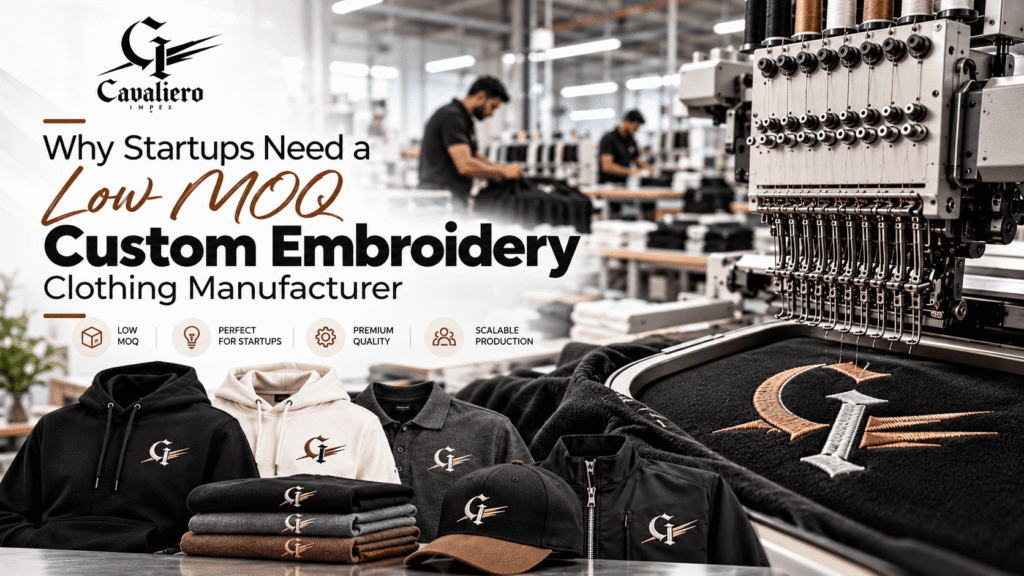
If you are launching a brand, a low MOQ is not just convenient. It is a strategic advantage.
1. Lower Financial Risk
Your first collection is an experiment. You don’t yet know which colors will sell, which sizes move fastest, or whether customers prefer a chest logo or a sleeve detail. Ordering 100 pieces instead of 1,000 means that if something doesn’t sell, the loss is manageable.
2. Better Cash Flow
Cash is the lifeblood of a new business. Money locked in unsold inventory can’t be spent on marketing, photography, a website or customer service. Small batches keep your capital working.
3. Faster Market Testing
With a low MOQ you can launch a small drop, watch the data and reorder the winners. That cycle of produce, test, learn and reorder is how modern direct-to-consumer brands grow.
4. Room to Improve the Product
Your first sample is rarely perfect in Custom Embroidery Clothing Manufacturer. Maybe the logo is slightly too large, or the thread color looks different on the garment than on screen. Small runs let you adjust before committing to large volumes.
5. Flexibility for Seasonal and Limited Editions
Limited drops create urgency and exclusivity. A low-MOQ partner lets you release a capsule collection without carrying leftover stock for a year.
6. Easier Customization
Small orders make it practical to offer multiple colorways, personalized names or numbers, and client-specific variations, which is especially valuable for team and corporate orders.
Understanding Embroidery: Why It’s a Premium Choice
Before choosing a manufacturer, it helps to understand what you are buying. Embroidery decorates fabric by stitching thread directly into it. Unlike printing, which sits on the surface, embroidery becomes part of the garment. If you want the technical background, this guide to machine embroidery , Custom Embroidery Clothing explains how modern machines work, and you can see our own embroidery services for what we produce.
Why Brands Choose Custom Embroidery Clothing Manufacturer
- Durability. Embroidery withstands repeated washing, wear and time far better than most printed graphics.
- Premium look and feel. The raised texture signals quality. A small embroidered logo on a polo or cap instantly reads as “professional.”
- Brand perception. Customers associate embroidery with craftsmanship and value, which supports higher price points.
- Timeless appeal. Embroidered logos rarely look dated or peeling the way cracked prints can.
Embroidery vs. Screen Printing
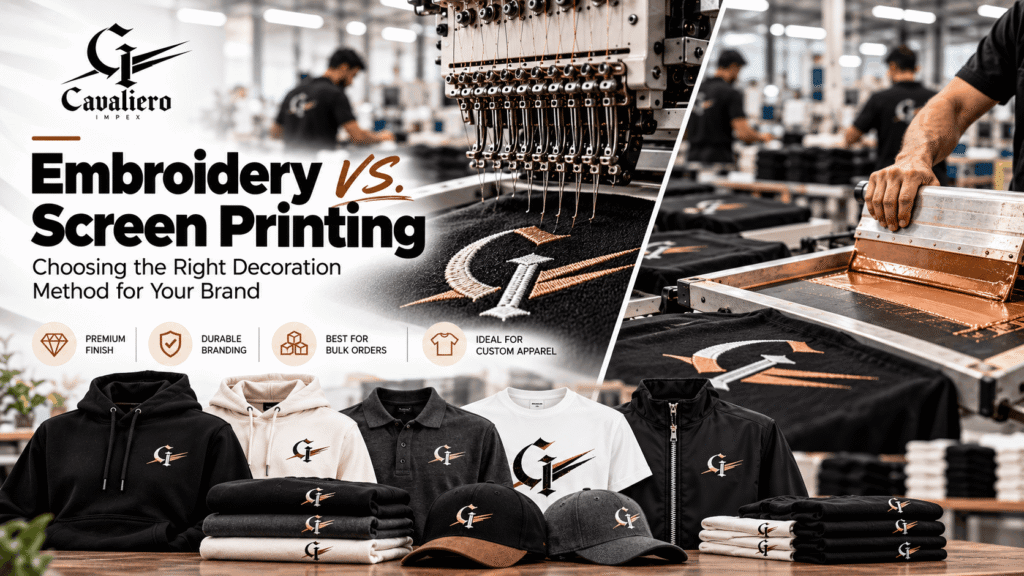
Many startups wonder which to choose. The honest answer is that it depends on the design and the product.
| Factor | Embroidery | Screen Printing |
|---|---|---|
| Feel | Textured, raised | Smooth or slightly rubbery |
| Durability | Excellent | Good, can crack or fade |
| Best for | Logos, text, small to medium designs | Large graphics, many colors, photos |
| Cost on small runs | Moderate | Can be cheaper at high volume |
| Perceived value | Premium | Casual to mid-range |
| Detail level | Limited by stitch size | Very fine detail possible |
Many successful brands combine both: embroidery for chest logos and details, and printing for large back or front graphics. If you want to explore the print side, take a look at our all-over printing options, and read more about how screen printing works.
Custom Embroidery Clothing Manufacturer Techniques Every Startup Should Know
A good manufacturer will offer several embroidery styles. Knowing them helps you pick the right one for each product and keeps you from paying for effects you don’t need.
Flat Embroidery
The standard and most common technique. Thread lies flat against the fabric, creating clean lines and smooth fills. It suits logos, monograms, text and detailed artwork in . It is also the most budget-friendly option, which makes it ideal for startups.
3D Puff Embroidery
A foam layer is placed under the stitching so the design rises off the garment, giving a bold, dimensional look. It is hugely popular on caps, beanies and streetwear. Puff embroidery works best with thick, simple shapes and bold lettering. Very small text and thin lines don’t work well.
Appliqué Embroidery
Fabric pieces are cut and stitched onto the garment, then bordered with embroidered edges. This is common on varsity jackets, team wear and letterman-style apparel. Appliqué offers big visual impact for large letters and numbers while using fewer stitches than filling the same area with thread.
Patch Embroidery
Designs are embroidered onto a separate backing and then sewn, heat-pressed or adhered onto the garment. Patches are ideal when you want to apply the same logo across multiple garment types or fabrics, and they make low-quantity orders easier because the patches can be produced in bulk and applied as needed.
Chenille Embroidery
A fuzzy, looped yarn creates a plush, textured effect, famously used on varsity letters. Chenille is a distinctive, heritage look but more expensive, so it is best used selectively.
Metallic and Specialty Thread Embroidery
Metallic, glow-in-the-dark or reflective threads add flair for fashion pieces and limited editions. They can be trickier to stitch and may cost more.
Which Style Should You Choose First?
For most startups, start with flat embroidery for your core products and consider 3D puff for caps or one signature item. Add appliqué or patches if you are building a team, varsity or heritage-inspired line.
Best Garments for a Low MOQ Embroidery Launch

Not every garment suits every brand. Here are the best products to launch with, and what to consider for each.
Hoodies and Sweatshirts
Hoodies remain the star of streetwear and merchandise. Their thick fabric supports bold embroidery well, including puff. Chest logos, sleeve details and back designs all work. Fabric weight (GSM) and finishing quality strongly influence how premium your hoodie feels.
T-Shirts
The most accessible entry point. Lightweight fabric limits very dense embroidery, so keep designs smaller and lighter to avoid puckering. A small chest or sleeve logo looks clean and upscale.
Polo Shirts
The classic corporate and golf-wear item. A left-chest embroidered logo on a pique polo is a staple of uniform programs. Polos sell reliably to businesses, restaurants, schools and clubs.
Caps and Hats
Caps are in Custom Embroidery Clothing Manufacturer among the best sellers for startups because embroidery is almost expected on them. They have lower per-unit costs and easy shipping, and they work well with 3D puff.
Jackets and Varsity Jackets
Higher price points and higher margins, but also higher production complexity. Appliqué and chenille shine here.
Tracksuits and Activewear
Great for sports brands and teams. Embroidery should be placed carefully on stretch fabrics and may require stabilizers to avoid distortion.
Beanies and Accessories
Low cost, high margin, and good for add-on sales. Tote bags, scarves and bucket hats can round out a collection.
A Smart First Collection
If you are unsure where to begin, a practical starter lineup might be:
- 1 hero hoodie in 2 colors
- 1 core T-shirt or polo
- 1 embroidered cap
Three products, two to three colors each, is manageable and gives customers enough choice without overwhelming your budget.
How a Low MOQ Custom Embroidery Clothing Manufacturer Makes Small Orders Work
You may wonder how a factory can profitably produce 50 or 100 pieces when others demand thousands. The answer is in how the operation is built.
Stocked Blank Garments
Many low-MOQ manufacturers keep a range of blank hoodies, tees, polos and caps in popular sizes and colors. You skip the fabric-sourcing and cut-and-sew stages entirely, and your order only needs embroidery. This reduces both the minimum and the lead time.
Flexible Multi-Head Machines
Modern embroidery machines can run several garments at once, switch colors quickly and handle varied designs. This agility makes short runs efficient.
Efficient Digitizing Workflows
Experienced digitizers convert artwork into stitch files quickly, and a file digitized once can be reused for every future order. This is one reason reorders are cheaper than first orders.
Small-Batch Production Lines
Some factories dedicate lines to small and mixed orders, with teams trained for quick changeovers rather than long identical runs.
Two Production Models
Understanding which model you are dealing with helps you set expectations:
- Embroidery on blank (stock) garments. Lowest MOQ, fastest turnaround, limited to the available base garments.
- Full custom cut-and-sew with embroidery. Your own pattern, fabric, fit and labels. Higher MOQ, longer lead time, maximum brand uniqueness.
Many startups begin with the first model to validate demand, then graduate to the second once the brand is established.
The Digitizing Step: Where Your Design Becomes Stitches
Digitizing is the most overlooked step in embroidery, and one of the most important. A beautiful logo can look terrible when poorly digitized.
What Is Digitizing?
Embroidery machines don’t read JPEGs or PNGs. They read stitch files (such as DST or PES) that tell the machine exactly where to place each stitch, in what direction, at what density and in what order. A digitizer manually creates this file from your artwork.
Why It Matters
Good digitizing determines:
- Clarity of small details and text
- Smoothness of fills and edges
- Stability, meaning whether the fabric puckers or the design distorts
- Efficiency, since fewer unnecessary stitches means faster production and lower cost
Preparing Artwork for Digitizing
To get the best results, send:
- Vector files (AI, EPS, SVG or PDF) when possible
- High-resolution PNG or JPEG if a vector isn’t available (at least 300 DPI)
- Pantone references or exact thread color preferences
- Desired size in inches or centimeters
- Placement (left chest, center chest, sleeve, back, cap front and so on)
Design Tips for Embroidery
- Keep it simple. Complex gradients and photographic detail don’t translate into thread.
- Avoid tiny text. As a rule of thumb, lettering below about 5-6 mm in height risks becoming illegible.
- Limit colors. Fewer color changes mean faster production and lower cost.
- Allow for thread thickness. Very thin lines may fill in or disappear.
- Consider the fabric. Textured or stretchy fabrics need design adjustments.
Digitizing Costs
Most manufacturers charge a one-time digitizing or setup fee per design, which is often waived or reduced for larger orders or repeat customers. Always ask whether the fee is included in the quote and whether you own the file afterward, since you will want it for reorders.
Choosing Fabrics, Threads and Quality Standards
Premium Custom Embroidery Clothing Manufacturer depends as much on materials as on technique.
Fabric Choices
- Cotton fleece: The hoodie standard. Soft, warm and supports embroidery well. Look at GSM (grams per square meter): around 300-400 GSM is a good premium range for hoodies.
- French terry: Lighter and breathable, great for spring and summer sweatshirts.
- Pique cotton: The classic polo fabric, with a textured weave that hides minor stitching imperfections.
- Cotton jersey: Standard T-shirt fabric. Lightweight, so choose lighter embroidery.
- Polyester and performance blends: Moisture-wicking and durable, ideal for sportswear, but they require proper stabilization and thread selection.
- Twill (caps and jackets): Tough, structured fabric that holds embroidery beautifully.
To learn more about cotton quality and fiber standards, Cotton Incorporated’s Cotton Works is a helpful industry resource.
Thread Types
- Polyester thread: The industry favorite. Strong, colorfast, resistant to fading and chlorine, and available in a huge color range.
- Rayon thread: A higher sheen and silky appearance, but less durable over repeated washes.
- Metallic thread: Eye-catching but requires careful handling.
- Cotton thread: A matte, natural look, used less often in commercial production.
For most startup products, polyester thread offers the best balance of durability, color accuracy and cost.
Stabilizers (Backing)
Stabilizers support the fabric during stitching so it doesn’t pucker or stretch. Choosing the right one depends on the fabric: cut-away stabilizers for knits and stretch fabrics, tear-away for stable wovens. A good manufacturer handles this without you asking, but it is worth confirming they test on your specific fabric.
Quality Benchmarks to Check
When you receive samples, inspect for:
- Clean, even stitching with no loose threads
- No puckering or rippling around the design
- Sharp edges and legible small text
- Correct thread colors
- Backing neatly trimmed and comfortable against the skin
- Consistent placement and size across pieces
Custom Embroidery Clothing Manufacturer Clothing Pricing: What Will You Actually Pay?
Pricing is the biggest question for every startup. While exact numbers depend on the manufacturer, product and quantity, understanding the cost drivers lets you budget accurately and compare quotes fairly.
Key Cost Factors
1. Garment cost. A basic cotton T-shirt costs far less than a heavyweight hoodie or a lined jacket. Fabric weight, quality and construction drive this.
2. Stitch count. Embroidery is typically priced by the number of stitches (usually per thousand). A small left-chest logo might be 4,000-8,000 stitches, while a large back design could exceed 20,000. More stitches mean more machine time and thread.
3. Number of colors. Each color change adds production time.
4. Embroidery type. Flat is the baseline. 3D puff, appliqué, chenille and metallics usually cost more.
5. Placement and number of locations. One logo is cheaper than a logo plus sleeve plus back detail.
6. Order quantity. Per-unit price decreases as quantity increases, but low-MOQ production lets you accept a slightly higher unit price in exchange for lower overall risk.
7. Digitizing and setup fees. A one-time cost per design.
8. Labels, tags and packaging. Custom woven labels, hang tags and polybags or custom packaging add to cost.
9. Shipping, duties and taxes. If you are importing, factor in freight, customs and local taxes.
Understanding the Tradeoff: Unit Price vs. Total Investment
Here is a simple way to think about it. Imagine two options for a hoodie:
- Option A: 1,000 pieces at a lower unit cost, requiring a large upfront investment.
- Option B: 100 pieces at a slightly higher unit cost, requiring a much smaller upfront investment.
Option A looks cheaper per piece, but if only 300 sell in six months, you are left with 700 units of dead stock and tied-up cash. Option B costs more per piece, yet it lets you test, learn and reorder with data. For a startup, the second option usually wins.
Calculating Your Margin
A healthy apparel brand typically prices retail at 2.5x to 4x the landed cost per unit (the total cost to get one finished piece to your door). Work backward:
- Total landed cost per unit (garment + embroidery + labels + packaging + shipping)
- Add marketing, platform fees, returns and overhead
- Decide on a target profit margin
- Set a retail price your customers will accept
Don’t price based on cost alone. Check what comparable brands charge, and make sure your price reflects the quality you deliver.
Ways to Reduce Cost Without Hurting Quality
- Simplify the design and cut unnecessary stitches
- Limit thread colors
- Choose standard garment styles over fully custom patterns at first
- Consolidate orders to meet pricing tiers
- Reuse the same digitized logo across multiple products
- Plan ahead to avoid rush fees
For a detailed quote tailored to your product, send us your requirements and our team will respond with an itemized estimate.
Lead Times: How Long Does It Take?
Timing affects your launch plan, marketing calendar and cash flow. Typical stages include:
| Stage | Approximate Time |
|---|---|
| Inquiry, quotation and artwork review | 1-3 days |
| Digitizing and embroidery sample | 3-7 days |
| Sample approval and revisions | 2-7 days (depends on you) |
| Production (small batch on stock blanks) | 7-15 days |
| Production (custom cut-and-sew) | 25-45 days |
| Quality check and packing | 2-4 days |
| Shipping | 3-7 days express, 15-40 days sea freight |
These ranges are general estimates. Always confirm the timeline in writing, and build in a buffer for revisions, holidays and shipping delays.
How to Avoid Delays
- Send clean, final artwork on the first try
- Decide sizes, colors and quantities before requesting a quote
- Respond quickly to sample feedback
- Confirm payment terms early
- Order before peak seasons such as Q4 holiday periods, when factories are busiest
How to Choose the Right Low MOQ Custom Embroidery Clothing Manufacturer

The manufacturer you choose is effectively your business partner. A great one saves you money, protects your reputation and helps you grow. A poor one can cost you your launch. Use this checklist.
1. Look at Their Real Experience
How long have they been producing embroidered apparel? Do they specialize in your type of product, whether team sportswear, streetwear, corporate uniforms or promotional merchandise? Ask for examples of previous work and client references.
2. Confirm the Actual MOQ and How It’s Calculated
Ask directly: Is the MOQ per style, per color or per design? Does it change for different garments? Is there a lower MOQ for stock blanks than for custom cut-and-sew? Get this in writing.
3. Always Request Samples
Never approve a bulk order without seeing a physical sample. A sample shows you the real embroidery quality, thread colors, fabric feel and fit. Yes, samples cost money, but they cost far less than a bad bulk batch.
4. Evaluate Communication
You’ll learn a lot from how a manufacturer communicates before you pay. Do they reply promptly? Do they answer your questions clearly? Do they flag potential problems in your design? Communication problems before the order usually become bigger problems during it.
5. Understand Their Quality Control
Ask what inspections they run: incoming fabric checks, in-line checks during production and final inspection before packing. A reliable factory documents this process and welcomes questions about it.
6. Check Customization Range
Can they offer different Custom Embroidery Clothing Manufacturer types, custom labels, hang tags, special packaging and personalized names or numbers? The wider the range, the more room your brand has to grow without switching suppliers.
7. Look for Transparent Pricing
A trustworthy quote itemizes garment cost, embroidery cost, digitizing fees, labels, packaging and shipping. Be cautious of quotes that are dramatically cheaper than everyone else’s, because the savings usually come from cut corners.
8. Verify Business Legitimacy
Check the company’s website, address, certifications and online presence. Search for customer reviews and request references. For general guidance on starting and structuring a small business, the U.S. Small Business Administration offers helpful resources.
9. Ask About Compliance and Ethical Production
Responsible manufacturers can speak confidently about labor conditions, safe materials and compliance with regulations in your target markets. If you plan to sell in the United States, review the FTC guidance on textile labeling requirements, which covers fiber content, country of origin and care labeling.
10. Plan for Long-Term Partnership
Choose a Custom Embroidery Clothing Manufacturer who can grow with you, from your first 50 pieces to your first 5,000. Switching suppliers later means new samples, new quality risks and lost time.
12 Questions to Ask Before You Place Your First Order
Copy this list into your first email or call:
- What is your MOQ per design, per color and per style?
- Do you offer Custom Embroidery Clothing Manufacturer on stock blank garments, and what are the options?
- What is the digitizing fee, and do I own the file afterward?
- How much does a sample cost, and how long does it take?
- What embroidery types can you produce (flat, 3D puff, appliqué, patches)?
- What are your lead times for samples and bulk orders?
- What are the payment terms and deposit requirements?
- Can you add custom woven labels, hang tags and packaging?
- What is your quality-control process, and what happens if there are defects?
- How do you handle reorders, and are prices lower the second time?
- What shipping options are available, and who handles customs?
- Can you provide references or examples of similar clients?
Good manufacturers answer these questions clearly and without hesitation.
Your Step-by-Step Launch Roadmap
Here is a practical process any startup can follow, from idea to delivery in Custom Embroidery Clothing Manufacturer.
Step 1: Define Your Brand and Product
Decide who you are selling to, what you are selling and why customers should care. Clarify your style, price positioning and core products before contacting factories.
Step 2: Prepare Your Artwork
Create or commission clean vector logos and designs. Keep embroidery limitations in mind and simplify where needed.
Step 3: Create a Tech Pack or Clear Brief
A tech pack is a document describing your product so the factory can make it accurately. Even a simple version should include in Custom Embroidery Clothing Manufacturer:
- Garment type, fabric, weight and color
- Embroidery placement, size and thread colors
- Size range and quantities
- Labels, tags and packaging requirements
- Reference images or sketches
Step 4: Request Quotes From Several Manufacturers
Contact three to five suppliers with the same brief so you can compare like for like. Compare MOQs, unit prices, fees, lead times and communication quality, not just price in Custom Embroidery Clothing Manufacturer.
Step 5: Order and Evaluate Samples
Review stitching, color accuracy, fabric feel, fit and placement. Wash and wear the sample to see how it holds up.
Step 6: Approve Pre-Production Details
Confirm every detail in writing: final artwork, thread colors, sizes, quantities, packaging, price, payment terms and delivery date.
Step 7: Place Your Bulk Order
Start with a quantity you can realistically sell. Pay deposits as agreed and keep records of all communication.
Step 8: Monitor Production
Ask for progress photos or videos during production, especially for your first order. This helps catch problems early.
Step 9: Inspect Before Shipping
Request pre-shipment photos, or arrange a third-party inspection for larger orders. Check a random sample from the batch, not just the best-looking pieces.
Step 10: Launch, Collect Data and Reorder
Track which products, colors and sizes sell best. Use that data to plan your next order with more confidence.
Common Mistakes Startups Make (and How to Avoid Them)
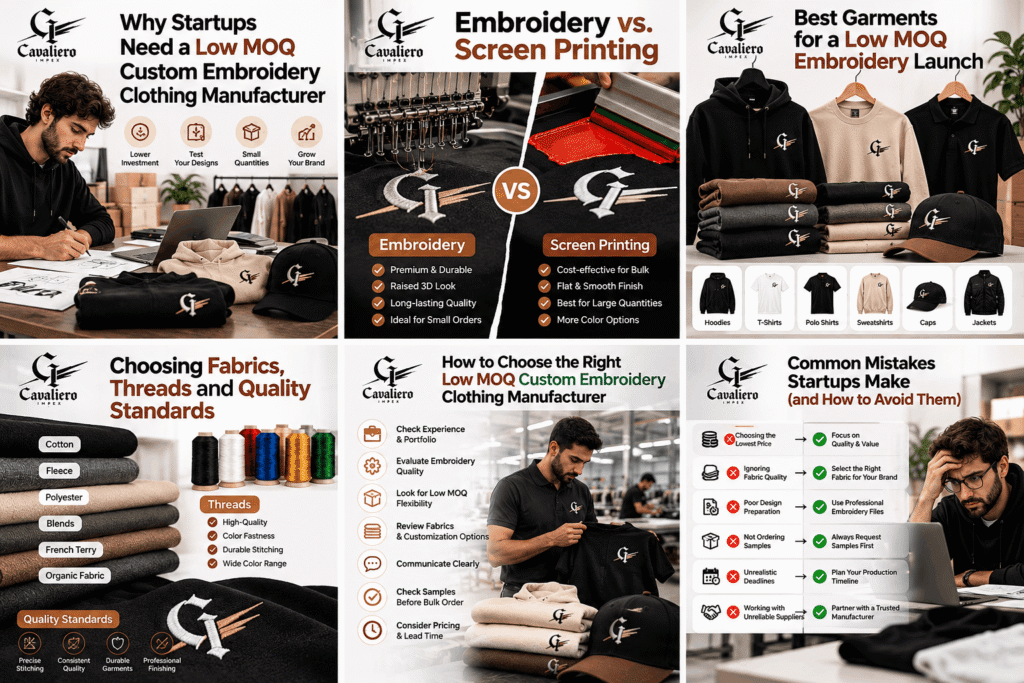
Mistake 1: Choosing the Cheapest Quote
Rock-bottom pricing often means poor materials, rushed stitching or hidden fees. Evaluate the total value, not just the unit price in Custom Embroidery Clothing Manufacturer.
Mistake 2: Skipping Samples
Approving bulk production without a sample is the most expensive gamble in apparel. Always see and feel the product first.
Mistake 3: Overcomplicated Designs
Gradients, tiny text and photographic detail rarely work in thread. Simplify your artwork or choose a different decoration method for complex graphics, such as all-over printing.
Mistake 4: Ignoring Fabric Compatibility
A design that looks perfect on a heavy hoodie may pucker on a lightweight tee. Match the embroidery to the fabric.
Mistake 5: Ordering Too Many Sizes and Colors
Spreading a small order across eight colors and seven sizes creates tiny, hard-to-sell quantities. Focus on two or three colors and the core sizes (S to XL) at first.
Mistake 6: Forgetting Labels and Packaging
Branding doesn’t end at the logo. Custom neck labels, hang tags and packaging make your product feel like a real brand rather than a generic blank in Custom Embroidery Clothing Manufacturer.
Mistake 7: Underestimating Timelines
Delays happen. Plan your launch with a buffer, and never promise customers a date that depends on perfect production.
Mistake 8: Unclear Communication
Vague instructions create mistakes. Provide detailed specifications, confirm everything in writing and ask for clarification when anything is uncertain.
Mistake 9: Not Owning Your Digitized Files
Make sure you receive the final embroidery file so you can reorder or switch manufacturers without paying to digitize again.
Mistake 10: Neglecting Marketing
A great product doesn’t sell itself. Budget for photography, social media, influencer samples and advertising from the beginning.
Branding Beyond the Custom Embroidery Clothing Manufacturer
Custom Embroidery Clothing Manufacturer is the signature, but the whole product experience builds your brand.
Custom Labels and Tags
Woven neck labels, printed inner labels, care labels and hang tags tell customers who you are and reassure them about quality. They also fulfill labeling requirements in many markets.
Packaging
Custom polybags, tissue paper, branded boxes and thank-you cards turn delivery into an experience customers share online. Even small touches can increase repeat purchases.
Consistent Visual Identity
Keep your logo, colors and style consistent across garments, labels, packaging and your online store. Consistency builds recognition and trust.
Storytelling
People buy stories as much as products. Share why you started your brand, how your products are made and what makes them different. Behind-the-scenes embroidery footage makes excellent social content.
Who Benefits Most From Low MOQ Custom Embroidery Clothing Manufacturer?
Fashion and Streetwear Startups
Test designs and release limited drops without heavy inventory.
Sports Teams and Clubs
Order uniforms, warm-ups and fan gear in small batches with player names and numbers. Pair embroidered crests with all-over printed team kits for a complete look.
Corporate and Business Uniforms
Outfit small teams, restaurants, salons, clinics and offices with embroidered polos, jackets and caps.
Schools, Societies and Events
Create merchandise for graduating classes, societies and special events without committing to bulk quantities.
Influencers and Content Creators
Launch merchandise lines with minimal risk and test what your audience wants.
Resellers and Retail Boutiques
Add private-label embroidered products to your store without large minimums.
Scaling Up: From First Batch to Full Collection
Success with a small first order is the beginning. Here is how to grow thoughtfully.
Reorder Your Winners
Use sales data to identify bestsellers and reorder those first. Because your design is already digitized, reorders are usually faster and cheaper.
Expand Your Product Range
Add new garment types and colors gradually. Each new product should complement what already works.
Negotiate Better Pricing
As your volumes grow, ask for tiered pricing, lower digitizing fees and priority scheduling. Loyal customers often receive better terms.
Move Toward Custom Cut-and-Sew
Once demand is proven, consider developing your own patterns, fabrics and fits. This creates a truly unique product and strengthens your brand identity.
Build Inventory Systems
Track stock levels, sales velocity and reorder points so you never run out of bestsellers or overstock slow movers.
Strengthen Quality Systems
As your order sizes increase, formalize inspection standards and consider third-party quality checks.
Sustainability and Ethical Production in Custom Embroidery Clothing Manufacturer
Today’s customers care about how clothes are made. Even a small brand can make responsible choices:
- Choose quality garments designed to last, since durability is the most sustainable feature
- Ask about organic cotton, recycled polyester or responsibly sourced materials
- Prefer small-batch production that reduces overproduction and waste
- Work with Custom Embroidery Clothing Manufacturer who treat workers fairly and operate transparently
- Use minimal, recyclable packaging
Low MOQ production is inherently more sustainable because it reduces deadstock and encourages made-to-demand thinking.
Why Work With Cavaliero Impex?
At Cavaliero Impex, we support startups, teams and growing brands with flexible custom apparel manufacturing, including embroidery, all-over printing and full customization. Our approach is built for small and growing businesses:
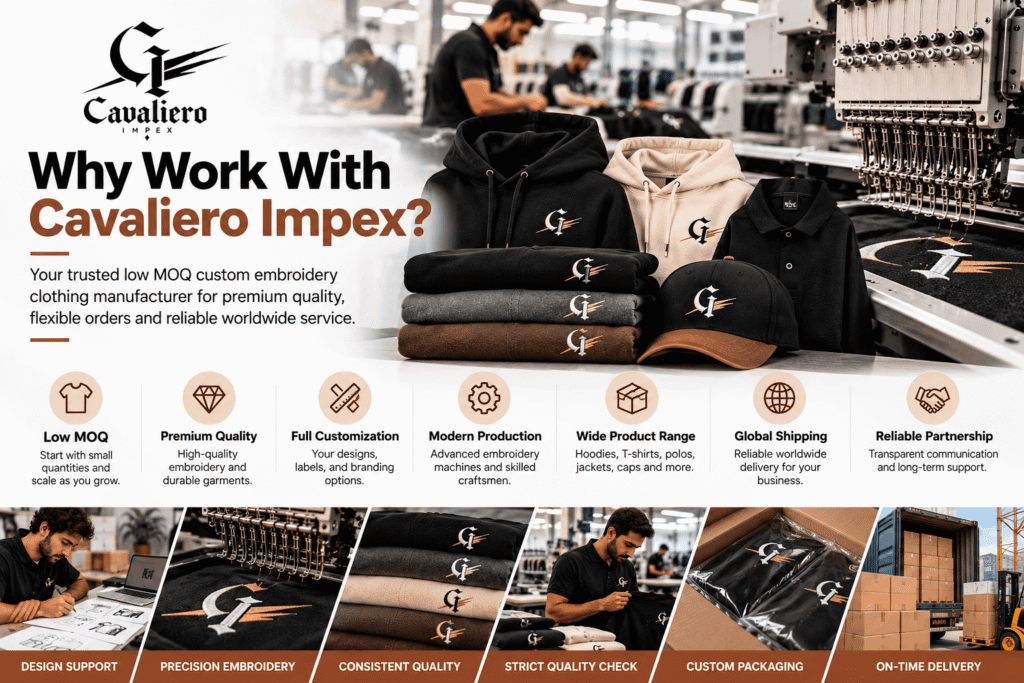
- Flexible order quantities designed for startups and small teams
- Multiple embroidery techniques, including flat, 3D puff and appliqué
- Customization from concept to finished product, including labels, tags and packaging
- Sample-first process so you approve quality before bulk production
- Clear communication and transparent quotations
- Support for team sportswear, streetwear and corporate uniforms
Ready to bring your design to life? Visit our home page to explore our services, browse our embroidery page, and send us your project details to request a quote.
Frequently Asked Questions
What is a low MOQ custom embroidery clothing manufacturer?
It is a clothing producer that accepts small order quantities, often from a few dozen pieces, for Custom Embroidery Clothing Manufacturer apparel. This makes it possible for startups, small businesses and teams to launch products without large upfront inventory investments.
What is the typical MOQ for custom embroidered clothing?
It varies widely. Embroidery on stock blank garments can start as low as 20-50 pieces with some manufacturers, while fully custom cut-and-sew products often start around 100-300 pieces per style. Always confirm how each manufacturer calculates its MOQ.
Is embroidery more expensive than screen printing?
On very large quantities, screen printing can be cheaper per piece. On small orders, the costs are often comparable, and embroidery typically offers a more premium look and greater durability. The best choice depends on your design and product.
How much does embroidery digitizing cost?
Digitizing is usually a one-time fee per design, and it varies by manufacturer and design complexity. Many suppliers waive or reduce it for larger or repeat orders. Ask whether the fee is included in your quote and whether you will own the stitch file.
How long does it take to get custom embroidered clothing?
Samples often take about a week, and small-batch production on stock garments commonly takes one to three weeks. Fully custom production takes longer, often four to six weeks, plus shipping. Always get timelines in writing.
Can I order different colors and sizes in one small order?
Often yes, but it depends on how the MOQ is structured. Some manufacturers apply the minimum to the whole style, while others require a minimum per color. Clarify this before ordering.
Do I need a vector logo for embroidery?
A vector file is ideal because it can be scaled and edited cleanly. If you only have a PNG or JPEG, a high-resolution version is usually acceptable, and the digitizer can recreate it, though results are best with clean artwork.
Can embroidery be done on any fabric?
Custom Embroidery Clothing Manufacturer works on most fabrics, but results depend on the material. Cotton fleece, pique, twill and denim are excellent. Very thin, stretchy or delicate fabrics need special stabilizers and careful design to avoid puckering.
What is 3D puff embroidery, and is it suitable for startups?
3D puff uses foam under the stitching to create a raised effect. It is popular on caps and streetwear and works best with bold, simple designs. It costs more than flat embroidery, so many startups use it selectively on signature products.
Should I order a sample first?
Yes, always. A sample lets you check stitch quality, color accuracy, fabric feel and placement before committing to a full order. It is the single best way to avoid costly mistakes.
Can I add my own labels and packaging?
Most professional manufacturers can add custom woven or printed labels, hang tags and branded packaging. These details elevate your product and strengthen your brand, so ask about them early.
How do I find a reliable manufacturer?
Check experience, request samples, ask detailed questions, compare itemized quotes, review references and evaluate communication quality. A reliable partner is transparent, responsive and confident about their process.
Final Thoughts
Starting a clothing brand takes courage, creativity and smart decisions, and one of the smartest decisions you can make is choosing the right manufacturing partner from day one.
A low MOQ custom embroidery clothing manufacturer gives you the freedom to start small, test ideas, learn from real customers and scale on your own terms. Instead of risking your savings on thousands of pieces, you can launch with a focused collection, protect your cash flow and invest in what matters most: building a brand people love.
To recap the essentials:
- Understand MOQ and how it’s calculated
- Start with simple, high-quality designs and a focused product range
- Choose the right embroidery technique for each garment
- Always request and approve samples
- Compare itemized quotes, not just prices
- Plan your timeline with a buffer
- Reorder winners and scale gradually
Your brand deserves a strong start. Take the first step today: visit Cavaliero Impex, explore our embroidery services, and let’s turn your idea into premium embroidered apparel.