
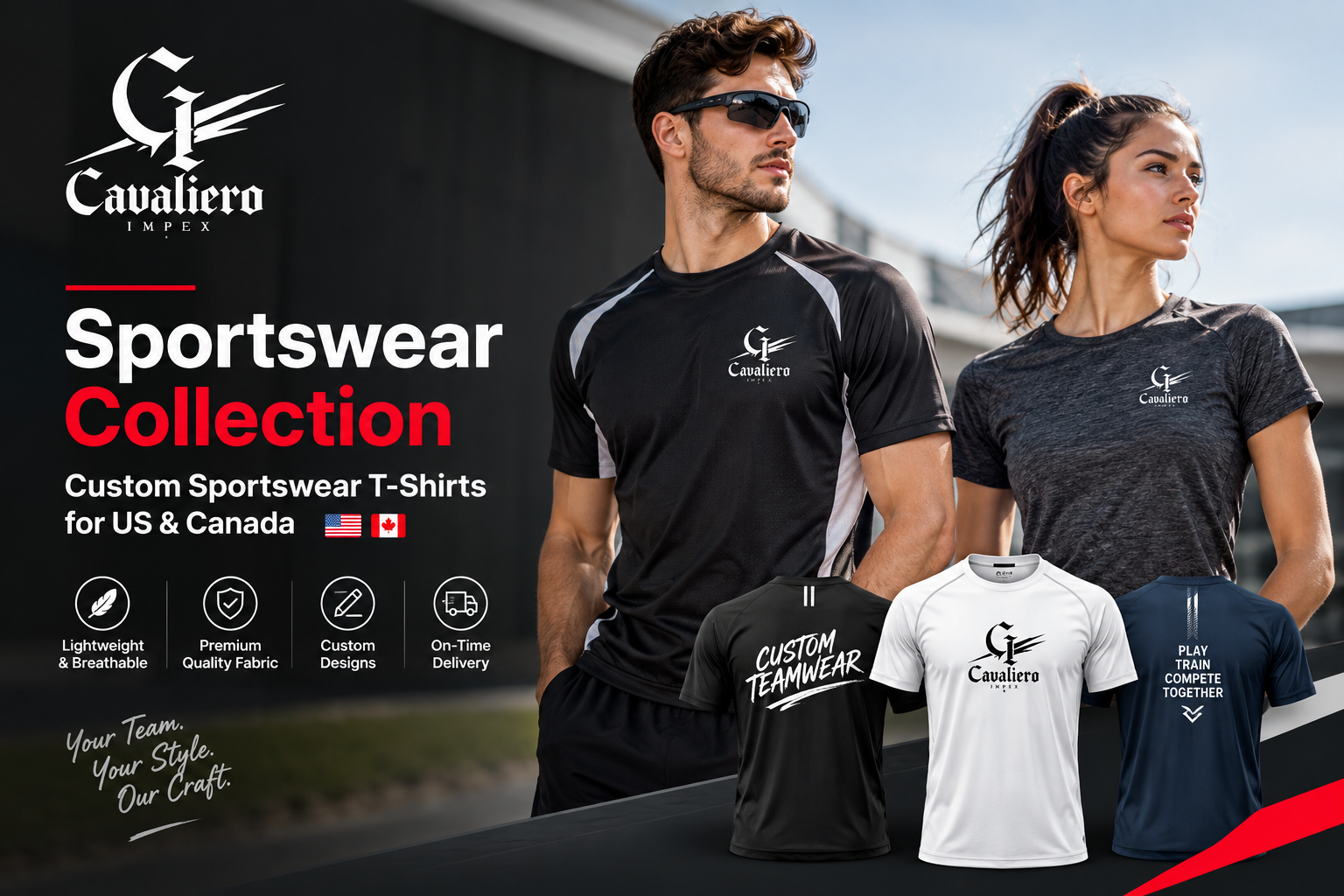
Explore Our Sportswear Collection for Custom Sportswear T Shirts in the USA and Canada
How clubs, schools, leagues, and private label brands can create a sportswear t shirts collection using a custom manufacturer rather than buying from a stock catalog
Quick answer: A strong sportswear collection consists of moisture-wicking performance tees, cotton-blend everyday tees, and shorts, hoodies, and warm-ups in matching styles decorated with your brand, and buyers who want their own designs, team colors, and a private label rather than a reseller’s stock catalog should work with a custom sportswear manufacturer that offers in-house sublimation, screen printing, and embroidery, MOQs around 50–150 units per style, and correct labeling for the US and Canada.
A sportswear t shirts collection typically includes three fabric tiers: performance polyester, cotton blends, and tri-blends
Sublimation suits full-color team designs, while screen printing and embroidery suit logos, crests, and numbering
Private label production lets you own the design, colors, labels, and packaging rather than reselling someone else’s catalog
MOQs of 50–150 units per style are realistic for a first collection with most established manufacturers
Colors, sizes, and decoration methods multiply cost, so a focused first collection performs better than a sprawling one
US shipments need FTC labeling and formal customs entry, and Canadian shipments need bilingual fiber content labeling
Approve a pre-production sample and a washed print sample before any bulk order
At Cavaliero Impex, we manufacture sportswear alongside hoodies, tees, bottoms, streetwear, and leatherwear for private label brands across North America. This guide explains how to plan a sportswear collection from fabric to freight, and what to check before you commit to a manufacturer. It is long on purpose: sportswear orders are usually tied to a season, a tournament, or a launch date, and mistakes found late are expensive to fix.
What a Sportswear Collection Includes for Teams, Clubs, and Brands
A sportswear collection is more than one shirt in several colors: buyers usually think in “programs”, a core set of pieces that can be reordered each season and mixed across sports, schools, or retail channels.
Core Pieces in a Sportswear T-Shirts Collection
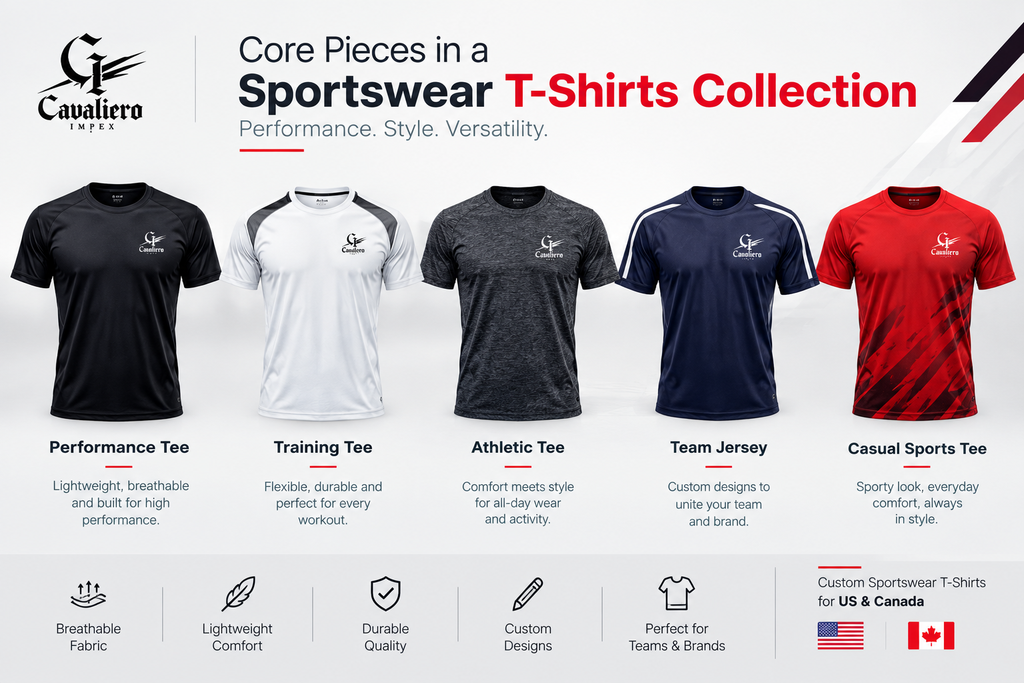
- Performance tees: lightweight polyester with moisture management, used for training and match days
- Cotton-blend tees: softer everyday shirts for fans, staff, and spirit wear
- Tri-blend tees: a premium, drapey option for lifestyle and fan merchandise
- Long sleeve tees: layering pieces for cooler seasons and outdoor training
- Shorts and bottoms: matched to the same color palette
- Hoodies and warm-ups: outer layers that complete the collection
Why Collections Beat One-Off Orders
Ordering a full sportswear collection at once keeps colors, fabric, and branding consistent across every piece. Mixing pieces from different suppliers is where mismatched shades and inconsistent logos usually appear. A single manufacturer producing the whole program can also hold your patterns, approved fabrics, and print files on record, which speeds up every later reorder.
Who Builds a Sportswear Collection and What Each Buyer Needs
The same phrase, “sportswear collection”, means different things to different buyers. Knowing which type you are shapes almost every decision that follows.
Schools, Clubs, and Leagues
These buyers care most about consistent team colors, youth and adult sizing, names and numbers, and delivery before a season starts. Budgets are often fixed, so price per unit and reorder reliability matter as much as design.
Team Stores and Distributors
Store owners and distributors usually sell to many teams at once. They need dependable quality, a wide color and size range, and a manufacturer that can support recurring reorders without re-developing each style.
Private Label Sportswear Brands
Brands building their own athletic label care about fit, fabric hand-feel, and exclusive designs. They usually want custom neck labels, hang tags, and packaging so the product looks like theirs from the first unboxing.
Corporate and Event Buyers
Companies ordering sportswear for staff, events, or promotions often need smaller runs, quick approval, and clean logo placement. Print quality and delivery timing matter more than technical fabric specs.
Fabrics for a Custom Sportswear T-Shirts Collection
Fabric choice decides how a shirt feels, how it performs, and which decoration methods will work on it.
Performance Polyester
Performance tees are typically cut from lightweight polyester in roughly the 130–160 GSM range, chosen for breathability and quick drying. Polyester is also the best base for full-coverage sublimation, because sublimated ink bonds into polyester fibers rather than sitting on top of them.
Cotton Blends and Tri-Blends
Everyday fan and spirit shirts usually use cotton or cotton-polyester blends, often around 160–200 GSM. Tri-blends add a softer, drapier hand and a slightly heathered look. Ask for physical swatches, because two fabrics with the same GSM can feel very different in the hand.
Cotton Content and Shrinkage
Higher cotton content usually feels softer but shrinks more, while higher polyester content holds its shape better across washes. Request shrinkage expectations for the exact blend being quoted, especially for large orders where small size variation becomes a customer complaint.
Performance Claims Need Proof
Terms like “moisture-wicking” and “anti-odor” are easy to print on a label and harder to verify. If you plan to make performance claims to your own customers, ask what testing supports them and keep the documentation, so your marketing stays accurate.
Fabric Testing
Retail and school buyers often ask for colorfastness results run against AATCC test methods, and some request materials certified under OEKO-TEX. A serious manufacturer should be able to supply this documentation on request rather than promising it verbally.
Pilling and Surface Durability
Sportswear is washed often, so surface wear matters. Ask how the manufacturer checks pilling and abrasion on the fabric, and request a washed sample to see how the fabric looks after repeated cycles rather than only when new.
Fit, Cut, and Sizing for Sportswear
Athletic Fit vs. Relaxed Fit
Performance tees are often cut closer to the body to move with the athlete, while fan and lifestyle tees are cut more relaxed. Decide the intended fit before sampling and document it with measurements, not just words like “athletic” or “regular.”
Youth, Adult, and Women’s Cuts
School and club programs often need youth and adult sizes, and many also need women’s or unisex cuts. Each additional size range needs its own graded pattern, so confirm what is included in your quote.
Extended Sizes
If your customers include larger sizes, plan for them from the start. Extended sizes affect fabric usage, pricing, and pattern grading, and are much easier to build in at the beginning than to add later.
Graded Spec Sheets
Ask for a graded spec sheet covering the full size range you plan to sell, not only the sample size. Grading errors often go unnoticed in a single sample and only appear when the full size run is produced.
Sublimation
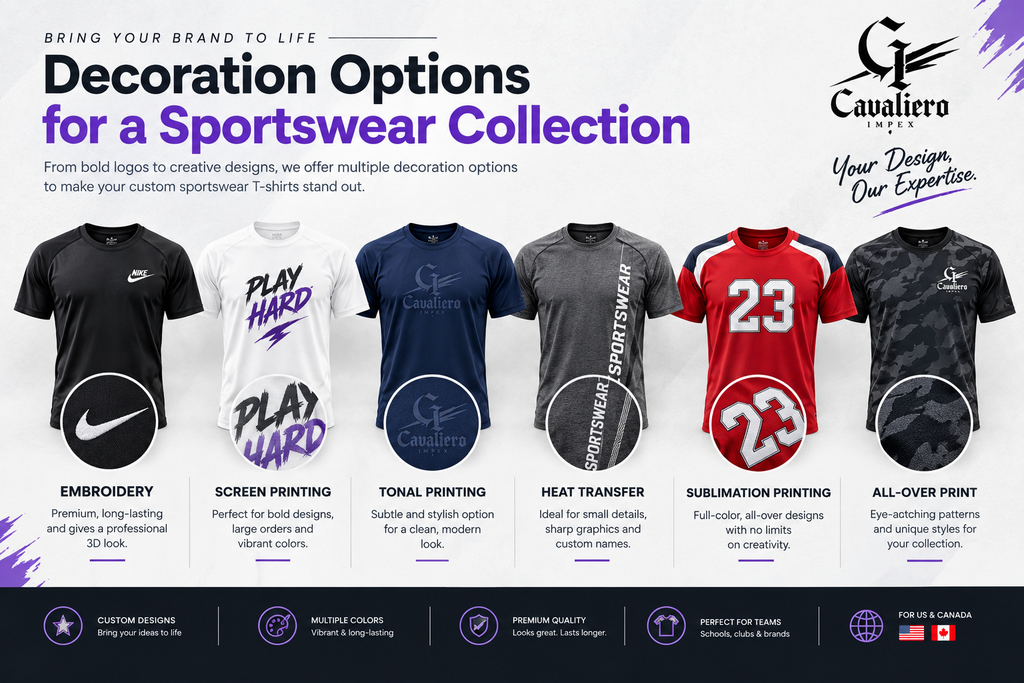
Best for all-over designs, gradients, and full-color team graphics on polyester. Design files need to be prepared for the specific garment pattern so the print aligns across seams. Ask for a washed sample to confirm the colors do not fade and the print does not crack.
Screen Printing
Best for chest logos, back graphics, and repeat runs of simple designs on cotton-blend tees. Ink type and curing quality decide how well the print lasts, and registration between colors is the main quality differentiator.
Embroidery
Best for small crests and logos on polos, caps, and jackets. Stitch density and thread quality decide how crisp the logo looks after repeated washing.
Heat Transfers and Specialty Finishes
Heat transfers and specialty finishes can suit small runs or unusual effects, though durability varies. Confirm how they perform after washing before committing a full design.
Names and Numbers
For team programs, confirm how the manufacturer handles individual names and numbers, and how errors are caught before shipping. A clear roster spreadsheet and written confirmation before production begins prevents most mistakes.
Color Matching
Team colors need to match across every piece. Manufacturers typically work against Pantone references or lab dips so a navy tee and a navy short do not arrive in two different shades. Screen displays vary, so approve color on a physical swatch, not a digital mockup.
Searching for Augusta Sportswear T-Shirts? What US Team Buyers Compare
Many US coaches, school buyers, and team store owners search for terms like “augusta sportswear t shirts collection” because they are looking for affordable wholesale team tees in many colors and sizes. Augusta Sportswear is an established US brand with its own catalog, and Cavaliero Impex is an independent manufacturer with no affiliation to it. If you are comparing options, this is how the two approaches differ in practice.
Buying from a Stock Catalog
A stock wholesale catalog is convenient when you need standard styles quickly and only want to add your logo. You choose from existing shirts, colors, and sizes. The trade-off is that the shirt itself is not yours, so you cannot change the cut, fabric, or labels, and other teams and stores may be selling the same base shirt.
Working with a Custom Manufacturer
A custom manufacturer builds the garment to your specification, so the shirt, fit, fabric weight, neck label, and packaging can all be your own. This suits brands, leagues, and stores that want a private label, exclusive designs, or a fit that stock catalogs do not offer. The trade-off is that you need a tech pack, a sampling round, and enough lead time.
Which Route Fits Your Situation
Choose a stock catalog when speed and standard styles matter most. Choose a custom sportswear manufacturer when you want your own brand, exclusive designs, or a repeatable collection you can reorder under your own label. Many buyers use both: stock basics for urgent orders and a custom line for their signature pieces.
Questions to Ask When Comparing
- Can I change the fabric, cut, and labels, or only add decoration?
- What are the minimums per style and per color?
- How long do sampling and production take?
- Who owns the design files and patterns?
- What are the labeling and customs responsibilities for my market?
- Private Label Details That Make a Collection Feel Like Your Brand
- Custom Neck Labels and Printed Neck Tags
A printed or woven neck label carries your brand and the required fiber content and origin information. Confirm label content and language requirements before production, especially if you sell in Canada.
Hang Tags and Packaging
Hang tags, poly bags, and folding presentation all shape how customers perceive the product. Many manufacturers can source these with the garments, but confirm whether they are included in the quote or priced separately.
Consistent Branding Across Pieces
Logo size and placement should follow a written brand guide so every piece in the collection looks intentional. Share the guide with the manufacturer at the start, not after the first sample.
MOQs and Pricing for a Private Label Sportswear Collection
Realistic MOQs
Most established manufacturers can accommodate 50 to 150 units per style for a first order. Confirm whether the minimum applies per style or per style-color combination, since a collection with many colorways can quickly multiply the total quantity you need to order.
What Drives Price
- Fabric weight and composition: heavier or specialty fabrics cost more per unit
- Decoration method and print colors: sublimation, multi-color screen prints, and embroidery each price differently
- Labels and packaging: custom neck labels, hang tags, and poly bags add per-unit cost
- Size range: extended and youth sizes add pattern and fabric complexity
- Order volume: larger orders spread setup and sampling costs across more units
Ask for an Itemized Quote
An itemized quote separating fabric, decoration, labels, packaging, and freight terms makes it possible to compare manufacturers fairly. A single bundled price makes it easy to miss what is and is not included.
Be Careful with Very Low Quotes
A quote far below every other offer often reflects lighter fabric, weaker decoration, or missing items rather than genuine savings. Compare quotes at the same fabric weight, decoration, and packaging specification.
From Tech Pack to First Sample
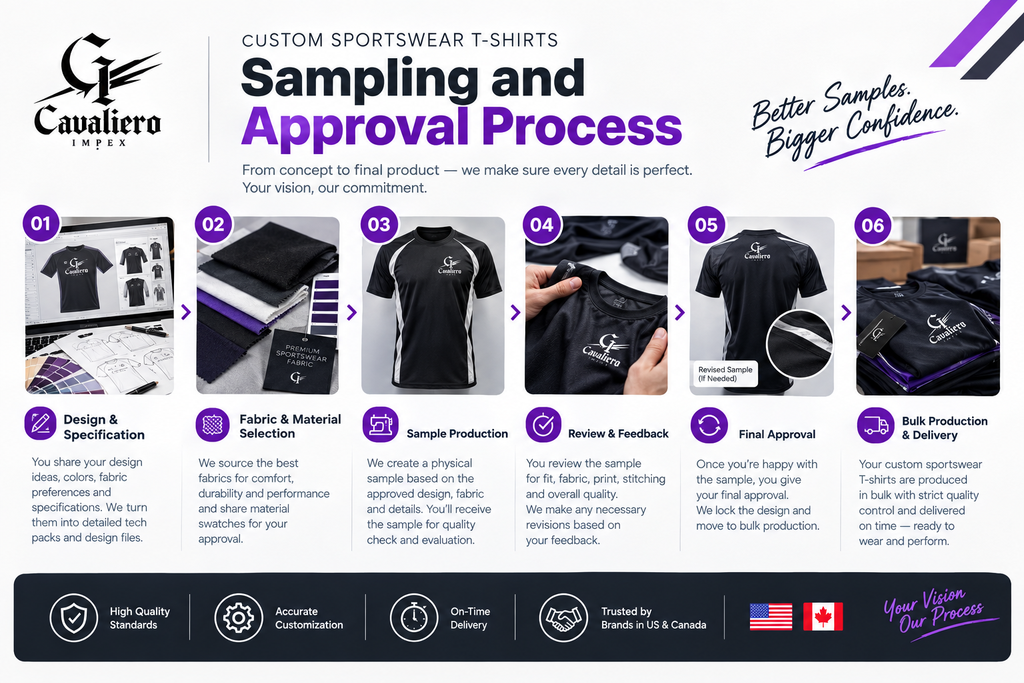
A tech pack with measurements, fabric details, colors, and decoration placement gives the manufacturer what it needs to produce an accurate first sample. An in-house sampling team can often produce a first sample within one to two weeks of a finalized tech pack.
Revision Rounds
Two to three revision rounds are common. What matters is how clearly the manufacturer documents each change and applies it to the next round rather than restarting from scratch.
Pre-Production and Washed Samples
Approve a pre-production sample against your tech pack before bulk cutting begins, and request a washed sample of every printed or sublimated design. Skipping either step is one of the most common causes of unwelcome surprises in bulk production.
Sample Costs
Clarify whether sample costs are charged separately, credited against a bulk order, or waived. Neither approach is wrong, but it should be agreed before samples are requested.
Quality Control for a Sportswear Collection
- Approve a pre-production sample against your tech pack before bulk cutting
- Request a washed sample of every printed or sublimated design
- Ask whether inspection happens in-line or only as a final check
- Confirm the inspection standard, such as an AQL level for ISO 2859-1
- Ask about the manufacturer’s general quality system, for example, its adherence to ISO 9001
- Confirm all labeling and packaging details in writing before production
In-Line vs. Final Inspection
Some manufacturers only inspect finished goods, which means a stitching or measurement error will not be noticed until after bulk production is complete. In-line inspection identifies and halts the production of defective items at an earlier stage.
Handling a Failed Inspection
Ask in advance what the policy is for failed inspection, such as whether rework, partial rejection, or a price discount applies. Having this information in advance makes any necessary follow-up easier.
Production Timeline and Seasonal Planning
Sportswear has a seasonal nature: fall sports, back-to-school, and spring leagues all have strict deadlines. Here’s a suggested production timeline for the first order:
Weeks 1-2: sourcing discussion, tech pack review, and itemized quote
Weeks 2-3: first sample production and shipping
Weeks 3-4: sample revisions and pre-production approval
Weeks 4-5: bulk production, decoration, and in-line inspection
Weeks 6-7: final inspection, labeling, and packaging
Week 7+: freight and customs (sea freight adds several more weeks)
Build In Buffer Time
Build in buffer time, as a late freight can be much more expensive than a delayed seasonal launch. Order early when possible, as manufacturers’ capacity is often constrained before peak seasons.
Rush Orders
Rush timelines may be possible but come at a significantly higher price and with less room for sampling. If you have a hard deadline, start the conversation well in advance.
Importing a Sportswear Collection Into the United States
FTC Labeling
FTC regulations require fiber content, country of origin, and care labeling for clothing sold in the US. A manufacturer with experience exporting to the US will know to include this information in the production rather than leaving it to you at the end.
Customs Entry and Duties
Customs entry and duties now require formal entry and an HTS code, as the Section 321 de minimis exemption was suspended in 2025. Buyers who previously took advantage of the low-value shipment exemption should budget in extra lead time for all shipments.
Tariffs Change
Tariff rates and duty exemptions are subject to change yearly, so inquire with a customs broker or the HTS lookup tool at USITC for the most current information rather than relying on a quote from months earlier.
Customs Brokers and Ports
A US customs broker, rather than the manufacturer, clears shipments with the CBP on your behalf and manages duties. Goods tend to arrive at West Coast or East Coast ports, depending on the route; set this up in advance with a customs broker.
Importing a Sportswear Collection Into Canada
Labeling
The Textile Labelling Act requires fiber content in both official languages, with French labels being particularly relevant for Quebec. Care labeling is optional but must be accurate if included.
Customs Entry and Duties
Shipments must go through the Canada Border Services Agency (CBSA), which has its own set of tariffs and duties. Do not assume that duties or tariff classifications are the same as in the US.
Sportswear Sourcing Into Both Countries
If you intend to sell in both countries, ensure that labels and documentation comply with the regulations of both countries at the time of inspection. In particular, fiber content, care instructions, and language may need to be adapted for the Quebec market.
Freight, Insurance, and Landed Cost
Air vs. Sea Freight
Air freight is much faster but comes at a significantly higher cost per unit. It is suitable for small urgent orders, while larger ones benefit from the lower price of sea freight.
Cargo Insurance
Confirm whether the declared value of the shipment is covered by default or ask to speak to the carrier directly about the terms, especially for your first order.
Calculate Landed Cost
Compare landed cost rather than the unit price when reviewing quotes, as freight, duties, and brokerage can add significantly to the final price.
Ethical Sourcing and Compliance
Buyers for Schools, Leagues, and Retail
Ethical sourcing is a growing concern among schools, leagues, and retailers, so ask whether working conditions have been audited by a third party (Sedex, WRAP). Ask about the possibility of organic cotton (GOTS-certified) if sustainability is important to you. If you plan to make sustainability claims about the production, agree on the documentation and records that will be provided to you in advance.
- Red Flags When Choosing a Sportswear Manufacturer
- Washed sample was not offered for printed or sublimated designs
- Not willing to itemize the quote
- Unwillingness to answer specific questions about the production process
- Asking for full payment upfront for first-time orders with no samples
- No experience exporting to the US or Canada
- Print or color quality changes drastically between sample rounds
- Common Mistakes Buyers Make
- Choosing a Manufacturer Based on Price Alone
Low-price quotes may involve hidden costs: rework, rush fees, and the impact on your own customers if the manufacturer fails to deliver.
Overcomplicating the First Collection With Too Many Colors and Styles
Every additional colorway and style increases complexity, minimums, and the potential for error. Save your first collection lean and focused on one or two key pieces that can be reordered in multiple colors.
Skipping the Sample Approval Process Entirely
Moving on to bulk production based on an earlier sample can result in “spec drift,” where the finished goods are substantially different than the original design.
Leaving Labeling Details Until the End
Waiting until production is nearly complete to review the US or Canadian labeling requirements can add significant time to the timeline if a relabeling pass is needed.
Not Documenting Every Agreement in Writing
Follow up every verbal or chat conversation about pricing, timelines, or specifications with a confirmation email. This avoids misunderstandings if one side forgot what the other thought had been agreed upon.
Building a Repeatable Collection Over Multiple Seasons
Keep Records of Approved Specifications
Save your approved tech packs, fabric swatches, color references, and print files for future collections. A manufacturer that keeps records of prior specifications can produce future reorders more quickly and cheaply than one that treats every order as new.
Reorders of Popular Items
Ask about the reorder policy and general lead time well in advance, rather than waiting until a style has sold out.
Growing Your Collection Year after Year
Build on your original collection in subsequent seasons by adding new styles and colors. Let the manufacturer know in advance approximately when you expect to launch additional styles so that they can reserve production capacity.
Glossary of Sportswear Sourcing Terms
GSM (grams per square meter) is a measure of fabric weight, with higher GSM generally indicating a heavier fabric. MOQ (minimum order quantity) refers to the lowest quantity that a manufacturer will produce, either across styles or per unit. Sublimation is a printing process that involves heat transferring dye onto polyester fabric, often used for large team graphics. Tri-blend is a fabric blend of three fibers, often including cotton, polyester, and rayon, that has a soft hand feel.
PP Sample refers to a pre-production sample, which is reviewed and approved before bulk manufacturing starts. AQL (acceptable quality level) is a standard for quality control inspection that determines the maximum percentage of defective items allowed for a given lot size. Tech pack refers to a technical specification document for a garment. HTS (harmonized tariff schedule) is the duty classification system used in the United States. CBSA (Canada border services agency) is the customs authority for Canada.
Sport-Specific Considerations for a Sportswear Collection
Sports teams and leagues typically have unique requirements for their sportswear, which should ideally be incorporated into the collection. Some considerations by sport are listed below:
Soccer, Football, and Field Sports
Lightweight polyester is common, as are numbered kits with sublimated prints that can withstand heavy washing. Ask about the construction of the underarm and hem, as these are the parts that are stretched the most during movement.
Basketball and Indoor Sports
Loose-fitting indoor t-shirts and shorts are more breathable and allow for a greater range of motion. Again, the underarm and hem should be examined closely. The more movement the garment allows, the more likely it is to require special construction, such as longer side seams.
Baseball and Softball
These sports use a wide variety of tops, from traditional jerseys to warm-up t-shirts. Decoration methods such as embroidery or heavier sublimation are often seen on the outerwear pieces. Ask about the location of any printed or embroidered decoration in relation to seams and buttons.
Running, Training, and Gym Wear
Moisture-wicking fabric and flatlock stitching prevent irritation from chafing, and tagless or printed neck labels contribute to the comfort of the garment. Mention these considerations in your tech pack or during your sourcing discussion.
Cheer and Dance
Cheerleading and dance wear often feature bright sublimated decorations or sets of coordinated pieces. The fit and sizing is often more important than any single element, as these garments are worn as outfits.
Sportswear For Retail Brands: Positioning and Product Pages
Fit Information Sells Sportswear
Customers who shop online for sportswear are likely to return an item if the fit was not what they expected, so it is important to provide detailed fit information. Set out a measured size chart based on your graded spec sheet alongside a description of how the garment fits.
Photography and Sample Quality
Use production samples for photography so the image reflects what the customer will actually receive. Confirm in advance that the manufacturer is able to provide production samples for photography and content creation.
Claims and Descriptions
Be specific about the fabric and properties of the garment. Only make claims that can be substantiated, such as moisture-wicking or sun-protection properties, and ensure that any supporting documentation matches the fiber content.
Reorder Planning for Bestsellers
Sportswear bestsellers sell out quickly, so ask about the reorder lead time before launch so that you know how long it will take to receive a second stock.
Care Instructions for Customers
Providing care instructions protects both the customer and the seller by ensuring that the garment is worn and cared for correctly. Sublimated polyester tends to withstand regular washing better than cotton blends, but high heat can damage elastic trims and certain print finishes. Washing garments inside-out in warm water (not hot) is less damaging to the fabric. Ask the manufacturer about garment-specific care instructions and print them on the garment’s label rather than providing general advice.
Warranty and Returns Considerations
Agree on a manufacturing defect warranty with your manufacturer before any bulk orders are produced. This entails determining what constitutes a manufacturing defect (e.g., failure of a seam or print to hold under normal conditions) and how long the warranty period lasts. This differs from damage that occurs due to incorrect care, which should be specified separately. If you sell directly to consumers, set your own return policy with these distinctions in mind and keep records of any photos and communications with the manufacturer in case of a dispute.
Working with an Overseas Sportswear Manufacturer Remotely
Most North American buyers work with manufacturers on the other side of the world and do not visit the factory in person. A video tour of the production facility, print shop, or sample in progress can give insight into the manufacturer’s operations, and their willingness to do so is often an indicator of their general reliability. It is also important to establish time zones for sampling and approvals, and for important conversations. Follow up any verbal or chat discussion with an email summary for both parties’ records. If you are new to overseas sourcing, you may want to consider a third-party inspection on large orders.
Comparing Manufacturing Regions for Sportswear
Large manufacturing hubs are typically focused on high-volume, low-complexity basics for major retailers. More nimble manufacturing regions, including sportswear and knitwear specialty hubs like Sialkot, offer greater flexibility for smaller orders and more complex customization. It is hard to say which is better: a high-volume manufacturer may be necessary if you need tens of thousands of basic t-shirts, whereas a lower-volume one may be able to accommodate your requests for printed designs and intricate construction better.
A Closer Look at Sportswear Pricing
Fabric
Fabric is typically the largest cost component for any garment, and it is important to understand how pricing is determined in this area. The weight and material of the fabric influence the price per square meter, with higher GSM generally correlating with a higher price.
Decoration
The decoration method influences the price: sublimation pricing is often affected by the complexity and size of the design, screen printing pricing is influenced by the number of colors and size of the print, and embroidery pricing is dictated by the number of stitches and colors.
Labor and Construction
More complex styles require more labor to construct and therefore command a higher price per unit. A simple men’s or women’s t-shirt will generally be cheaper than a garment with extra panels or detail.
Packaging and Labels
Extra tags, neck labels, and poly bags are additional costs that should be itemized separately.
Volume and Reorders
Higher volumes typically have a lower price per unit. Reorders of existing styles generally carry a lower price per unit than styles produced for the first time, as well as shorter lead times, as there is no need for sampling.
A Simple Framework for Comparing Manufacturer Quotes
Prioritize manufacturers that demonstrate a good understanding of your requirements. A few common criteria include transparency about fabric quality, construction, and print capabilities; good sample approval process; willingness to work within your MOQ; responsiveness to your requests; and experience with exports to the US/Canada and labeling requirements. Remember that a slightly higher price from a more reliable manufacturer can be preferable to a lower price from one that cannot deliver what you need within your timeline.
How to Prepare a Tech Pack for a Sportswear Collection
A good tech pack enables you to get a fast and accurate first sample from any custom apparel manufacturer. It does not need to be complicated, but it should leave little room for error.
What to Include
Design sketches or electronic files showing the front, back, and sleeve views; garment measurements in a graded spec sheet; fabric details such as fiber content, GSM, and desired hand feel; color references in Pantone format or swatch; decoration placement and size for logos, numbers, and graphics; label and trim details including neck label, care label, and hang tag; and construction details such as seam type and hem finish are useful additions.
Common Tech Pack Gaps
Measurements, logo placement, and color references are the most common causes of extra sample rounds, which is why a manufacturer with technical expertise will ask about them if they are not specified. It is preferable to a manufacturer that does not ask — and therefore produces a sample that does not meet your requirements.
How Quality Problems Show Up, and How to Catch Them Early
Most common quality issues fall into a few categories, and asking the right questions can help you identify potential red flags.
Print Problems
Cracking, peeling, fading, and misaligned seams are signs of a print problem that usually show up after washing the garment. This is why a washed sample is so important: it identifies these issues before bulk printing.
Fabric Problems
Uneven shrinkage, color variation between fabric lots, and pilling are signs that the manufacturer sources fabric inconsistently. Ask whether they work with the same fabric suppliers year-round rather than buying from different ones as needed.
Construction Problems
Twisted seams, uneven hems, and weak stitching show up at the inspection stage and are caused by cutting or sewing errors.
Sizing Problems
Inconsistent sizing within a size range is usually the result of incorrect grading. A graded spec sheet and measurement check during inspection can help avoid this issue.
Labeling Problems
Incorrect fiber content, missing country of origin, or missing French language content for Canada are preventable errors that can delay your order.
Building a Brand Story Around Your Sportswear Collection
A sportswear collection needs to tell a story that resonates with buyers. Decide what kind of positioning you would like to use for your sportswear collection and build on that narrative. Does it focus on performance, community, or heritage? Do you want to offer value-priced basics or designer-level customizations? Your positioning will shape the materials, designs, and presentation that you choose for your collection.
Keep the Message Accurate
If you intend to make specific claims or promote your sportswear in a particular way, ensure that you have accurate information and supporting documentation. Ask the manufacturer about what promotional claims they can support and what information they can share with you.
Limited Runs and Drops
If you intend to offer drops or limited runs of sportswear, ensure that the promised quantity matches the actual quantity. Customers are likely to notice if there are drastically more pieces available than promised.
Team and Community Programs
Schools and leagues that purchase sportswear for their teams and students appreciate consistency in team colors and reliable reorder options. A manufacturer that can hold fabric in stock and produce garments to the same specifications every year helps to maintain this consistency.
Pre-Order Checklist for a Sportswear Collection
Before placing the bulk order, make sure that the following points have been addressed and documented:
- Final tech pack approval, including graded spec sheet
- Fabric composition and GSM approval
- PP sample approval
- Washed sample approval for every printed or sublimated design
- Color reference approval on swatch
- Label approval for the US, Canada, or both
- Packaging, hang tag, and polybag approval
- Payment terms and shipping terms approval
- Inspection standard and defective handling approval
- Estimated delivery date and buffer time approval
- Customs broker setup for destination country
- Sizing Across the US and Canada
American and Canadian sizing are similar in most respects and can generally be treated as one. However, ensure that the manufacturer uses a North American size chart for grading rather than a different regional chart if you are unsure. Check the graded spec sheet against actual garment sizes before bulk production begins.
How to Start Your Sportswear Collection with Cavaliero Impex
The ordering process for Cavaliero Impex is designed to be as simple as possible for first-time buyers. The goal of the first conversation is to give the manufacturer enough information to provide an accurate quote, while also learning more about what they can offer.
Step 1: Share Your Concept and Quantities
Send in a brief message telling us who the collection is for, what you need, approximate quantities, and your deadline. Attach any design references or tech pack if you have any. If you are unsure what you need, let us know: a good manufacturer will not assume anything you did not ask for.
Step 2: Review the Itemized Quote
Ask us to provide an itemized quote for the garments. Use this to compare the quote to the specifications you provided, rather than focusing on the final price. You can browse the existing catalog on the Cavaliero Impex shop to see what we offer.
Step 3: Approve Samples
Approve the pre-production sample and any washed prints before bulk production begins. Keep track of every approval in writing so that you and the manufacturer have a clear idea of what has been agreed upon. If you have concerns about something that was not clear in the description, ask for a video call to discuss the details. You can contact us through the website to set one up.
Step 4: Plan Labels, Customs, and Freight
Review the US or Canadian label requirements and decide on your freight option. Set up a customs broker for the destination country. The blog on the Cavaliero Impex website contains more information on leather jackets, streetwear, and import/export regulations if you need extra guidance.
Step 5: Reorder and Grow
Once your first collection is complete, use the specifications you saved to reorder popular styles and plan new designs. Buyers who provide feedback and growth plans ahead of time tend to get better support, as manufacturers can set aside production capacity for repeat orders.
Frequently Asked Questions
What is included in a sportswear collection?
Typically performance tees, cotton-blend tees, long sleeves, shorts or bottoms, and hoodies or warm-ups, all in a matching color palette and branding.
What fabric is best for sportswear t-shirts?
Lightweight polyester suits training and match days and supports sublimation, while cotton blends suit fan and everyday wear.
What is the difference between a stock catalog and a custom manufacturer?
A stock catalog sells existing styles you decorate, while a custom manufacturer builds the garment to your specification under your own label.
Can I get my own design and label instead of buying stock shirts?
Yes. A custom manufacturer can produce your own design, fit, neck label, and packaging under your brand.
What is a realistic MOQ for a first sportswear order?
Most manufacturers can accommodate 50 to 150 units per style, though this varies by fabric and decoration.
How long does sampling take?
An in-house sampling team can often produce a first sample within one to two weeks of a finalized tech pack.
Do I need a washed sample?
Yes, for any printed or sublimated design. It shows how colors and prints hold up after laundering.
Do US and Canada require different labels?
Yes. The US follows FTC labeling rules, while Canada requires fiber content in both English and French.
Do I need a customs broker?
For US imports, a customs broker typically files entry and handles duties on your behalf. Canadian shipments have their own entry process through CBSA.
How should I compare manufacturer quotes?
Compare at the same fabric, decoration, and packaging specification, and calculate landed cost including freight and duties.
Can I order name and number personalization for teams?
Yes, but confirm the roster process and error-checking steps with the manufacturer before production.
How early should I order for a fall season?
Start the conversation well ahead, since sampling, production, and sea freight together take many weeks and capacity tightens before peak seasons.
Is Cavaliero Impex affiliated with Augusta Sportswear?
No. Cavaliero Impex is an independent manufacturer. Augusta Sportswear is a separate US brand.
Can I reorder the same style later under my own label?
Yes, especially if the manufacturer keeps your approved patterns, fabrics, and print files on record.
What should be in a sportswear tech pack?
Flat sketches, measurements with grading, fabric details, color references, decoration placement, labels and trims, and construction notes.
How do I avoid print cracking or fading?
Request a washed sample before bulk approval and confirm ink type, curing, and sublimation process with the manufacturer.
Can one manufacturer produce tees, shorts, and hoodies for the same collection?
Many can, which helps keep colors and branding consistent across pieces. Confirm capability for each product type before ordering.
How many colors should a first collection include? Fewer is usually better. A focused palette keeps minimums manageable and makes reorders simpler.
Can I see how my logo will look before bulk production?
Yes. Approve a physical sample with your actual decoration, not just a digital mockup.
Final Thoughts: Building a Sportswear Collection with Confidence
The best sportswear collections start with clear decisions: who the buyer is, which pieces the program needs, which fabrics and decoration methods fit those pieces, and how much lead time the season allows.
A manufacturer that answers specific questions about fabric, sampling, and labeling with equally specific answers is showing you what the working relationship will be like once real money and real deadlines are involved.
For US and Canadian buyers, build labeling and customs into the conversation from the start, approve samples before bulk production, and keep records of everything you approve.
Those habits prevent most of the delays and surprises that turn a simple order into a stressful one.
Ready to build your own sportswear collection? Browse our shop, read more on our custom apparel manufacturing page, explore the Cavaliero Impex blog, or get in touch to discuss your next order.