

Building a Long-Term Relationship with Your Custom Streetwear Manufacturer
What American and Canadian streetwear brands should know before sourcing bulk or private label hoodies, tees and joggers overseas
Quick answer: A reliable custom streetwear manufacturer should offer direct fabric sourcing, in-house screen printing and embroidery, flexible MOQs starting around 50-150 units per style, accurate size grading, and correct labeling for shipments entering the United States or Canada.
Key Takeaways
- Streetwear buyers should prioritize fabric hand-feel, print quality and fit accuracy over technical performance specs
- MOQs of 50-150 units per style are realistic for a first test order with most established manufacturers
- All-over prints, oversized fits and unique wash treatments need close sample review before bulk approval
- Packaging and unboxing presentation matters more in streetwear than in most other apparel categories
- US-bound shipments need FTC country-of-origin and care labeling; Canada-bound shipments need bilingual (English/French) fiber content labeling
- A pre-production sample should always be approved before bulk cutting begins
At Cavaliero Impex, we manufacture streetwear alongside hoodies, tees, team sportswear, bottoms and leatherwear for private label brands across North America. This guide covers what a growing streetwear label should be looking out for before committing to a custom streetwear manufacturer — from fabric and fit through to the labeling and customs rules that apply when a shipment actually arrives in the US or Canada.
Why Streetwear Sourcing Needs a Different Lens Than Basic Apparel
A custom streetwear manufacturer needs to deliver on things a basic apparel supplier doesn’t necessarily prioritize: exact fit on oversized silhouettes and accurate all-over print registration, and design-specific wash or distressing treatments that need to look intentional rather than inconsistent across a bulk order.
Fabric Hand-Feel Matters More Than Spec Sheets
Streetwear customers base a garment’s value on how it feels and drapes as much as on its fabric technical specs. So a manufacturer that can speak to hand-feel, not just provide fabric swatches before bulk dyeing, is a better fit for streetwear-specific design intent.
Fit and Silhouette Accuracy
Oversized, boxy, or drop-shoulder silhouettes common in streetwear need precise pattern work to look intentional rather than simply “too big”. A manufacturer experienced with streetwear specifically should be able to execute a graded spec sheet that keeps the proportions consistent across the full size range, not just the sample size — this is part of what happens during our manufacturing process, where pattern grading is checked before bulk cutting begins.
Design Trend Turnaround
Streetwear moves faster than most apparel categories in terms of design trends and drop cycles. So a manufacturer with efficient sampling and a willingness to work in smaller, more frequent production runs is a better long-term fit for a brand releasing new designs every few weeks or months, rather than one built around large, infrequent seasonal orders.
Fabric Considerations for Streetwear
GSM and Fabric Weight
Streetwear hoodies and tees commonly use heavier fabric weights than basic retail apparel — mid-to-heavyweight fleece (300-400 GSM) for hoodies and heavier cotton jersey (180-220 GSM) for tees are common streetwear benchmarks, as a heavier, more substantial fabric is strongly associated with a premium streetwear feel.
Cotton Content and Garment Wash Compatibility
Streetwear brands planning a garment-washed or enzyme-washed finish should confirm the fabric’s cotton content and pre-shrink treatment with the manufacturer, as a fabric not designed for post-production washing will shrink unpredictably or lose shape once the wash treatment is applied.
Fabric Testing and Certification
Buyers working with retail partners or larger distributors should ask whether the manufacturer can provide colorfastness test results and fabric composition reports that verify materials have been tested for harmful substances. Our manufacturing process covers this kind of fabric verification before a design moves into bulk production.
Decoration Techniques for Custom Streetwear

Screen Printing
The standard choice for large front or back graphics on tees and hoodies. Ink durability and print registration across multiple colors are the key differentiators, and buyers should request a washed sample before approving a bulk run. See our screen printing capabilities for how we handle multi-color registration and ink durability testing.
All-Over Sublimation Prints
Full coverage prints need fabric with enough polyester content to hold sublimated ink, and design files need to be prepared with the specific garment pattern in mind, to ensure the print aligns correctly across seams once cut and sewn.
Embroidery
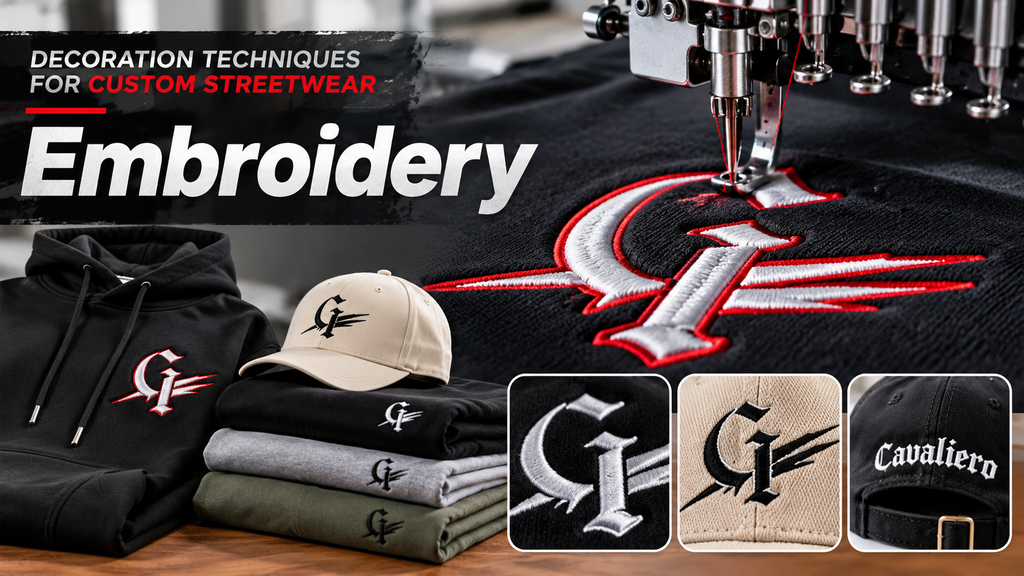
Best suited to smaller logos on the chest, sleeve, or cap, where stitch density and thread quality determine how crisp the logo looks after repeated washing — a common request for brands doing team-based personalization across a roster or club.
Puff Print and Specialty Finishes
Streetwear designs sometimes use raised puff print, glow-in-the-dark ink, or metallic finishes for a more distinctive look. These specialty techniques often have a higher per-unit cost, and require a manufacturer with specific equipment, so buyers should confirm capability and request a sample before committing a full design to a specialty finish. Our screen printing team can advise on which specialty finishes are realistic for a given design.
Wash and Distressing Treatments
Garment washes, acid washes, and distressing effects need to be tested and approved on a physical sample, as these treatments can have varying levels of intensity per batch, if a manufacturer doesn’t have a controlled, repeatable process.
Color Matching
Screen displays and printed swatches can represent color differently, which is why manufacturers work against physical lab dips for color-critical streetwear designs, particularly if a brand’s signature colorway needs to be consistent across multiple production runs — something we manage as part of our manufacturing process.
MOQs for a Growing Streetwear Label
Most established manufacturers can accommodate 50 to 150 units per style for a first test order, with pricing improving at higher volumes. Buyers should confirm whether MOQ is calculated per style or per style-color combination, as streetwear collections often launch with several colorways of the same design.
Testing New Drops at Low Volume
Streetwear brands frequently want to test a new design’s demand before committing to a full production run, as trends shift quickly in this category. A manufacturer willing to support smaller test quantities, even at a modest price premium over the standard MOQ pricing tier, is a better long-term partner for a brand that releases frequent, smaller drops rather than infrequent, large seasonal collections.
Scaling a Successful Design
Once a design proves popular, buyers should ask how quickly a manufacturer can scale into a larger reorder, and whether the original pattern, fabric sourcing, and print files are retained to get faster turnaround on repeat production. Reach out via our contact page to discuss reorder turnaround before your first production run ships.
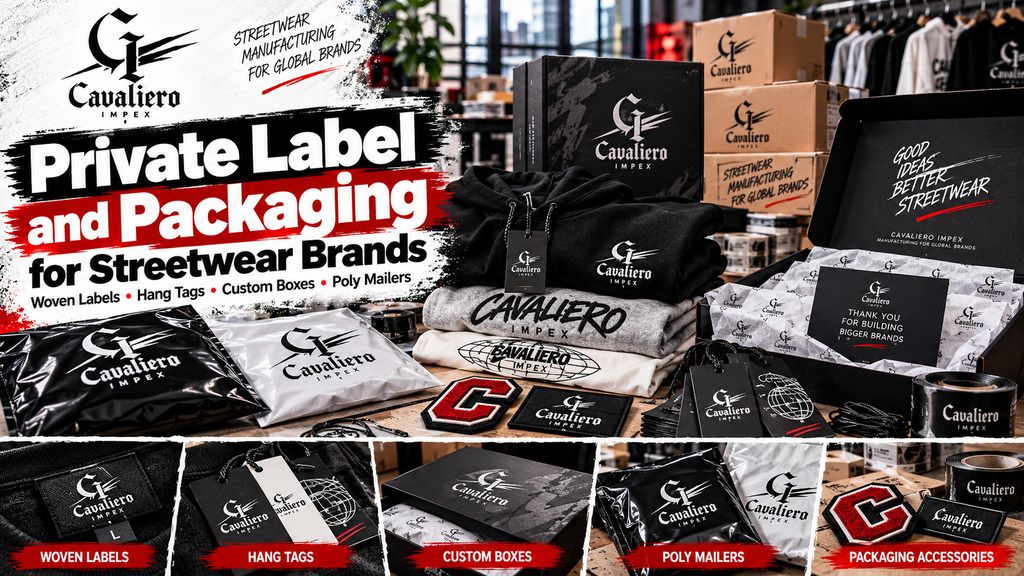
Beyond the garment decoration itself, streetwear brands care more about packaging presentation than many other apparel categories — custom poly bags, branded hang tags, and specific fold or tissue-wrap presentation all factor into the unboxing experience, and a manufacturer with private label streetwear experience should already have standard processes for this rather than it being an afterthought. Our team personalization services extend to this kind of branded packaging and labeling.
Custom Poly Bags and Mailers
Branded poly bags or mailers with a brand’s logo printed directly on the packaging are common in streetwear, and many manufacturers can source these alongside the garment order, rather than requiring the buyer to source packaging separately.
Hang Tags and Care Labels
Beyond the required fiber content and country-of-origin information, streetwear brands often use hang tags as a design element in their own right, carrying brand storytelling or drop-specific information. Buyers should confirm hang tag printing and attachment are included in a manufacturer’s private label service, as some manufacturers price this as a separate line item.
Production Timelines for Streetwear
Production timelines for streetwear generally follow standard apparel timelines, but with wash and distressing treatments, or specialty print finishes, adding extra days to the process compared to a plain garment. Buyers should ask for a timeline specific to their exact decoration and finishing requirements, rather than assuming a standard hoodie timeline applies to a heavily customized design.
Drop-Based Release Planning
As many streetwear brands operate on a drop-based release schedule rather than continuous restocking, buyers should build in buffer time before an announced drop date, as a delayed shipment is more disruptive to a hyped, date-specific launch, than to an ongoing restock of a basic product line.
Importing Custom Streetwear into the United States
FTC Labeling Requirements
Streetwear shipments need accurate country-of-origin and fiber content/care labeling under the FTC’s Care Labeling Rule. A manufacturer with US export experience will already build these labels into production, rather than as an afterthought.
Customs Entry and Duties
Every shipment now requires formal customs entry and an HTS classification, as CBP suspended the Section 321 de minimis exemption in 2025 — buyers who previously relied on the $800 duty-free threshold for smaller test orders should plan for formal entry costs on every shipment going forward. Tariff rates have shifted more than once in recent years, so buyers should confirm the current applicable rate with their customs broker or the US International Trade Commission’s HTS lookup before finalizing pricing.
Importing Custom Streetwear into Canada
Bilingual Textile Labelling
Canada’s Textile Labelling Act requires fiber content information to appear on the label in both English and French. Care labeling is voluntary in Canada, but if included, it must be accurate. Buyers selling into Quebec specifically should confirm French-language label content meets both federal and provincial requirements.
CBSA Entry and Duties
Shipments entering Canada go through the Canada Border Services Agency (CBSA), with its own tariff classification and duty schedule, separate from the US system. Buyers shipping to both markets should not assume the same HTS classification or duty rate applies on both sides of the border.
Pricing Factors for Custom Streetwear
Fabric Weight and Composition
Heavier fabric weights and specific fiber blends cost more per unit than lighter, standard blends, and buyers should expect pricing to scale with fabric weight, rather than assuming a flat rate across different GSM options.
Decoration Complexity
All-over prints, specialty finishes like puff print or metallic ink, and multi-step wash treatments all add cost relative to a basic single-color screen print. Buyers comparing quotes should confirm exactly which decoration techniques are included in a given price.
Packaging Add-Ons
Custom poly bags, branded hang tags, and specialty folding or presentation all add incremental cost per unit, that should be itemized separately from the garment price, rather than left ambiguous in a bundled quote.
Order Volume
As with most apparel categories, larger orders reduce the per-unit cost, by spreading fixed costs like sampling and initial dye lots across more units.
Sustainability and Ethical Manufacturing Considerations
Buyers often ask about working conditions and material sourcing, particularly for brands marketing to a values-conscious streetwear customer base. Buyers interested in audited facilities or organic and recycled fabric certifications should raise this directly through our contact page so it can be confirmed against a specific production run. Buyers planning to market sustainability claims to their own customers should agree with the manufacturer up front on what documentation can support those claims credibly.
Sampling Process for Streetwear
Sample Turnaround
A manufacturer with an efficient in-house sampling department, as part of a structured manufacturing process, can typically produce a first sample within one to two weeks of receiving a finalized tech pack, though wash treatments or specialty prints may extend this slightly.
Sample Revision and Wash Testing
For designs involving a wash or distressing treatment, buyers should request a washed sample specifically, not just an unwashed prototype, as the wash process itself is part of what needs approval, not just the base garment construction.
Common Mistakes Buyers Make When Choosing a Custom Streetwear Manufacturer
Approving a Design Without a Washed Sample
Skipping a washed sample for a garment-washed or distressed design is one of the most common causes of unexpected results in bulk production, as the wash treatment can change fit, color, and hand-feel in ways an unwashed sample won’t reveal.
Underestimating Packaging Lead Time
Buyers sometimes focus entirely on the garment itself, and treat custom packaging as a last-minute add-on, which can delay a shipment, if the packaging isn’t ready at the same time as the garments.
Not Confirming Labeling Requirements Before Production
Buyers who wait until a shipment is ready to ship, to confirm FTC or Textile Labelling Act requirements, risk needing a relabeling pass that delays delivery.
Quality Control Checklist for Your Custom Streetwear Manufacturer
- Confirm exact fabric GSM, composition and pre-shrink treatment in writing, before production
- Request a washed sample for any garment-wash or distressed design
- Approve a pre-production sample against the original tech pack, before bulk cutting
- Confirm packaging (poly bags, hang tags) lead time, alongside the garment production timeline
- Confirm US or Canadian labeling requirements are built into production, not added afterward
- Clarify payment terms and shipping/customs responsibilities, upfront
Comparing Regions to Find the Right Custom Streetwear Manufacturer
North American streetwear brands sourcing overseas typically compare a handful of established manufacturing regions. Larger-scale hubs are often optimized for very large, simpler bulk orders, for major retail brands, while more specialized manufacturing regions — including established knitwear and sportswear hubs like Sialkot — offer more flexibility on smaller, more customized orders, closer communication with decision-makers, and faster turnaround on frequent, smaller drops. Neither approach is universally better, it’s a matter of whether a brand needs simple basics at very high volume, or more customized, design-driven pieces, at a moderate volume.
Glossary of Streetwear Sourcing Terms
GSM (Grams per Square Meter): A measurement of fabric weight; higher GSM generally means a heavier, more substantial fabric.
MOQ (Minimum Order Quantity): The smallest quantity a manufacturer will produce per style, or per order.
All-Over Print: A design that covers the entire garment edge to edge, typically produced via sublimation.
Puff Print: A specialty screen print technique using foaming ink that raises the design above the fabric surface.
Garment Wash: A post-production washing treatment applied to a finished garment, to soften fabric or create a distressed look.
HTS (Harmonized Tariff Schedule): The US classification system used to determine duty rates on imported goods.
CBSA (Canada Border Services Agency): The Canadian government agency responsible for customs entry and duty collection on imports.
Frequently Asked Questions
What’s a realistic MOQ for a new streetwear brand’s first order?
Most manufacturers can accommodate 50 to 150 units per style for a first test order, with better per-unit pricing available at higher volumes.
How can a buyer confirm an all-over print will align correctly across seams?
Requesting a physical sample with the actual production pattern — not just a flat print mockup — is the only reliable way to confirm alignment before committing to a bulk order.
Do wash and distressing treatments vary between production batches?
They can, if a manufacturer doesn’t use a controlled, repeatable process — so buyers should ask specifically how consistency is maintained across a bulk run, not just within a single sample.
Does Canada require the same care labeling as the US for streetwear?
No — Canadian care labeling is voluntary, while US labeling generally requires care instructions, under the FTC’s Care Labeling Rule; fiber content in Canada must appear in both English and French, regardless.
Can a manufacturer produce custom packaging alongside the garment order?
Many manufacturers can source or produce custom poly bags, mailers, and hang tags, as part of a private label order, though buyers should confirm this is included in the quote rather than assuming it by default.
How long should a buyer expect sampling to take for a heavily customized streetwear design?
Standard sampling typically takes one to two weeks, but designs involving specialty prints or wash treatments should allow extra time for these to be tested and approved, separately.
What’s the difference between MOQ per style and MOQ per style-color combination?
MOQ per style allows the total quantity to be split across multiple colorways of the same design, while MOQ per style-color combination requires the full minimum to be met for each individual color separately — which can significantly affect cost, for a multi-colorway collection.
Should a streetwear brand prioritize price or fabric quality when comparing manufacturer quotes?
Neither in isolation — the most reliable approach is comparing quotes at the same fabric weight, composition, and decoration specification, since a lower price often reflects a lighter fabric or simpler decoration, rather than genuinely better value.
How does a buyer verify a manufacturer’s stated production capacity?
Requesting a video tour of the production floor, asking for references from other buyers with similar order sizes, or placing a smaller test order before committing to a larger one, are all reasonable ways to build confidence before scaling up.
Can a manufacturer accommodate a mid-season reorder, if a design sells out quickly?
Many can, particularly if the original pattern, fabric sourcing, and print files were retained from the first production run — buyers should ask about typical reorder turnaround time, when first placing an order, not only after a design has already sold out.
What happens if a defect is found, after a shipment has already reached customers?
This should be addressed during the initial agreement stage, before any order is placed — including how defective units are handled, what documentation is required, and whether replacements or credits are offered.
Is it worth using a sourcing agent for a first streetwear order?
It depends on the buyer’s experience level and order complexity — a sourcing agent can add local quality oversight and reduce the buyer’s own time investment, particularly valuable for a first order with an unfamiliar manufacturer, or a design involving multiple specialty finishes.
How much does custom packaging typically add to per-unit cost?
This varies by packaging type and order volume, but branded poly bags and hang tags generally add a modest per-unit cost that should be itemized, separately in the manufacturer’s quote, rather than bundled into the garment price.
Building a Long-Term Relationship with Your Custom Streetwear Manufacturer
Buyers planning to release multiple collections or seasonal drops with the same manufacturer benefit from communicating that intention early, as manufacturers often prioritize production slots, offer more flexible sampling terms, and maintain better internal records of previously approved patterns and fabric specifications
, for buyers they expect to work with repeatedly. This is particularly valuable for streetwear brands, specifically, as fast-moving design trends mean a manufacturer with quick access to a brand’s prior specs, and approved fabrics, can turn around new drops considerably faster than starting each design from scratch.
Being upfront about growth intentions also opens the door to requesting early reviews, on a brand’s existing label and hang tag design, as the manufacturer can integrate these into new designs, before a full production run begins.
A Practical Sourcing Timeline for a First Streetwear Order
- Week 1–2 — Sourcing conversation and quotation: buyer shares tech pack or design reference; get in touch and the manufacturer confirms fabric, decoration method, MOQ, and pricing breakdown
- Week 2–3 — Sampling: first sample produced and shipped for review
- Week 3–4 — Sample revision and approval: buyer confirms fit, fabric, print, and any wash treatment, or requests changes
- Week 4–5 — Bulk production: fabric cutting, stitching, decoration, washing (where applicable) begin, following our manufacturing process
- Week 6–7 — Inspection and shipment preparation: garments are inspected, labeled, and packaged for shipping
- Week 7 plus freight and customs: sea freight usually takes several more weeks, depending on the destination, while air freight is significantly faster but much more expensive
This timeline is extended for styles that require specialized finishing, washing, and/or packaging, so buyers should plan ahead if their intended launch date is time-sensitive.
Choosing Between Multiple Custom Streetwear Manufacturer Quotes
Beyond the obvious benefit of comparing prices, buyers should score individual manufacturers against several key criteria when evaluating quotes for custom streetwear manufacturing.
In particular, requesting specific references for fabric, decoration, and wash sample quality, flexibility in meeting MOQ requirements,
packaging capability, and general experience with US/Canada labeling and exports will help narrow the field to manufacturers that are genuinely competent in this niche.
A manufacturer that delivers slightly higher prices for greater reliability in these areas is often a safer long-term option than one that appears cheaper but has limited experience with streetwear-specific production challenges.
Sizing Considerations for US and Canadian Streetwear Buyers
While US and Canada size charts are largely equivalent to one another, streetwear’s emphasis on oversized and boxy silhouettes means that grades must be particularly carefully chosen for consistency,
as boxier styles tend to require specific pattern adjustments to retain the intended look across sizes. Requesting a graded spec sheet (as opposed to a single-size tech pack) is always advisable when sampling begins for any style that falls under this category.
Sample Costs and Ownership
Depending on the manufacturer, sample costs either apply separately to the quotation, are deducted from the first bulk order’s value, or are waived entirely as an introductory offer.
Some manufacturers use sample costs as a tool to screen prospective buyers, effectively signaling serious intent to continue cooperation after the initial sample batch has been reviewed.
Streetwear buyers shopping multiple design options before making a final choice should consider cumulative sample costs as part of the overall value equation.
Payment Terms for Streetwear Production
The standard international payment terms for custom streetwear manufacturing are the same as those used in apparel production as a whole — a deposit before production begins,
and the balance due before or upon delivery. Unless otherwise specified, manufacturers typically quote and invoice North American buyers in USD, with payment arranged via bank wire transfer due to the relative convenience of the method for smaller- and medium-sized streetwear orders. A letter of credit is usually unnecessary for such transactions.
Working with a Custom Streetwear Manufacturer Remotely
The majority of North American streetwear brands only ever visit a potential manufacturer’s factory once, if at all, when beginning long-term cooperation.
A manufacturer that agrees to conduct a video call on a live sample inspection, fabric warehouse visit, or print/washing facility tour — as part of a transparent manufacturing process — can provide a valuable perspective to a buyer that is otherwise unfamiliar with the production environment beyond photos and samples
. Similarly, buyers that plan to establish an ongoing relationship with a manufacturer should mention this fact during initial sourcing conversations, as manufacturers that plan to rely on recurring streetwear sales will be more motivated to establish an ongoing relationship with the buyer.
Care Instructions for Streetwear Customers
Due to the prevalence of garment washes and specialized decoration techniques used in streetwear production, clothing items in this category frequently require more detailed care instructions than a standard t-shirt or hoodie.
In particular, garments with puff print or other specialty print treatments should not be tumble dried or ironed directly over the printed surface in order to avoid damaging the design.
Buyers should request specific care instructions from the manufacturer on a per-decoration basis rather than relying on generic washing and drying recommendations.
Warranty and Returns Considerations for Streetwear Brands
Streetwear brands that sell directly to consumers should be especially mindful of developing an appropriate return policy for decorated and washed styles, as print cracking and bleeding caused by incorrect washing methods represents a customer service issue rather than a manufacturing defect.
Establishing warranty terms with the manufacturing partner (covering print peeling, fabric integrity, and other potential issues) before the first bulk order is produced will simplify the resolution of any post-sale issues that arise after the garments have left the warehouse.
Red Flags: When to Reconsider a Custom Streetwear Manufacturer
Refusal to Provide a Washed Sample
A manufacturer that cannot or will not provide a washed sample for a garment-washed or distressed design is essentially asking the buyer to assume considerable risk on their behalf.
Vague Pricing Breakdown When Requested
A manufacturer that fails to provide specifics when asked about what a quoted price includes beyond fabric and decoration typically has little understanding of what sets streetwear production apart from other apparel categories.
No Verifiable US or Canada Export Experience
A manufacturer that fails to provide verifiable references when asked about their experience with US or Canada exports should be regarded as untrustworthy at best, especially for first-time buyers.
Inconsistent Print or Wash Quality Across Sample Rounds
A manufacturer that displays visibly varying print and wash quality across multiple sample rounds without providing an explanation is failing to maintain a consistent product quality at the prototyping stage, which will almost certainly result in unacceptable variation at the production level.
Comparing Manufacturing Regions in More Detail
Specialization vs. Scale
Some manufacturing regions are known for providing high-volume production for larger retail chains that sell clothing in thousands or even tens of thousands of units at a time, while others are specialized in maintaining long-term relationships with fewer buyers.
Due to streetwear’s emphasis on frequent small releases over continuous high-volume production, manufacturers in the latter category tend to be far more desirable partners for most streetwear-focused brands.
Time Zone Overlaps
While manufacturing regions vary significantly across production capabilities and cost ranges, buyers should always keep in mind that communication outside of automated updates is critical for sampling, approval, and fitting processes.
A manufacturer that can schedule occasional phone calls at times that are convenient for the buyer, or dedicate a specialist to a streetwear production task, typically has more to offer in terms of cooperation.
Trade-Offs to Understand
A brand that needs tens of thousands of units of a single plain style may benefit from working with a more competitive high-volume manufacturer, while a company that intends to build an entire streetwear capsule around a smaller production of decorated and washed styles will benefit from working with a specialized manufacturer.
Marketing and Brand Positioning Considerations Tied to Sourcing
Country-of-Origin as a Brand Positioning Tool
Some streetwear-focused manufacturers have a strong reputation for being specialists within their category, which gives brands that work with them an opportunity to highlight this fact within their marketing materials.
Buyers should ask the manufacturer about the specific evidence of experience they can use before choosing to work with them again.
Limited-Run and Drop Marketing Considerations
As many streetwear brands utilize limited-run production as the basis for their marketing and sales strategy, buyers should have an honest conversation with the manufacturer about their expectations regarding quantity. A discrepancy between the public “limited runs” and actual production quantities may damage the brand’s credibility with its customers if the difference becomes apparent.
Consistency Across SKU Expansion
As a streetwear brand grows and needs to release a larger catalog of styles, it becomes significantly more challenging to produce a consistently high quality of garments within the same production run.
Buyers should ask their manufacturers about their internal specifications management practices to ensure that their production staff correctly follow pattern grading instructions when expanding their catalog of styles.
Freight, Insurance, and Landed Cost for Streetwear Bulk Order
Shipment Freight Considerations
While air freight is significantly faster than sea freight, the cost difference can be tremendous, making it far more practical to utilize sea freight for larger streetwear orders and reserve air freight for smaller urgent orders
. Buyers should evaluate how much time they have before a particular release date when selecting a freight option, as larger streetwear orders can take several months to clear through customs for either destination.
Shipment Insurance Considerations
Buyers that work with new manufacturers on their first bulk streetwear order should discuss insurance coverage with them, as the value of a single sea freight shipment can easily exceed the value of a typical domestic order for many manufacturers.
Landed Cost Considerations
When comparing manufacturer quotes, streetwear buyers should analyze landed cost (the final price that includes freight and any applicable duties) rather than relying on FOB pricing, as a manufacturer with a much lower price per garment may become significantly less competitive when accounting for increased freight costs.
Fast Fashion Volume Production Considerations vs. Quality-Focused Small-Batch Manufacturing
Streetwear is typically positioned somewhere in the middle of a scale that measures apparel production according to the trade-off between cost and quality, and buyers should be aware of which end of the spectrum they are closer to when evaluating manufacturers.
A streetwear brand that prioritizes fast production of large volumes of plain style variants can work with a manufacturer that utilizes fast fashion production practices.
However, a brand that wants to establish a streetwear-focused collection around high-quality decorated and washed styles will benefit from working with a manufacturer that is capable of delivering on quality-focused small-batch manufacturing.
Sample Production for Influencer Seeding and Content Creation
Streetwear buyers that intend to utilize early production samples or a small batch produced in the style for influencer seeding and/or content creation purposes should communicate this to the manufacturer as early as possible, as it may involve requesting a larger sample batch than is typical for a single sample.
Some manufacturers may also be able to begin production of the sample batch at an earlier date to accommodate the request, but such considerations should only be made after confirming the separate timeline for such a sample run to avoid interfering with the main production batch’s timeline.
Final Thoughts: Choosing a Custom Streetwear Manufacturer with Confidence
Streetwear manufacturing has unique sourcing considerations that go beyond the basic requirements of generic apparel production. By addressing the specific issues and asking the right questions, US and Canadian streetwear buyers can utilize this guide when evaluating manufacturers and developing long-term relationships with them.
Streetwear manufacturers that truly understand the nuances of their specialty will typically be able to provide detailed responses to questions about fabric weight, wash compatibility, and print registration, rather than simply stating that they have experience with streetwear production.
By discussing US and Canada labeling requirements at the beginning of the sourcing conversation, buyers can avoid potential complications at the shipping stage. A manufacturer with relevant experience with North American exports will typically be able to advise the buyer on relevant regulations such as the FTC guidelines and Textile Labelling Act,
and incorporate them when planning the production and shipping timeline, particularly for a product that is intended to have a drop-based release schedule. While this guide covers a number of practical considerations for US and Canadian streetwear buyers, the most important test of a custom streetwear manufacturer’s sourcing competence remains their ability to answer specific questions about production capabilities accurately.
In particular, brands that are new to working with streetwear manufacturers should recognize that their approach to sourcing needs to be significantly different from what they may be accustomed to in the case of more generic apparel production. The increased emphasis on fit, decoration, washing, and presentation, as well as the tight timelines that apply to most streetwear releases,
mean that a blanket approach used for sourcing basic plain styles will be inadequate in most cases. Understanding the specific terminology, MOQ requirements, and compliance considerations that apply to streetwear manufacturing will enable buyers to make informed sourcing decisions when launching a new streetwear label. If you’re ready to start a conversation about your first order, get in touch with our team.