
Build Trust, Boost Perceived Value, and Turn Generic Garments into a Brand Customers Love
Introduction
Search for a plain black hoodie, a white cotton tee, or a pair of joggers on any online marketplace and you will see hundreds of nearly identical products at nearly identical prices. The fabric is similar, the cut is similar, and some of them may even come from the same factory. So why do some brands sell out their drops at premium prices while others sit in the discount section?
More often than not, the answer is apparel branding.
Private label clothing has made fashion more accessible than ever. You no longer need your own factory, a team of pattern makers, or a huge budget to launch a clothing line. But that low barrier to entry means the market is crowded, and when many brands sell similar products, the product alone stops being the reason people buy. The brand becomes the reason.
In this guide, you will learn:
- What private label clothing and apparel branding actually mean
- Seven reasons apparel branding is essential for private label clothing brands
- The core elements of a strong apparel brand
- The branding techniques that make garments look and feel premium
- A step-by-step process for building your brand through apparel branding
- Common mistakes to avoid
- Answers to frequently asked questions
Whether you are launching your first collection or trying to move an existing label out of the “generic” category, this guide will help you see apparel branding as an investment rather than an expense.
What Is Private Label Clothing?
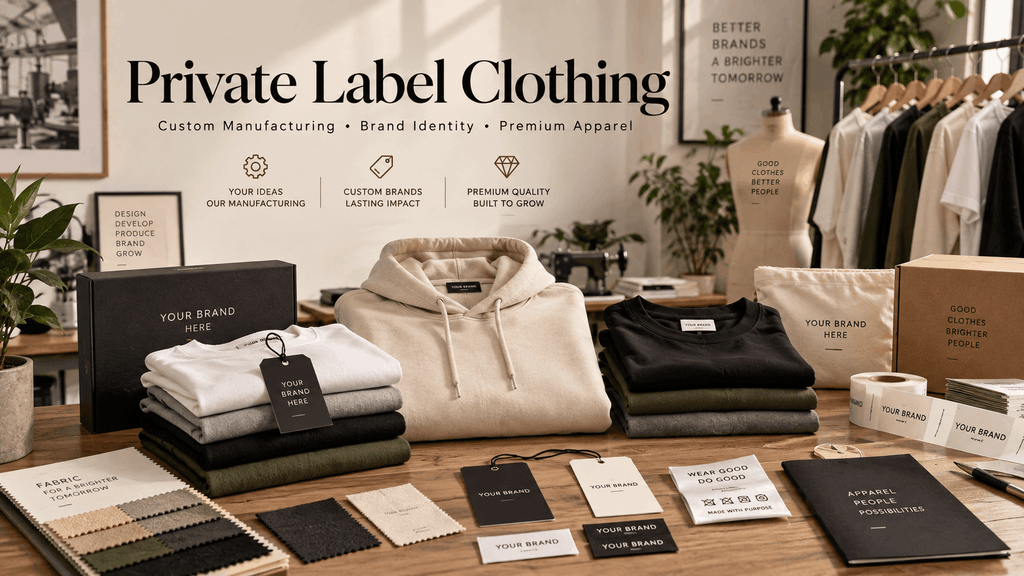
Private label clothing is apparel made by a third-party manufacturer and sold under your own brand name. The factory handles production, while you decide how the product is positioned, labeled, packaged, marketed, and sold. Depending on the manufacturer, you may choose the fabric, adjust the fit, add custom trims, and apply your own labels and packaging. In retail terms, this is a classic private label product: made by one company and sold under another’s brand.
It helps to separate private label from two related models:
- White label: Ready-made garments with little or no customization, often sold to many buyers at once. Your brand is added as a label or print, but the garment itself is identical to what others sell.
- Full custom cut-and-sew: Garments built from scratch with original patterns, custom fabrics, and unique construction. This offers the most control but requires higher budgets, longer timelines, and larger minimum order quantities.
- Private label: The middle ground. You start with proven fits and constructions, then customize enough to make the product distinctly yours.
The advantages are clear. Startup costs are lower, development is faster, minimum order quantities are often more flexible, and you can test the market before committing to large volumes. For many entrepreneurs, it is the most practical way to enter the apparel industry.
But there is a catch. Because private label products often share a similar starting point, your competitors may have access to comparable blanks, fabrics, and factories. If you compete only on the garment, you compete on price. Apparel branding is how private label businesses avoid that trap.
What Is Apparel Branding?
Many people assume apparel branding means a logo on a shirt. A logo is only one small part of it.
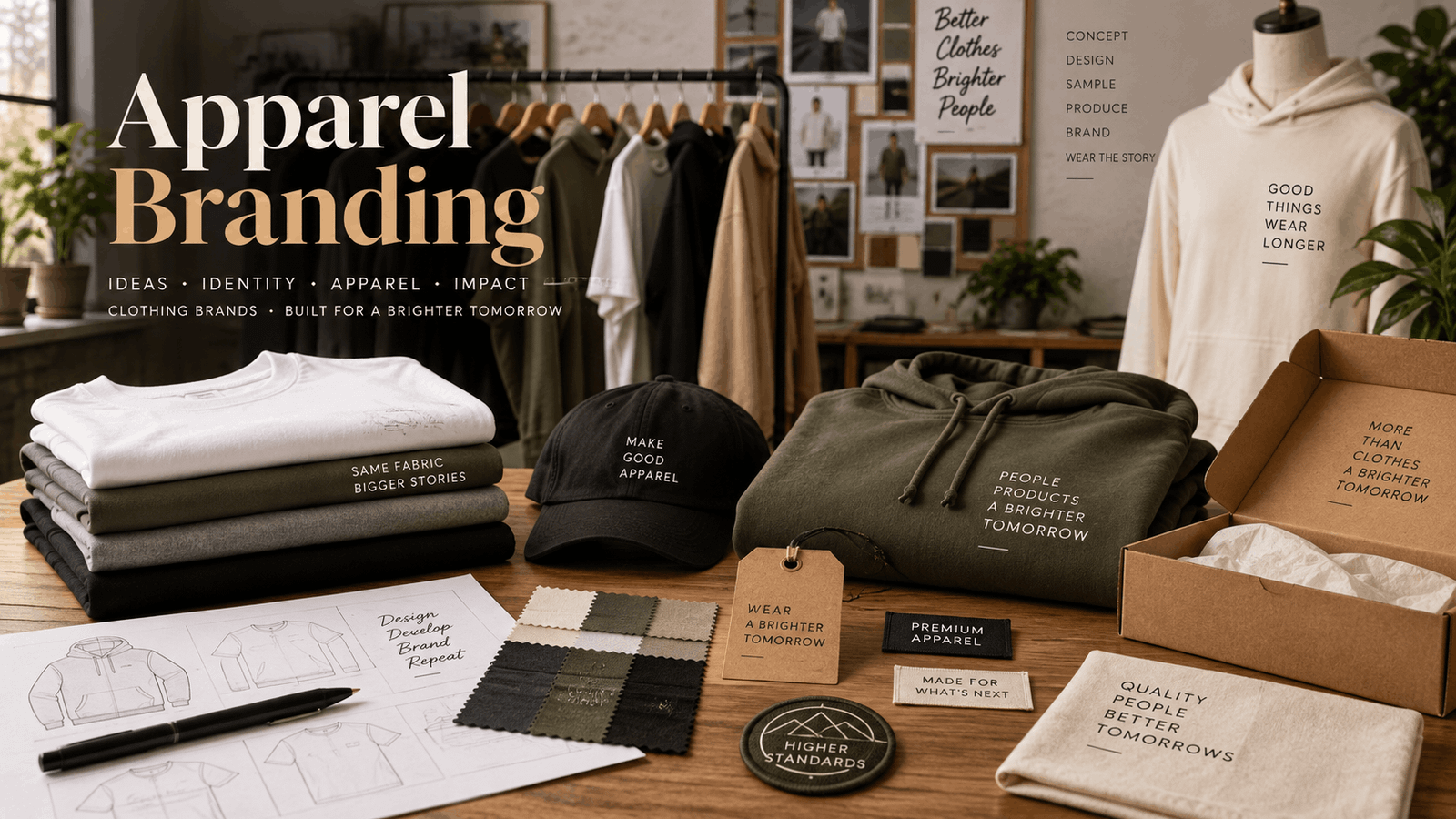
Apparel branding is the complete system of identity, messaging, and experience that makes customers recognize, trust, and prefer your clothing over alternatives. It includes your brand name, visual identity, tone of voice, product design choices, garment labeling, packaging, photography, website, customer service, and the story you tell about why your brand exists.
Think of it in two layers:
- The visible layer: The logo, color palette, typography, woven labels, neck prints, hang tags, embroidery, packaging, and photography. This is what people see and touch.
- The meaningful layer: The positioning, values, promise, and personality behind those elements. This is what people feel and remember.
Strong apparel branding connect both layers. A minimalist label sewn into a heavyweight hoodie says something different from a loud graphic on a thin tee. A recycled-paper hang tag with a short origin story says something different from a generic barcode sticker. Every detail either supports your brand promise or weakens it.
Why Apparel Branding Matters for Private Label Clothing Brands
1. Branding Separates You From Identical Products
The biggest challenge in private label fashion is sameness. When shoppers compare two similar hoodies, they look for a reason to choose one over the other. Without branding, that reason is usually price, and a race to the lowest price is a race few small brands can win.
Branding gives customers a reason to choose you beyond the specification sheet. It answers questions the garment cannot answer alone: Who is this brand for? What does it stand for? How will I feel wearing it? A brand built around minimalist streetwear for young professionals attracts a different customer than one built around rugged workwear for outdoor crews, even if both sell similar fleece tops.
This is why two brands can use the same factory and still have completely different reputations. One presents its product as a commodity; the other presents it as part of an identity. Customers do not just buy a garment. They buy the story and status attached to it.
A clear apparel branding also makes your business easier to remember. In a scroll-heavy social media environment, you may have only a second or two to catch attention. A consistent color palette, recognizable label placement, and distinct visual style help your products register instantly, and recognition is the first step toward preference.
2. Branding Increases Perceived Value and Supports Higher Prices
Perceived value is what customers believe a product is worth, and it often differs from what the product costs to make. Branding is one of the strongest influences on it.
Consider two identical cotton tees. One arrives in a plain polybag with a paper-printed size sticker. The other has a woven neck label, a printed inner tag with care instructions, a designed hang tag, and packaging that feels intentional. Most customers will assume the second is higher quality, even if the fabric is the same. Presentation shapes expectation, and expectation shapes willingness to pay.
For private label brands, this matters for margins. Manufacturing costs are often similar across competitors, so profit comes from what you can charge. Strong branding lets you price on value rather than on cost plus a thin markup. It also protects you during sales and promotions, because a brand with real perceived value can offer selective discounts without training customers to wait for markdowns.
Branding also reduces price sensitivity. Customers who feel connected to a brand ask “Do I love this?” rather than “Where is it cheapest?” That shift changes the entire economics of the business.
Small details signal quality: consistent stitching around the label, a clean neck print instead of a scratchy tag, well-considered logo placement, and a matching color story across trims. These cost little relative to the value they add.
3. Branding Builds Trust and Credibility
When customers cannot touch or try a garment before buying, especially online, they rely on trust signals. A professional brand presence reduces the perceived risk of buying from someone new.
Consistent visuals, clear product descriptions, quality photography, transparent policies, and well-finished garments all tell customers that a real, reliable business stands behind the product. Inconsistent branding does the opposite. A logo that changes between platforms, low-quality mockups, and generic packaging can make even a good product feel risky.
Trust matters more for private label brands because they usually lack the built-in recognition of established names. Customers do not yet know you, so your branding does the introducing.
Trust also compounds. Each positive interaction, from opening the package to washing the garment several times, confirms the promise your brand made. When the experience matches the branding, customers start to believe in the brand. When there is a gap, such as premium branding on poor-quality garments, trust breaks down quickly. Good branding must be backed by good products, and good products are far more valuable when the branding communicates them properly.
4. Branding Drives Customer Loyalty and Repeat Purchases
Acquiring a new customer is generally more expensive than selling again to an existing one. Loyalty is where branding pays off most over time.
People stay loyal to brands they identify with. A private label brand with a clear personality gives customers something to belong to, whether that is a lifestyle, an aesthetic, a community, or a set of values. When customers feel that connection, they are more likely to return for the next drop, recommend the brand to friends, and forgive the occasional shipping delay.
Loyalty is built through repetition and consistency. Recognizable packaging, a signature label, a consistent fit and fabric standard, and a distinct voice across email, social media, and customer service all reinforce the relationship. Over time, customers start buying from you by default instead of comparing options.
Branding also creates opportunities for community. Brands with a strong identity attract user-generated content, because customers want to show what they are wearing and be seen as part of the group. A well-designed label or hang tag can even become part of that experience, since people share unboxing photos when packaging feels special.
For private label businesses, repeat customers provide something equally valuable: predictable demand. Predictable demand makes it easier to plan inventory, negotiate better terms with manufacturers, and reduce the risk of unsold stock.
5. Branding Makes Marketing More Efficient
Marketing costs climb steadily, and paid advertising can quickly eat into the margins of a small clothing brand. A strong brand makes every marketing dollar work harder.
When people already recognize and trust your brand, ads convert better, email campaigns get opened, and social posts get shared. Your creative work also becomes easier because you have a defined visual language and tone. Instead of reinventing your look for every campaign, you build on a consistent foundation.
Branding also fuels organic growth. Distinctive garments and packaging generate word-of-mouth, tagged photos, and search traffic for your brand name. Over time, branded searches, where customers look for you directly, become one of the most valuable and cost-effective traffic sources a clothing business can have.
There is an SEO benefit too. Brands with clear positioning tend to create more focused content, earn more relevant backlinks, and build topical authority around their niche, such as streetwear, sportswear, or teamwear. This supports long-term visibility without relying entirely on paid channels.
Finally, consistent branding shortens the customer journey. If a customer sees your logo on social media, a friend’s jacket, and a collaboration partner’s page, familiarity builds with each exposure. By the time they visit your store, part of the persuasion has already happened.
6. Branding Opens Doors to Wholesale, Retail, and Partnership Opportunities
If you want to grow beyond direct-to-consumer sales, branding becomes a business credential. Retailers, boutique owners, corporate buyers, and collaborators are more willing to work with brands that look established and professional.
A wholesale buyer evaluating your line looks at more than the garment. They ask whether the brand is consistent, whether the labeling and packaging are retail-ready, and whether customers will recognize and want it. A cohesive brand identity, clear product range, and professional presentation signal that you are a serious, reliable partner.
Branding also helps with collaborations. Creators, athletes, community organizations, and other brands prefer to partner with labels that have a clear identity and audience. A strong brand gives them confidence that the partnership will look good and reach the right people.
For brands serving bulk buyers such as sports clubs, schools, and businesses, branding builds credibility for custom orders. When a team manager sees professionally finished labels, consistent quality, and a clear brand standard, they feel safer placing a large order. Being branded well is often what turns a quote request into a signed order.
7. Branding Creates Long-Term Brand Equity and Business Value
Products can be copied. Fabrics can be sourced by anyone. Designs can be imitated. What is much harder to copy is the reputation, recognition, and emotional connection you build over time. That is brand equity, and it is one of the most valuable assets a clothing business can own.
Brand equity makes the business more resilient. When supply costs change, when trends shift, or when new competitors appear, a brand with strong equity holds its ground. Customers who value the brand stay, and the brand can extend into new products more easily. A hoodie brand can expand into tees, accessories, or activewear because the audience already trusts it.
Brand equity also affects what your business is worth. A company with a recognized name, loyal customers, and a distinctive identity is far more attractive to investors or potential buyers than one that simply resells commodity products. Even if you never plan to sell, this equity gives you more leverage in negotiations with suppliers, retailers, and partners.
It also protects you legally and strategically. A distinctive brand name and logo can be registered as trademarks, giving you a defensible asset. The more unique and consistent your branding is, the easier it is to protect and the harder it is for imitators to confuse customers.
In short, private label lets you rent production capacity. Branding lets you own something lasting.
The Core Elements of Strong Apparel Branding
Knowing why branding matters is the first step. Here are the elements that make it work in practice.
Brand Positioning and Story
Positioning defines where your brand sits in the market: who you serve, what you offer, and why you are different. “Affordable premium basics for busy professionals” and “performance teamwear for grassroots athletes” are both positioning statements. Without one, every other branding decision becomes guesswork. Pair positioning with a short, honest apparel branding story that explains why the brand exists.
Visual Identity
Your visual identity includes your logo, color palette, typography, graphic style, and photography direction. Choose a system flexible enough to work on a woven label, a website banner, and an embroidered chest logo. Simplicity tends to age better than complexity, especially on garments where space is limited.
Garment Labeling
Labels are the most direct way to brand the garment itself. This includes the main neck label, size and care labels, sleeve or hem tags, and inside-print labels. A neatly executed label instantly separates a branded product from a generic one, and it is one of the most cost-effective upgrades available in private label production.
Labels also serve a legal purpose. In the United States, for example, most textile products need to show fiber content, country of origin, and the identity of the manufacturer or dealer, as explained in the FTC’s guide to textile labeling requirements. Always check the rules for every market you plan to sell into.
Hang Tags and Packaging
Hang tags, polybags, mailers, tissue paper, stickers, and inserts shape the first physical impression. Even simple touches, such as a well-designed tag with fabric details and care advice, can make the product feel curated. Custom packaging should match your positioning: minimalist and recycled for eco-conscious brands, bold and colorful for streetwear.
Product Quality and Consistency
Branding makes a promise, and quality keeps it. Consistent fit, fabric weight, color accuracy, and stitching across every batch are essential. A premium label on an inconsistent garment damages the brand faster than having no label at all.
Brand Voice and Customer Experience
How you write product descriptions, respond to messages, handle returns, and communicate on social media forms your brand personality. A brand that sounds confident and clear online but delivers a confusing checkout or slow support undermines its own identity. Consistency across every touchpoint is what turns a good-looking brand into a trusted one.
Apparel Branding Techniques That Elevate Private Label Garments
Private label clothing gives you many ways to put your identity on the product. Choosing the right techniques depends on your brand style, budget, and garment type.

- Woven labels: Durable, textured labels that suit premium and streetwear brands. They are often sewn at the neck or hem and signal quality.
- Printed neck labels (tagless): Heat-transfer or screen-printed labels inside the collar. They improve comfort and give a modern, clean finish.
- Embroidery: Stitched logos or text that add texture and perceived value, ideal for hoodies, caps, polo shirts, and teamwear.
- Screen printing: Cost-effective for larger runs and bold graphics on tees and hoodies, with strong color and durability.
- Heat transfer and vinyl: Useful for detailed logos, names, and numbers, especially on sportswear and team kits.
- Puff print and high-density print: Raised textures that add a distinctive tactile element popular in streetwear.
- Rubber and silicone patches: Modern, durable badges suited to jackets, activewear, and casual collections.
- Custom hang tags: Printed on quality card stock, recycled paper, or specialty materials to reinforce your brand feel.
- Custom trims: Branded zipper pulls, drawcord tips, buttons, and eyelets add subtle detail that customers notice.
A useful principle is to choose fewer techniques and execute them well. A garment with one confident branding detail looks more premium than one crowded with logos.
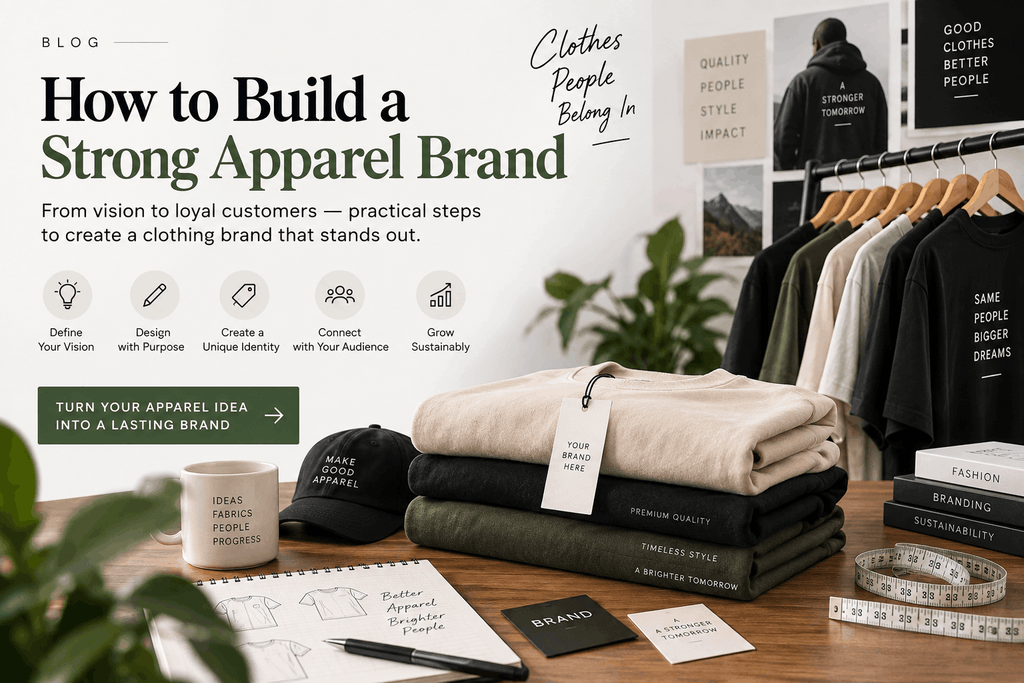
How to Build a Strong Apparel Branding: Step by Step
Step 1: Define Your Audience and Niche
Start with a specific customer, not “everyone.” Consider their age, lifestyle, values, budget, and where they shop and spend time online. A narrow, well-understood niche makes every later decision easier and more effective.
Step 2: Clarify Your Positioning and Promise
Write a one-sentence promise that explains what you offer and why it matters. Test it: could a competitor say the same thing? If yes, sharpen it until it is distinctly yours.
Step 3: Develop Your Name and Visual Identity
Choose a memorable, easy-to-spell name that is available as a domain, social handle, and trademark. Then design a logo and system that work on garments, packaging, and screens. Work with a professional designer if possible, since a weak logo is expensive to fix later.
Step 4: Choose Your Products and Quality Standard
Start with a focused range where you can deliver consistently high quality. Order samples, wash-test them, and compare fabric weights and finishes before committing to production.
Step 5: Design Your Garment Branding and Packaging
Decide how your brand appears on the product: label style, placement, prints or embroidery, hang tags, and packaging. Ensure they align with your positioning and remain consistent from one product to the next.
Step 6: Build a Consistent Online Presence
Create a professional website and social channels using the same visuals, tone, and product photography style. Invest in good imagery and clear product information, since these are often the only “touch” customers get before buying.
Step 7: Tell Your Story Through Content
Share the story behind your products, materials, and design decisions. Behind-the-scenes content, styling guides, and educational posts build trust and attract organic traffic. Publish content that answers real customer questions.
Step 8: Collect Feedback and Refine
Listen to reviews, returns, and customer messages. Use that feedback to improve fit, quality, and communication. Strong brands evolve while keeping their core identity intact.
Common Apparel Branding Mistakes to Avoid
Copying competitors instead of defining your own identity. Imitation may bring short-term attention, but it makes you forgettable and can create legal problems.
Inconsistent visuals. Changing colors, fonts, or logo versions across platforms weakens recognition. Create brand guidelines and follow them.
Over-branding the garment. Large logos everywhere can look cluttered and cheap. Restraint often signals confidence.
Prioritizing looks over quality. Beautiful Apparel branding cannot compensate for poor stitching, shrinkage, or fading. Customers judge the product first and the brand second.
Ignoring the small details. Scratchy neck labels, misaligned prints, and generic packaging can quietly undermine an otherwise strong product.
Trying to appeal to everyone. Broad, vague branding attracts nobody strongly. Specificity builds loyalty.
Skipping trademark protection. Failing to check availability or register your brand name and logo can put your business at risk later on.
Launching without a story. Products without context are easy to compare on price alone. Give customers a reason to care.
Choosing the Right Manufacturing Partner for Your Brand
Your manufacturer plays a direct role in how well your branding is executed. When evaluating partners, look beyond price and consider:
- Customization capabilities: Can they produce custom labels, prints, embroidery, and packaging in-house or through trusted partners?
- Quality consistency: Do they have quality control processes, and will they provide samples and production references?
- Flexible minimums: Reasonable minimum order quantities allow you to test the market without overcommitting.
- Communication and reliability: Clear communication, transparent timelines, and responsiveness reduce costly misunderstandings.
- Compliance and ethics: Responsible sourcing and labor practices increasingly matter to customers and retail partners. Ask about recognized textile certifications such as OEKO-TEX.
The right manufacturing partner acts as an extension of your brand. Share your brand guidelines, provide detailed tech packs, approve pre-production samples, and build a long-term relationship. Consistency in production is what allows your branding promise to hold up across every order.
Apparel Branding Trends Worth Watching
- Quiet, minimal branding: Subtle logos and refined labels appeal to customers who prefer understated style.
- Oversized and cropped silhouettes: Relaxed proportions continue to shape modern streetwear. Our guide to the oversized cropped hoodie explores the style in depth.
- Sustainability and transparency: Recycled materials, responsible packaging, and honest sourcing stories increasingly influence buying decisions, and sustainable fashion is now a mainstream expectation.
- Community-driven brands: Brands built around a culture, sport, or shared interest tend to earn stronger loyalty.
- Personalization: Custom names, colors, and made-to-order options let customers feel a personal connection to the brand.
- Tactile details: Textured labels, embroidered accents, and distinctive trims are becoming visible signals of quality.
Trends can inspire, but they should support your identity rather than replace it. Adopt what fits your brand and ignore what does not.
How to Measure the Impact of Your Branding
Branding can feel intangible, but its effects show up in measurable ways. Track:
- Repeat purchase rate and customer lifetime value: Rising numbers suggest stronger loyalty.
- Branded search volume: More people searching for your name indicates growing awareness.
- Direct and organic traffic: Growth here reduces dependence on paid advertising.
- Average order value and margins: Effective branding supports better pricing.
- Social engagement and user-generated content: Tags, shares, and unboxing posts show emotional connection.
- Reviews and referrals: Positive sentiment and word-of-mouth reflect trust.
Review these metrics regularly and connect them to your branding efforts. Over time, you will see which elements resonate most.
Frequently Asked Questions (FAQs)
What is apparel branding?
Apparel branding is the complete system of identity, messaging, and experience that makes customers recognize and prefer your clothing. It includes your logo, labels, packaging, visual style, brand voice, product quality, and story, not just the logo on a garment.
Why is branding important for private label clothing?
Private label products often start from similar blanks, fabrics, and factories, so the garment alone rarely differentiates you. Branding creates recognition, trust, perceived value, and loyalty, allowing you to compete on more than price.
Can a private label clothing brand really look premium?
Yes. Premium perception comes from consistent quality and thoughtful details such as woven or printed labels, quality hang tags, considered packaging, and clean design. Many well-known brands started with private label production and built their reputation through branding.
What is the difference between private label and white label clothing?
White label garments are generic, ready-made products with minimal customization that many sellers can offer. Private label allows more customization, such as fabric choices, fit adjustments, custom trims, and unique branding, so the product feels more distinctly yours.
How much should I invest in branding?
There is no fixed percentage, but branding should be treated as a core business investment. Start with essentials: a professional logo, quality labels, consistent visuals, and good photography. Expand into premium packaging and extended trims as revenue grows.
Which branding elements matter most on the garment itself?
Neck labels (woven or printed), care labels, hang tags, and well-placed logos or embroidery have the biggest impact. Focus on quality and consistency rather than adding many elements.
How long does it take to build a recognizable clothing brand?
It varies by niche, budget, and consistency. Some brands gain traction within months, while building strong recognition and loyalty typically takes years of consistent quality, messaging, and customer experience.
Should I trademark my clothing brand name and logo?
It is strongly recommended. Trademark registration helps protect your name and logo from imitation. Consult an intellectual property professional in your region, as rules vary by country. The World Intellectual Property Organization offers a helpful overview of how trademarks work internationally.
Can good branding fix poor product quality?
No. Branding creates expectations, and poor quality breaks them. The strongest brands combine dependable products with clear, consistent branding.
Conclusion
Private label clothing has opened the door for countless entrepreneurs to build fashion businesses without the burden of running a factory. But accessibility comes with competition, and in a market full of similar products, the brand is what turns a garment into a choice.
Apparel branding lets you stand out from identical products, justify stronger pricing, earn trust, build loyalty, market more efficiently, win wholesale opportunities, and create lasting brand equity. It reaches every part of the business, from the label inside the collar to the tone of your customer emails.
The most successful private label brands treat branding as a strategy, not an afterthought. They define who they serve, make a clear promise, deliver consistent quality, and express their identity in every detail. If you are building or refining a private label clothing brand, start there. Get the foundation right, and every product you launch will carry more meaning, more value, and more staying power.
Ready to start building your line? Get in touch with our team to talk about your next collection.
Your factory can make the garment. Your brand makes people want to wear it.